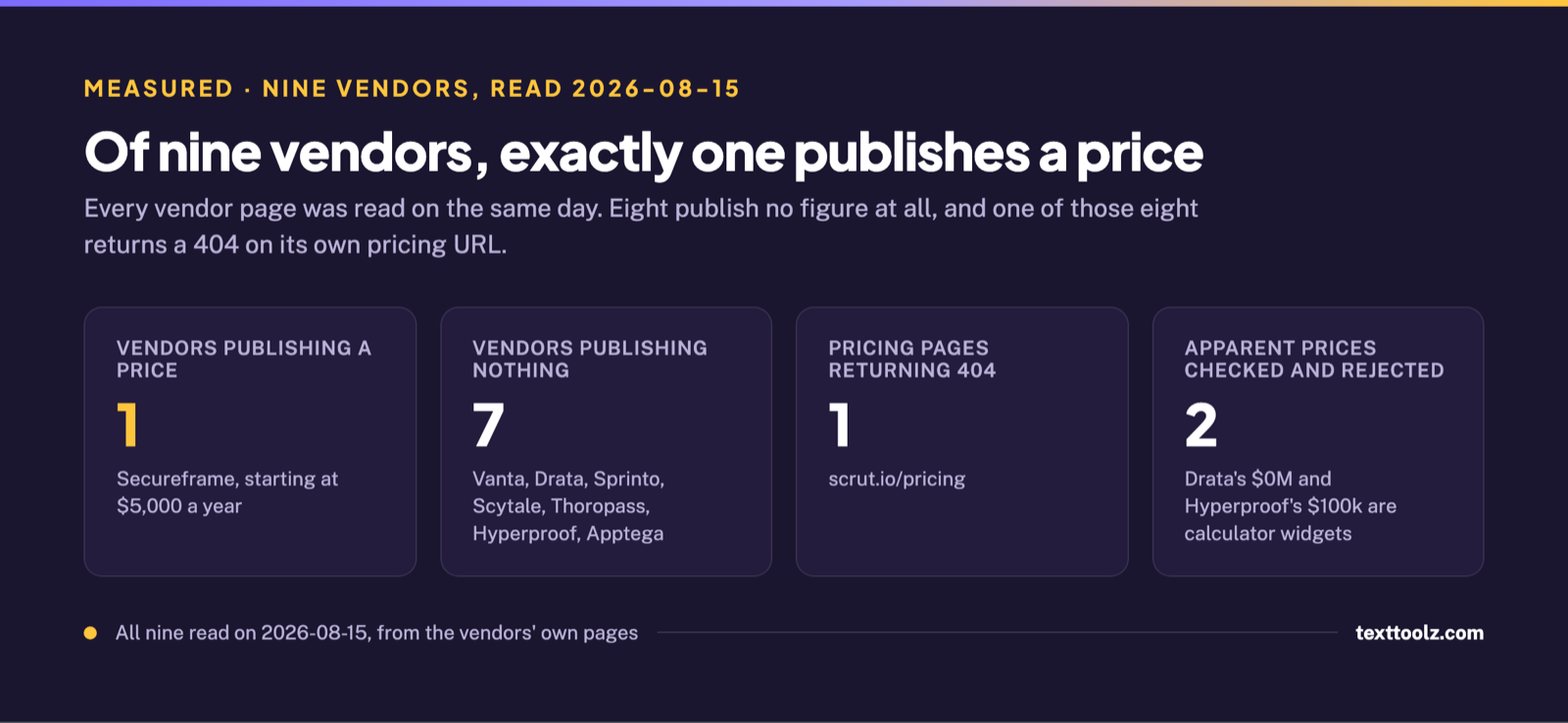
Of the nine compliance automation vendors examined for this article, exactly one publishes a price. The figure everybody else quotes, $7,500 a year, comes from a single third-party table that applies it identically to four vendors, none of which publish it, and the one vendor that does publish a price says $5,000.
Every result on this search except a forum thread and a video is published by a company selling compliance automation, and five of the six comparison articles rank their own product first. TextToolz sells no compliance software, no audit and no security service, and takes no referral fee from anything named here.
That matters more in this category than in most. Compliance automation is bought by a company that has just been asked for a SOC 2 report by a customer, usually under time pressure and often without a security hire. A market with one published price across nine vendors is a market with no reference price, and the practical effect is that your quote is set by what the seller thinks you will pay.
Every pricing page named below was fetched on 15 August 2026. Where a number comes from somewhere other than the vendor, that source is named in the sentence carrying it.
What compliance automation software actually does
Compliance automation software connects to your cloud, identity, device and HR systems, collects evidence that your security controls are operating, monitors them continuously, and packages the result in the form an auditor expects. Instead of screenshotting settings into a folder for three months, the platform watches the settings and records the proof itself.
The boundary is worth stating early because vendor marketing tends to blur it. These platforms automate the collection of evidence. They do not automate the audit, which is performed by an independent firm, and they do not automate control design, which is the work of deciding what your company actually does about access, change management and incident response. A platform can tell you that a control is failing. It cannot decide that the control was the right one.
What genuinely differs between products is narrower than the feature lists suggest: how many of your systems the platform can read without help, whether a human expert is included or contracted separately, whether the audit itself is bundled, and how much of the work carries over when a second framework arrives.
Only one of these vendors publishes a price
This is the first thing worth knowing about the category, and no page ranking for this search carries it as a column.
| Vendor | Publishes a price | What the pricing page shows instead |
|---|---|---|
| Secureframe | Yes | “Starting at $5,000/year”, stated twice on the page |
| Vanta | No | No figure of any kind |
| Drata | No | A savings calculator |
| Sprinto | No | No figure |
| Scytale | No | No figure |
| Thoropass | No | No figure |
| Hyperproof | No | A calculator |
| Apptega | No | A “Talk to sales” route |
| Scrut Automation | Page returns 404 | The pricing URL was not reachable on the date checked |
Secureframe publishes “Starting at $5,000/year” and is alone in doing so. Everything else in this market is quoted to you in a call.
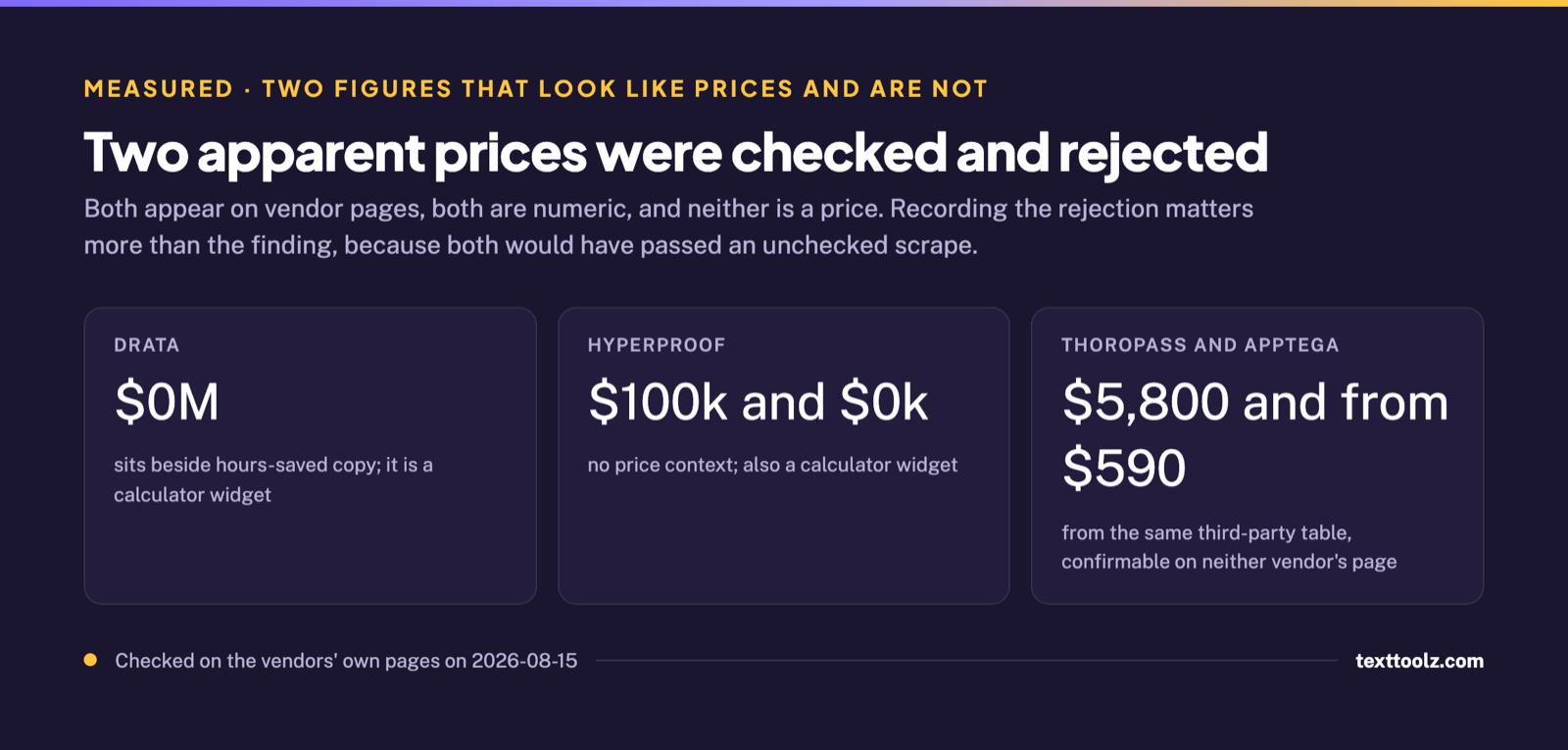
Two of those pages appear at first glance to contain prices, and both were checked and rejected. Drata’s pricing page yields a “$0M” figure that sits beside copy about hours saved per year, which makes it a savings calculator rather than a rate. Hyperproof’s yields “$100k” and “$0k” with no price context around either. Neither is quoted anywhere in this article, and both are recorded here because reading a calculator widget as a rate card is precisely the error this page exists to prevent.
Where the $7,500 figure everyone quotes came from
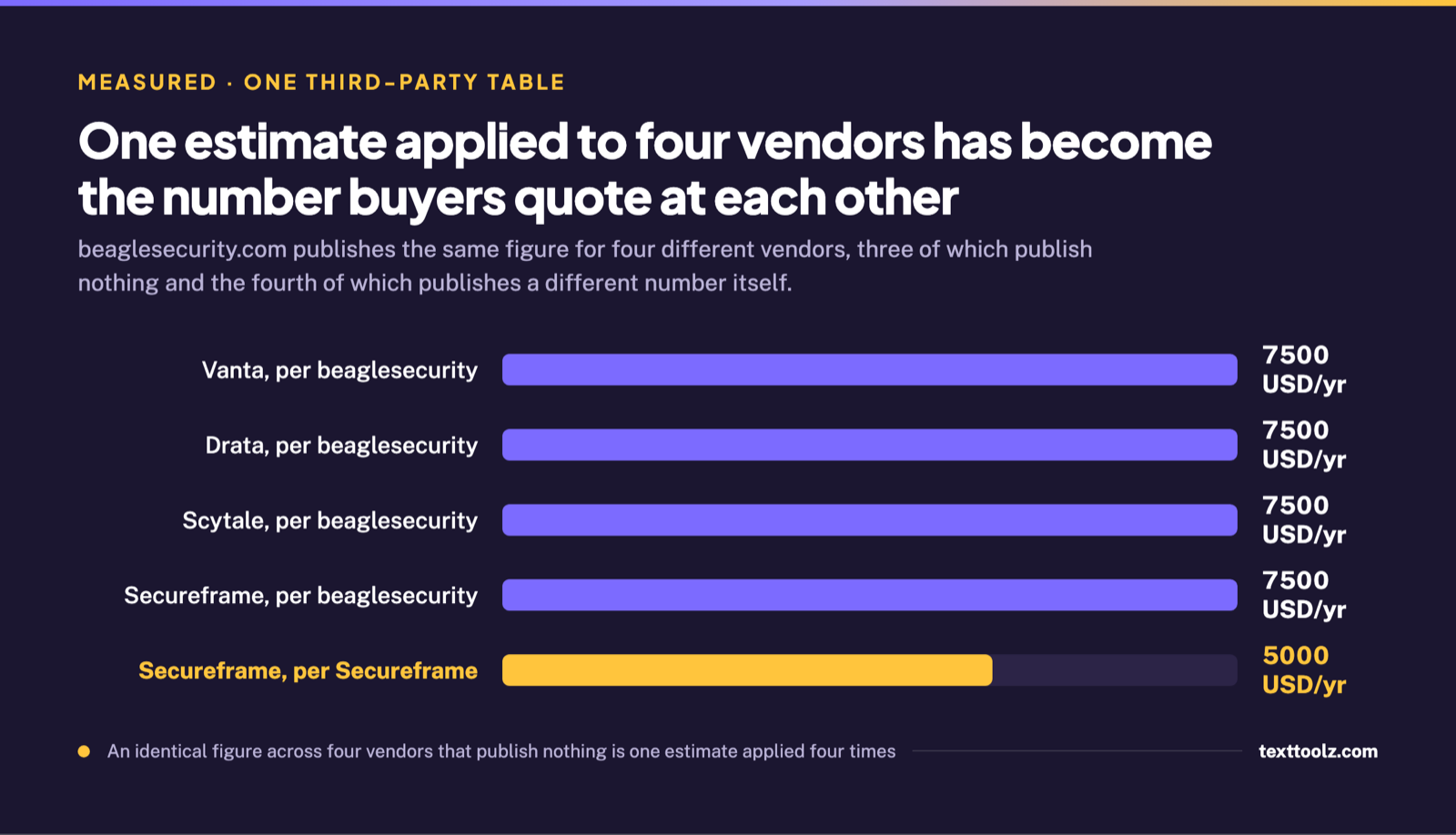
One page on this entire search publishes a price table: beaglesecurity.com. It lists “Starts at $7,500/year” for Vanta, Drata, Secureframe and Scytale, the same figure for all four.
None of those four publishes that number. Vanta’s pricing page carries no figure. Drata’s is the calculator described above. Scytale’s carries no figure. And Secureframe, the one vendor in the group that publishes anything, publishes $5,000, not $7,500.
An identical number applied to four vendors that publish nothing is not four measurements. It is one estimate used four times. It has nonetheless become the figure buyers quote at each other, cite in budget requests and arrive at sales calls expecting, which is how a market with no reference price manufactures one.
Two further figures in the same table have the same problem. Thoropass is listed at $5,800 a year; its own pricing page publishes no price. Apptega is listed from $590, the lowest number anywhere on this search; its pricing page shows a sales contact route and no figure.
Credit where it belongs: beaglesecurity is the only page here that attempted a price table at all, and it is also the only comparison article on this search that ranks somebody else’s product first. Publishing an estimate is more useful than publishing nothing. It just needs reading as an estimate, and no page including beaglesecurity’s own labels it as one.
The software is not the spend
The subscription is one of two purchases, and frequently the smaller. The SOC 2 audit itself is performed by an independent firm and billed separately, and a buyer comparing platform subscriptions is comparing perhaps half of what they will actually pay.
That makes two of the platforms here structurally incomparable with the rest. Thoropass embeds the audit, and Scytale bundles dedicated compliance experts through the process. Setting either subscription beside a platform that includes neither is the same category error this series found in HVAC software, where a per-user rate was printed beside a flat unlimited-user rate as though the two were the same kind of number.
The practical instruction is short. Before comparing any two vendors, get both numbers: the platform for twelve months, and the audit. Ask explicitly whether the auditor is included, recommended, or entirely your problem, and get the audit firm’s quote independently if it is not bundled. A cheap platform attached to an expensive audit is not a cheap programme.
Ready is not the same as compliant
Two pages on this search draw this distinction and the rest let it blur, which is understandable because the blur favours the seller.
Audit-ready means your controls exist, they are operating, and evidence is accumulating. It is a state your platform can tell you that you are in. Compliant means an independent auditor has examined that evidence and issued a report, which is a document with a firm’s name on it and a period of time attached.
The customer who asked you for a SOC 2 wants the second thing. They will not accept a dashboard screenshot showing every control green, and a platform that markets “audit-ready in weeks” is describing the state before the part that takes the longest. For a Type II report specifically, the observation window itself is months, and no amount of automation shortens it.
Can you do this on spreadsheets
Yes, for a first Type I at small headcount, and the fact that every page on this search is published by somebody selling the alternative is a good reason to say so plainly.
What you are buying with the software is time and the reduction of a specific risk: that a control quietly stopped operating in month four and nobody noticed until the auditor did. A twenty-person company with a single cloud environment, one identity provider and a founder willing to spend evenings on it can assemble a first SOC 2 evidence set manually. Plenty have.
Where spreadsheets stop working is predictable and worth naming, because it tells you when to buy rather than whether. Continuous monitoring is the first: manual evidence is a snapshot, and a Type II report covers a period. User access reviews at renewal are the second, because they recur forever and are tedious enough to get skipped. The second framework is the third and the most decisive: mapping the same controls to ISO 27001 or HIPAA by hand is where the manual approach genuinely stops being economical.
The twelve platforms
Each entry states what the vendor is built around, whether it publishes a price, who it suits and one real limitation. What no entry states is support quality or time to audit, neither of which anybody in this category measures publicly.
| Vendor | Publishes a price | Distinguishing feature | Best suited to |
|---|---|---|---|
| Secureframe | Yes, from $5,000/year | The only published price in the category | Buyers who want a number before a call |
| Vanta | No | Breadth of integrations | A first SOC 2 with a broad stack |
| Drata | No | Automation depth, API-first | Multi-framework mid-market |
| Sprinto | No | Assigned compliance experts | Startups with no security hire |
| Scrut Automation | Pricing page 404s | Single window across frameworks | Teams running several frameworks |
| Scytale | No | Experts plus an AI GRC agent | Teams wanting the expert layer bundled |
| Thoropass | No | Embedded audit | First SOC 2, no auditor relationship |
| Hyperproof | No | Enterprise GRC scale | Existing compliance functions |
| Apptega | No | Scoring and dashboards | MSPs and consultancies |
| Strac Comply | No | Bundles DLP and DSPM | Data in unstructured SaaS |
| JupiterOne | No | Asset graph first | Engineering-led organisations |
| Cynomi | No | Built for vCISO delivery | MSPs running client programmes |
Secureframe
Secureframe is the only vendor in this comparison that publishes a price, and that single fact is worth more to a buyer than most feature differences on this page. Its pricing page, fetched 15 August 2026, states “Starting at $5,000/year”, and states it twice.
Note the discrepancy that follows from it. beaglesecurity’s table attributes $7,500 a year to Secureframe, which is fifty percent above what Secureframe publishes about itself. Stated as a fact about the two pages rather than as an accusation: one of them is an estimate and the other is the company’s own number, and only one of them is labelled.
Functionally it covers SOC 2 alongside ISO 27001, HIPAA and GDPR, with access-control tracking called out specifically by cynomi’s comparison, credited, plus policy templates and AI assistance in drafting them. It also publishes the explainer on manual versus automated compliance that ranks ninth on this search, which is a genuinely useful piece of writing regardless of whether you buy the product.
Best for a buyer who wants to know the order of magnitude before spending an hour on a discovery call, and for teams whose framework set is the common one.
The limitation is that a starting price is not a rate card. What the $5,000 tier includes, what triggers the next one, and whether the audit sits inside or outside it are all still questions for the call. Publishing a floor tells you where the conversation begins, not where it ends.
Vanta
Vanta is the most widely adopted platform in the category and the default name a founder hears first, and it publishes no price at all. Its pricing page carried no figure of any kind when fetched on 15 August 2026.
Its product page claims more than 1,400 automated tests and over 400 integrations covering AWS, Azure, Okta, GitHub and Wiz among others. beaglesecurity’s comparison credits it with 375 integrations. Both figures are credited to whoever published them and the discrepancy is noted rather than resolved, since integration counts move month to month and neither page is dated in a way that settles it.
Integration breadth is the right thing to evaluate Vanta on, because it decides what fraction of evidence collects itself versus what someone on your team assembles by hand. For a company on a mainstream cloud and identity stack, that fraction is high, and it is the whole argument for the category.
One fact about the sources worth stating: beaglesecurity ranks Vanta first, and it is the only comparison article on this search that ranks a product other than its own publisher’s at the top.
Best for a first SOC 2 at a company running common infrastructure, where breadth of integration coverage does the most work. The limitation is the absence of a published price, which means the $7,500 figure attached to Vanta in circulation originates with a third party and not with Vanta.
Drata
Drata’s positioning is automation depth. Its own material and cynomi’s comparison, credited, describe continuous control monitoring, real-time risk assessment, custom control mapping, detailed audit trails and an API-first architecture, with audit-ready dashboards spanning SOC 2, ISO, HIPAA and PCI DSS.
It publishes no price. Its pricing page presents a savings calculator, and the “$0M” figure extractable from that page sits beside copy about hours saved per year rather than beside any rate. This article checked that figure and rejected it, and says so rather than quietly omitting it, because a reader who fetches the same page will see the same number and deserves to know it was examined.
The API-first design is the substantive differentiator for a technical team. A platform you can drive programmatically is one you can wire into your own deployment and access-provisioning flows, which turns compliance evidence into a by-product of existing automation rather than a parallel activity.
Named in the consideration set on the Reddit thread ranking fifth for this search, alongside Hyperproof, Scrut, Secureframe, Thoropass and Vanta.
Best for mid-market teams running several frameworks at once with engineering capacity to use the API. The limitation is the same as Vanta’s: no reference price, and a circulating figure that belongs to a third party.
Sprinto
Sprinto sells the expert layer as hard as the software. Its published positioning, via beaglesecurity and getsecureslate, credited, includes dedicated compliance experts assigned to each customer, over 100 integrations, automated evidence collection, policy management and audit preparation support. cynomi credits it with customisable policy libraries spanning SOC 2, ISO, HIPAA, GDPR and PCI DSS.
Its pricing page publishes no figure, fetched 15 August 2026.
It appears repeatedly across this search as the early-stage recommendation, including in strac.io’s own shortlist for a Series A company needing Type I quickly. That consistency across pages published by competitors is a reasonable signal, and it is one of the few on this search that is not a vendor recommending itself.
The assigned-expert model is what a company without a security hire is actually buying. Software tells you a control is failing; a person tells you which of your three plausible fixes the auditor will accept. For a first audit with nobody internal who has done one, that difference is the product.
Best for startups facing a first SOC 2 with no security or compliance headcount. The limitation is that human expertise is the expensive component in any software business, and with no published price a buyer cannot see how much of the bill it represents.
Scrut Automation
Scrut is worth reading closely for a reason unrelated to its features: it is the most committed buyer of sponsored placement this research has found in any category, having bought five separate posts on one publisher within a single month, all on adjacent compliance topics. That is a topical-authority strategy rather than a link purchase, and it says something accurate about how competitive customer acquisition is in this market.
On the product, beaglesecurity and cynomi credit it with 80 percent automated evidence collection, over 100 pre-built policies with customisation, single-window compliance management across frameworks, continuous monitoring and multi-framework support beyond SOC 2. Its SOC 2 solutions page ranks eighth on this search.
Recorded honestly: scrut.io/pricing returned a 404 when fetched on 15 August 2026. This article links the solutions page instead, because sending a reader to a broken URL is not a citation. The 404 is a small operational thing rather than a product judgement, but in a market where eight of nine vendors already publish no price, an unreachable pricing page is the kind of detail a buyer notices.
The single-window claim is the substantive one. Teams running SOC 2 and ISO 27001 and something else typically discover that the third framework costs more effort than the second, and a platform that maps controls once across all of them is solving the problem that actually grows.
Best for teams already certain they will run several frameworks rather than one. The limitation is that the cross-framework value only arrives with the second framework, so a company doing SOC 2 alone is paying for headroom.
Scytale
Scytale combines the platform with dedicated human compliance experts and, more recently, an AI agent it calls Scy. Its own comparison article ranks Scytale first of six and is the second result on this search.
The feature set as published: automated evidence collection, continuous control monitoring, user access reviews, vendor risk management, multi-framework cross-mapping and customised policy templates. Its pricing page publishes no figure, fetched 15 August 2026, despite beaglesecurity attributing $7,500 a year to it.
Its “GET SOC 2 COMPLIANT 90% FASTER” banner sits directly above a lead-capture form. That claim is reported here as a marketing position rather than a duration, because no method is published behind it and no page on this search publishes one behind any comparable claim.
The expert model is the same argument Sprinto makes and it is a real one. Where Scytale differs is in putting an AI agent alongside the humans, which is either a meaningful extension or a relabelled workflow depending on details nobody publishes. This page does not know which, and says so.
Best for teams that want the expert layer bundled into the subscription rather than contracted separately. The limitation is that bundled expertise is the reason to choose it and the reason it will not be the cheapest line on your shortlist.
Thoropass
Thoropass embeds the audit. The platform and the auditor arrive together, which changes the total-cost comparison more than any subscription difference discussed on this page, because it collapses the two purchases described earlier into one.
beaglesecurity credits it with control automation and embedded auditor support, and attributes a starting figure of $5,800 a year. That could not be confirmed: Thoropass publishes no price on its own pricing page, fetched 15 August 2026.
It is named in the Reddit consideration set alongside Drata, Hyperproof, Scrut, Secureframe and Vanta, which is the closest thing to a buyer-generated shortlist available on this search.
The bundling argument is strongest for a company doing its first SOC 2 with no auditor relationship and nobody internally who wants to run a procurement for one. Selecting an audit firm is genuinely difficult when you have never been audited, and having that decision made is worth something real.
Best for a first SOC 2 where the auditor relationship does not exist yet. The limitation is the direct consequence of the benefit: bundling means you choose your auditor by choosing your software, and if the platform suits you and the audit practice does not, they are difficult to separate later.
Hyperproof
Hyperproof is aimed further up the market than the startup-first platforms in this list, at organisations that already run a compliance function and need tooling for it rather than guidance through a first audit. Many frameworks, many controls, and the mapping between them is the problem it is built for.
It publishes no price. Its pricing page yields “$100k” and “$0k” with no surrounding price context, which is a calculator rather than a rate card, and this article quotes neither figure as a price.
It appears in the Reddit consideration set, which is notable because that thread is the only place on this search where the shortlist comes from buyers rather than sellers, and Hyperproof’s presence there alongside the startup-focused platforms suggests the buyer pool overlaps more than the positioning implies.
The distinction worth understanding is between a platform that walks you through a framework and a platform that gives an existing team leverage. The first assumes you do not know what a control is. The second assumes you have four hundred of them and a spreadsheet you have outgrown, and they are genuinely different products.
Best for organisations with a compliance function already in place and a control inventory too large to manage by hand. The limitation is fit at the other end: a twenty-person company chasing a first Type I is not the buyer, and with no published price there is no cheap way to test that assumption.
Apptega
Apptega offers multi-framework support with scoring and dashboards, and beaglesecurity attributes a starting figure of $590 to it, the lowest number anywhere on this search. That could not be confirmed: Apptega’s pricing page presents a sales contact route and no figure, fetched 15 August 2026.
The scoring model is the feature worth understanding before buying. Apptega reduces a compliance posture to a number, which is genuinely useful for reporting upward to a board or across to a customer, and equally easy to over-trust. A score is a summary of a control set, and two companies with the same score can have very different gaps behind it.
Its natural buyer is a managed service provider or consultancy running several client programmes at once, where a comparable score across clients is operationally valuable in a way it is not for a single company assessing itself.
That orientation also explains the low attributed entry price, if it is accurate: a tool sold per client engagement prices differently from one sold as a company’s single compliance platform.
Best for MSPs, consultancies and internal teams managing multiple entities. The limitation is an unconfirmable entry price and a scoring abstraction that hides roughly as much as it summarises, which matters most for the buyer least equipped to look behind it.
Strac Comply
Strac Comply makes the broadest product claim in this comparison. Rather than stopping at evidence collection, it bundles the security capabilities an auditor expects to see actually working: data loss prevention, data and SaaS security posture management, third-party OAuth governance, secure sharing, vendor risk questionnaires and penetration test orchestration.
The argument behind that is sound. A compliance platform proves a control exists; it does not usually perform the control. Bundling both means the same vendor that reports on your data protection is the one enforcing it, which removes a category of gap between what the evidence says and what is happening.
Evidence is auto-collected from over 100 integrations with continuous monitoring, per its own published claim. No price was found on its pages.
The source context matters here more than usual. strac.io publishes the longest article on this search at roughly 8,900 words, it ranks Strac Comply first of ten, and its FAQ includes a question titled “How does Strac Comply specifically help with SOC 2 that other compliance platforms don’t?”. That is a well-made page and it is also a sales document.
Best for teams whose customer data sits across unstructured SaaS such as Slack, Notion, Zendesk and Google Workspace, and who would otherwise buy a separate data loss prevention tool alongside a compliance platform. The limitation is that this is the newest entrant making the widest claim, and the page making it ranks itself first.
JupiterOne
JupiterOne inverts the usual order. Most platforms in this category start from a framework and ask what evidence proves each control. JupiterOne starts from an asset and relationship graph of what actually exists in your environment, and builds compliance reporting on top of that inventory. cynomi’s comparison credits it with automation for frameworks including SOC 2 and ISO.
That ordering is the real distinction and it produces a different kind of answer. A framework-first tool tells you whether control CC6.1 has evidence. A graph-first tool tells you that there are four production databases, one of which nothing in your documentation mentions. The second finding is frequently more valuable and is not what a compliance platform is usually bought to produce.
No published price was located.
The trade-off is that the graph is only as useful as the completeness of what it can see, and building that inventory is real work that a team hoping for a fast Type I may not want to do first.
Best for engineering-led organisations that want the asset inventory as much as the compliance report, and for teams that suspect their environment contains things their documentation does not. The limitation is that comparing it to the audit-readiness platforms on time-to-SOC-2 misses what it is for, and a buyer shortlisting purely on audit speed will undervalue it or buy it for the wrong reason.
Cynomi
Cynomi is built for managed service providers and virtual CISO delivery rather than for a company running its own compliance programme. It automates security posture assessment and policy generation across many client estates from one console.
It ranks itself first in its own list of twelve, which appears twelfth on this search. That is less objectionable than the same move elsewhere in this list, because Cynomi is not competing with most of the platforms it ranks for the same buyer: an MSP tool and a startup’s first SOC 2 platform are different products sold to different people, and its own list acknowledges as much by including all of them.
No published price was located.
The multi-tenant design is the whole product. Assessing thirty client environments against a framework, generating thirty policy sets and reporting on all of them is a different problem from doing it once well, and tools built for one are usually poor at the other.
Best for MSPs and vCISO practices running many client programmes, where consistency and per-client reporting matter more than depth on any single estate. The limitation follows directly: an in-house team buying it for a single SOC 2 is buying a multi-tenant tool for a single-tenant job, and will pay for orchestration it has no use for.
Beagle Security
Beagle Security is the odd entry in this list and the reason much of this article exists. It is a penetration testing product that supports SOC 2 security controls rather than a compliance automation platform, and it publishes its own price at $3,588 a year in its own comparison table.
That table is the source of the $7,500 figure this article has spent several sections showing to be unattributable to any of the four vendors it is applied to. Credit and correction belong in the same paragraph, so: beaglesecurity is the only page on this search that published a price table at all, and it is the only comparison article here that ranks another company’s product first rather than its own. Both are unusual and both are to its credit. The table needs reading as a set of estimates, and nothing on the page says that it is.
On the product itself, penetration testing is a named requirement in most SOC 2 programmes, and it is usually procured separately from the compliance platform. A tool that handles it and reports into the control set removes one vendor from the programme.
Best for teams that need penetration testing as an explicit SOC 2 control and would rather it reported into the same place as everything else.
The limitation is straightforward: it is not a compliance automation platform and should not be shortlisted as an alternative to one. It solves one control well.
What to ask on the pricing call
In a market with one published price, the call is where the entire negotiation happens, and going into it without these four questions means accepting whatever framing the seller brings.
What does this tier include, and what moves me to the next one? Compliance platforms commonly meter on employee count, framework count, or number of monitored systems, and which of those you are metered on decides what your renewal looks like after a year of hiring.
Is the audit inside this number or outside it? The single most expensive ambiguity in the category, and the reason Thoropass and Scytale cannot be compared on subscription price with the rest.
What happens at renewal? First-year pricing in this category frequently includes onboarding assistance that does not recur, and continuous monitoring is worth more in year two than year one. Ask for the year-two number in writing during the year-one negotiation.
What does the second framework cost? ISO 27001 or HIPAA is the point where cross-framework mapping either earns its keep or turns out to be a separate line item. Ask before you need it, because you will have no leverage after.
What the tables cannot tell you
Support quality is unmeasured. Every vendor here claims expert guidance and none publishes anything checkable about response times, escalation or who you actually get. The one rating column on this search, in beaglesecurity’s table, carries no date, no review count and no link, which is why this article excludes it entirely rather than repeating numbers it cannot verify.
Time to audit is also unmeasured. Speed claims appear on six of these pages, phrased as percentages faster or weeks rather than months, and not one publishes a method, a sample or a definition of the starting point. They are marketing positions and this article treats them as such.
What to ask for instead of a rating: two references at your own company size, in your own framework, who completed an audit within the last year. A vendor that cannot produce those is telling you something, and a vendor that can has just given you the only evidence in this category that was not written by a marketing team.
How this comparison was built
Ten ranking pages were extracted in full on 15 August 2026, and nine vendor pricing pages were fetched the same day: Vanta, Drata, Secureframe, Sprinto, Scrut, Thoropass, Scytale, Hyperproof and Apptega. Scrut’s pricing page returned a 404, which is reported rather than filled in from a competitor’s summary.
No platform in this list was used, and no audit was undertaken. This is a pricing and documentation comparison and does not claim otherwise. Two apparent prices were checked and rejected as calculator widgets rather than rates, and that is stated because reading them as prices is the specific error this page exists to prevent.
Where a figure comes from a publication rather than a vendor, that publication is named in the sentence carrying it: beaglesecurity for the price table and integration counts, cynomi and getsecureslate for feature descriptions, strac.io for the shortlist framing. The Reddit thread ranking fifth could not be extracted, so the only buyer-generated shortlist on this search was read from its search snippet alone, and that limitation is stated.
Prices change and this category changes quickly. Every figure carries the date it was read. The durable finding is structural: one published price across nine vendors means there is no reference price, and every number you hear quoted, including $7,500, needs tracing to whoever first estimated it.
If you sell in this category and something here is out of date or wrong, the editorial contact page is the fastest route to a correction.
Frequently asked questions
These are the questions the pages ranking for this search answer in their own FAQ blocks, answered here from the same published sources used above.
What is compliance automation software?
Software that connects to your cloud, identity and HR systems, collects evidence that security controls are operating, monitors them continuously and packages the result for an auditor. It automates evidence collection. It does not automate the audit or the design of the controls themselves.
How much does compliance automation software cost?
Only one of nine vendors publishes a figure: Secureframe, from $5,000 a year. The widely quoted $7,500 comes from a single third-party table that applies it identically to four vendors, none of which publish it. Expect the real number to come from a sales call.
Can SOC 2 compliance be fully automated?
No. Evidence collection automates well and continuous monitoring genuinely reduces manual effort. The audit is performed by an independent firm and cannot be automated, and deciding which controls your company should operate remains a judgement call that software cannot make for you.
Do I need this software, or can I use spreadsheets?
For a first Type I at small headcount with a simple stack, spreadsheets work and the trade is your time. They stop working at continuous monitoring for a Type II, at recurring user access reviews, and decisively at the second framework, where manual control mapping stops being economical.
Is “SOC 2 ready” the same as “SOC 2 compliant”?
No, and the difference is what your customer is asking for. Ready means controls exist and evidence is collecting, which your platform can tell you. Compliant means an independent auditor has issued a report, which only an audit firm can produce, and a Type II requires an observation window.
How long does an audit take with software compared to without?
This cannot be answered from published material. Six of these pages publish a speed claim, none publishes a method, a sample or a definition of the starting point, and no independent measurement exists on this search. Ask vendors for references who completed an audit in the last year.