Six of the twelve results for this search are Trintech’s own pages. No source that claims to publish Trintech’s pricing actually publishes a price. And the clearest explanation of its product line was written by a direct competitor.
TextToolz sells no financial close software, no reconciliation product and no ERP, competes with nothing named here, and takes no referral fee from anything on this page.
One thing needs saying before anything else, because a single-company review that omits it is an advertorial: we have not used Trintech. What follows is a review of published evidence, and the next section explains exactly what that means and why it is still worth your time.
What this review is and is not
We have not used Trintech, run an implementation, sat in a demonstration or spoken to a customer. Nothing on this page is a hands-on assessment and nothing should be read as one.
What this page does instead is assemble every attributable fact published about the vendor, name who published each one and what interest they had in publishing it, and state clearly where the evidence runs out. Where a claim cannot be verified, this page says so rather than repeating it in softer language.
That sounds like a weak offer until you see what the alternatives are. As the next section shows, the great majority of writing available about this product was produced either by Trintech or by a company trying to sell you something else. A page that at least labels the provenance of every claim is doing something none of them do.
If you need to know whether the software is good, this page will not tell you, and it says so again at the end along with what to ask for instead.
Nobody has written independently about this product
Of the twelve results returned for this search, six are pages on trintech.com: the Adra product page, the Cadency product page, the homepage, a news announcement, a sitemap and a product demonstration video.
A seventh is Trintech’s own Facebook account, posting to ask customers whether they use Adra or Cadency and inviting them to leave a review on Gartner Peer Insights.
What remains is a competitor’s alternatives page, two software review platforms, and a Microsoft marketplace listing carrying vendor-supplied copy.
There is one further absence worth recording. No forum result ranks on this query at all. No Reddit thread, no accounting community discussion, no practitioner board. For a company established in 1994 selling into large finance departments, that is unusual, and it means the informal channel where buyers normally compare notes is not visible here.
This page does not speculate about why the evidence base looks like this. It states the shape of it, because that shape is the single most important context for everything below.
What Trintech actually sells
Trintech was established in 1994, is based in Dallas and sells on a subscription model, according to treasurymetric’s summary.
The scope term that matters is record to report: the path from a transaction being captured, through reconciliation and journal entry, to a period being closed and audit-ready. That is a narrower and more specialised job than general accounting software, and it is why this category exists separately from the ledger itself.
Two functions inside that are worth separating, because buyers conflate them and Trintech sells both. Account reconciliation is proving that a balance is right: matching what the ledger says against what the bank, the sub-ledger or the counterparty says, and explaining any difference. Close management is running the process: who does which task, in what order, by when, with what approval and what evidence retained.
A company can have a reconciliation problem, a close management problem, or both, and the products below address them in different combinations. Trintech’s line runs to at least six named products plus an AI layer, which is itself a buying consideration and is dealt with directly below.
Adra
Adra is Trintech’s mid-market suite, covering account reconciliation, transaction matching and close task management for finance teams that are not running an enterprise controls programme.
The sentence that resolves the most common confusion about this vendor was not written by Trintech. It comes from Aico, a direct competitor in financial close software, on a page whose purpose is to move buyers away from Trintech: “Adra is focused more on mid-sized businesses, while Cadency covers the enterprise-level financial closing process.” That interest is stated plainly here, and the sentence is still the clearest statement of the split available anywhere on this search.
Trintech’s own material supports it obliquely rather than directly. Its news page announcing the expansion of the Adra Suite into North America describes the suite as helping accelerate and simplify the financial close for mid-sized companies, which is a company announcement rather than independent reporting and is credited as such.
Best for mid-sized finance teams whose month-end is slow and manual, and who want reconciliation and task management working without a controls-framework implementation attached.
The limitation is twofold. No price is published anywhere, which the pricing section below deals with at length. And the positioning of Trintech’s own mid-market product is expressed more clearly by a rival than by the vendor, which tells a prospective buyer something about how much self-directed research this purchase will require.
Cadency
Cadency is the enterprise platform, positioned around the full record-to-report process with governance and controls attached rather than around task efficiency alone. Trintech describes it as a Financial Corporate Performance Management solution.
The word doing the work there is controls, and it is worth translating out of the marketing. In practice it means a close where every reconciliation carries evidence, every approval is recorded against a named person, exceptions are flagged as they arise rather than discovered at audit, and the whole period can be reconstructed afterwards on demand. That is what a company under SOX-style obligations is buying, and it is a materially different product from software that simply makes the close faster.
treasurymetric names the ecosystem as SAP, Oracle and NetSuite. For any buyer that is the first hard filter: a close platform that does not read your ERP cleanly creates the reconciliation problem it was bought to remove.
Best for enterprises with formal control obligations, multiple entities or an audit relationship that demands documented evidence rather than assurances.
The limitations are the same absence of published pricing, and one explicit exclusion. treasurymetric names small businesses and non-technical users as who this product is not ideal for, which is dealt with in its own section below because it is the most useful negative statement on the entire search.
ReconNET, Frontier, Accurate and DATAFlow
Trintech’s own site navigation lists four further products alongside Adra and Cadency: ReconNET, Frontier, Accurate and DATAFlow.
Here is what this review can honestly say about them. Their existence and their place in the product line are verifiable from the vendor’s own navigation, which was extracted directly. Beyond that, no independent description of any of the four appears anywhere in the material reviewed for this article. They are not covered by the competitor’s page, not covered by the review sites, and not covered by the marketplace listing.
Rather than paraphrase vendor copy and present it as assessment, the useful thing to do is name the buying problem this creates. A six-product line with overlapping functions is a discovery burden that falls entirely on the buyer, and it is a common source of mismatched purchases: an organisation is quoted for one product, assumes it covers a function that actually sits in another, and finds out during implementation.
The practical instruction follows directly. Ask which specific product any quote covers, in writing. Ask what each of the other five would add and what each would cost. And ask whether the functions you care about, transaction matching in particular, sit inside the product being quoted or alongside it.
The AI and agentic layer
Trintech’s navigation carries a separate set of pages for an AI platform: AI transaction matching, AI reconciliations, AI journal entry, AI close task management, embedded AI and agentic AI.
This review reports that as positioning, because positioning is what the published evidence supports. No page on this search, including Trintech’s own, publishes a measurement behind any of it.
It is worth being specific about what a checkable claim would look like, since the absence is easy to state and harder to make useful. For transaction matching, the meaningful number is an auto-match rate on a defined dataset: what proportion of transactions the system matched without human intervention, on what volume, at what error rate, and under what conditions. That figure is measurable, it is the number a finance team actually cares about, and no vendor in this category publishes it.
Fairness matters here. This is a category-wide absence rather than something specific to Trintech. Every competitor named on this search makes comparable AI claims with comparable evidence behind them, which is to say none. A buyer cannot use AI claims to distinguish between vendors in this market, however prominently they feature.
The consequence for an evaluation is that the AI layer should be tested rather than read about. Ask for a proof of concept on your own transaction data and measure the match rate yourself.
What it costs, and why nobody can tell you
This is the strangest finding of the review, and it is checkable in about two minutes.
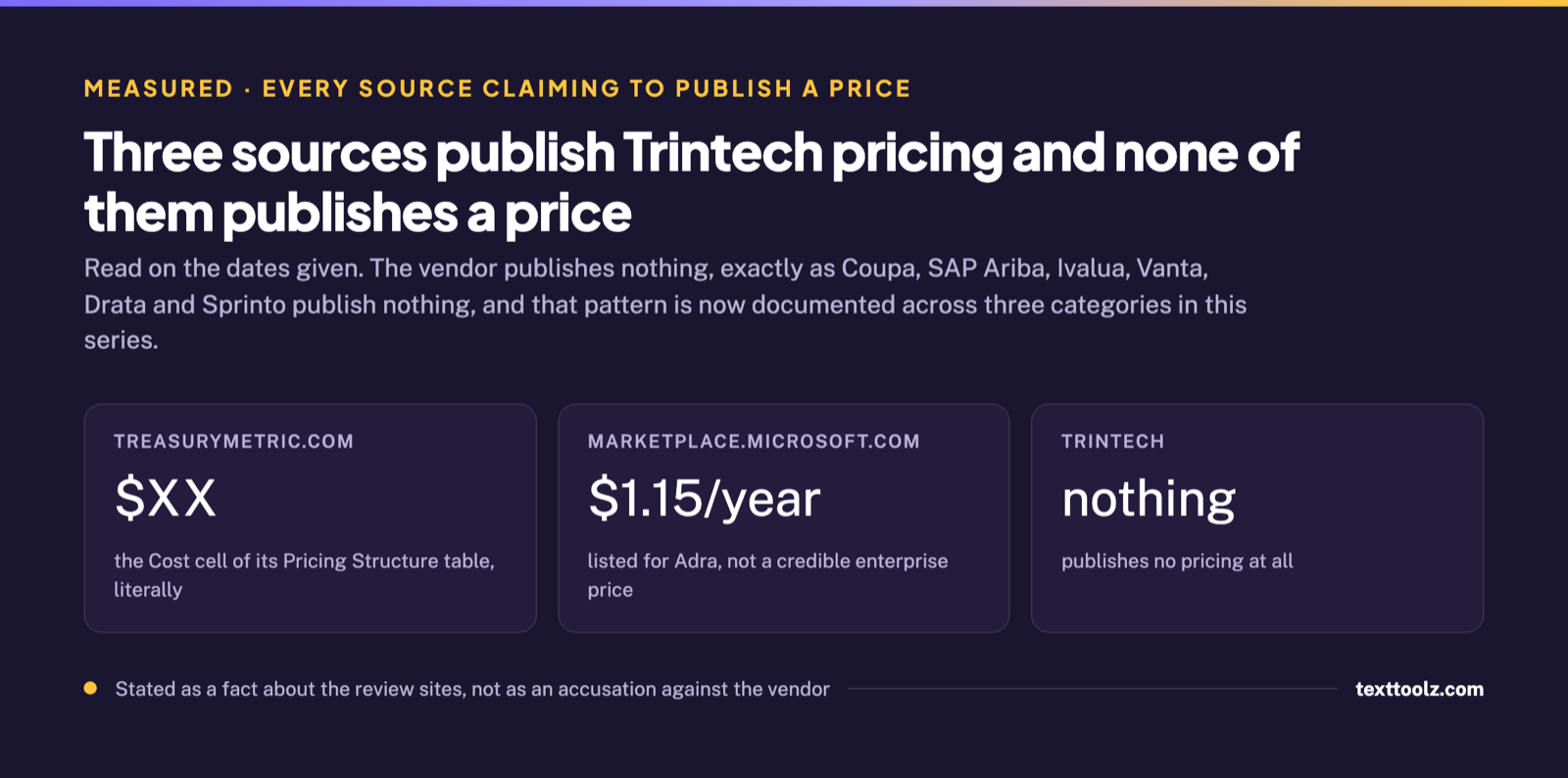
| Source | What it publishes | Status |
|---|---|---|
| treasurymetric.com | A Pricing Structure table with one row. The Cost cell reads $XX | An unfilled placeholder |
| marketplace.microsoft.com | “Starting at $1.15/year” for Adra by Trintech | Not a credible enterprise price |
| trintech.com | Nothing | The category norm |
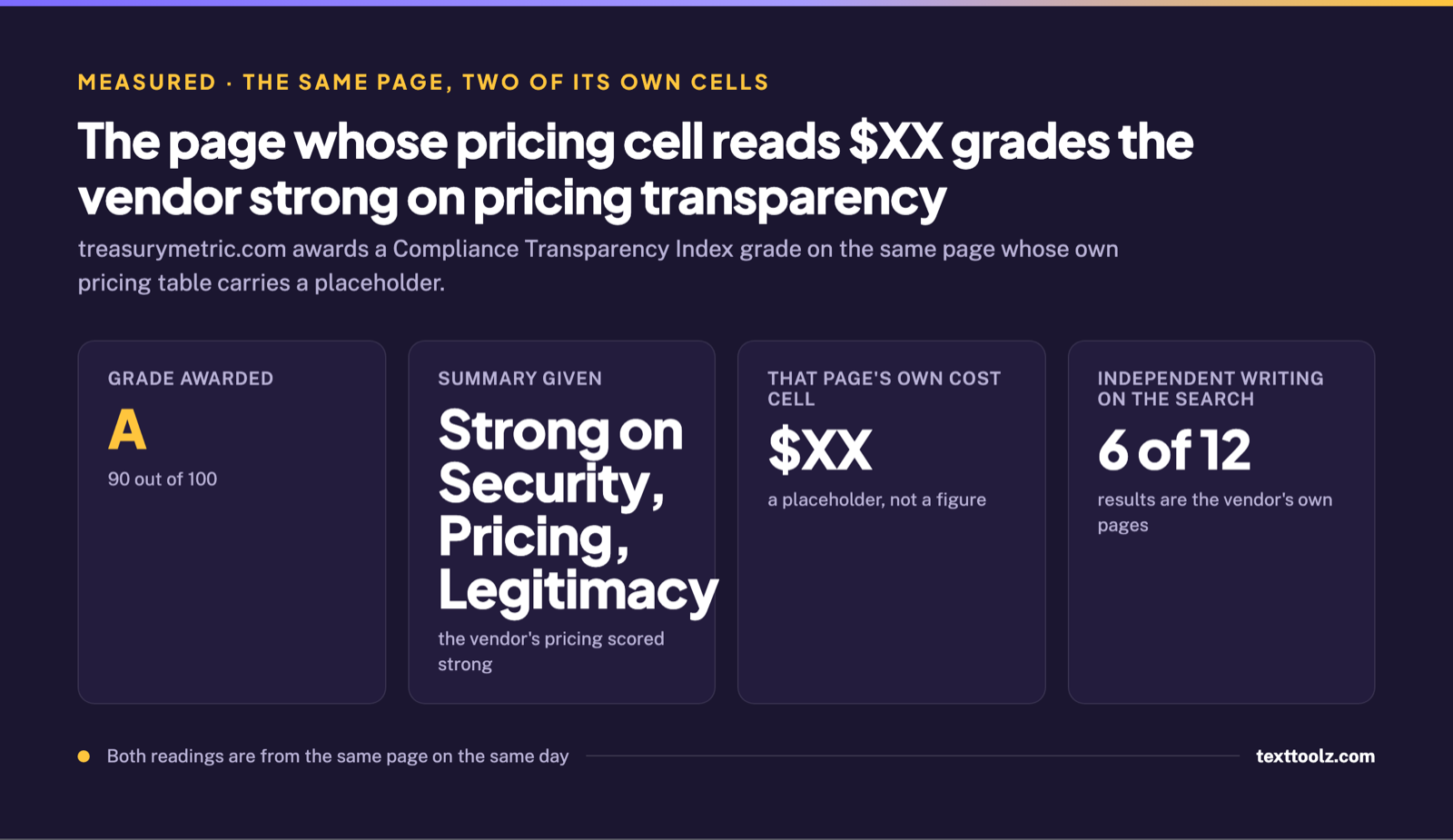
The treasurymetric page is titled as a 2026 review of Trintech Cadency covering pricing, features and compliance. Its pricing table contains a single row, listing a Standard plan including basic reconciliation, transaction matching and close management, at a cost of $XX. That is the literal contents of the cell.
The same page then awards Trintech a Compliance Transparency Index grade of A, scored 90 out of 100, summarised as “Strong on Security, Pricing, Legitimacy. Gaps in Commercial Rights.”
It scores the vendor as strong on pricing transparency, on a page whose own pricing cell is an unfilled template variable.
Two things need saying clearly about this. First, it is a fact about the review site, not an accusation against Trintech. Trintech did not write that page and is not responsible for its placeholder. Second, and more useful to a buyer: Trintech publishing no price is entirely normal for this market. This series has now documented the same pattern across three separate categories. In compliance automation, exactly one vendor in nine published a price. In enterprise procurement, Coupa, SAP Ariba, Ivalua, Jaggaer and Zycus all publish nothing, and the two figures in circulation came from a competitor’s blog.
Enterprise software with negotiated pricing produces this reliably: a vacuum where the rate card should be, filled by whoever has a reason to fill it. The consequence for you is that you cannot benchmark a Trintech quote against anything published. You can only interrogate it: ask what the number is metered on, what it becomes at renewal, whether implementation sits inside it, and what a second entity costs.
Who it is not for
treasurymetric names small businesses and non-technical users as who Cadency is not ideal for. That single line is the most decision-useful statement on the entire search, and it appears exactly once.
No vendor page says this, for reasons that need no explanation. But it matters, because a meaningful share of people who arrive at a financial close software search have a bookkeeping problem rather than a close problem. If your month-end pain is reconciling a bank account in QuickBooks, this category is not your answer and this vendor is explicitly not aimed at you.
The honest service to that reader is to say so early rather than to keep them reading. Enterprise close platforms assume a finance function with defined roles, an ERP worth integrating with, and a control obligation that justifies the overhead. Without those three, the software adds process to a problem that needed less of it.
Security and compliance, as published
treasurymetric lists SOC 2 Type II, GDPR readiness, enterprise single sign-on and a data retention policy for Cadency. That is credited to treasurymetric and has not been independently verified here.
In a financial systems purchase these are eligibility criteria rather than quality signals. A close platform touches the general ledger and the audit trail, so security and access control are preconditions for being considered at all rather than reasons to prefer one vendor over another. Every serious competitor will clear the same bar.
The action is specific and worth taking regardless of what any review says. Ask Trintech directly for the current SOC 2 Type II report and check its date and its scope, because a third-party summary of a certification is not the certification, and a report can be current, expired, or scoped to a part of the platform you are not buying.
The alternatives, and who named them
Four names come up across the non-vendor sources on this search: BlackLine, FloQast, Workiva and Aico. All four are named by parties with something to gain from naming them, which is worth holding in mind before treating the list as neutral.
The provenance needs care. Aico names BlackLine, FloQast and Aico itself as the market leaders alongside Cadency, on a page titled around Trintech alternatives that exists to move buyers to Aico. A software review platform’s financial close category names Workiva, FloQast, BlackLine and Adra by Trintech among its top-rated products, on a platform whose ranking model depends on vendor relationships.
So the names are useful and neither source’s conclusion is carried here. This page rates none of these products, having used none of them, and a reader should treat the list as a starting shortlist rather than as a ranking.
The one structural observation worth adding is that these products are not all the same shape. Some are close management first, some reconciliation first, and some sit inside broader reporting platforms. Working out which shape you need, using the reconciliation-versus-close-management distinction set out earlier, will narrow the list faster than any comparison table.
What this review cannot tell you
Whether the software is good, which is almost certainly the question that brought you here and is the one thing the published record cannot answer.
We have not used Trintech, implemented it, or spoken to a customer, and no independent evaluation of it exists anywhere on this search to credit. Any verdict offered here on quality, usability or support would be invented, so none is offered.
Several things were deliberately excluded and the reasons are worth stating. Star ratings from software review platforms are not used, including the figure repeated on Microsoft’s marketplace listing, because Trintech’s own Facebook account publicly asks customers to leave reviews on one of those platforms. A rating a vendor solicits is not independent evidence, and repeating it without that context would mislead. Individual quoted user endorsements are excluded for the same reason. Vendor claims about time saved and risk reduced are excluded because no method is published behind any of them.
What to ask for instead is concrete: two customer references at your company size, running your ERP, live for at least a year, and a conversation with them without the vendor on the call. Then a proof of concept on your own transaction data with the auto-match rate measured by you. Those two things will tell you more than every page on this search combined.
How this review was built
Twelve search results were reviewed and seven were extracted in full on 16 August 2026. One result, a software review platform, returned an HTTP 403 and was deliberately not retrieved by other means, because its ratings are excluded from this review on principle and would not have been used.
Keyword research was run against Google’s autocomplete, seeded on the category rather than on the brand name, because brand-name autocomplete for an enterprise vendor returns almost nothing and the category harvest shows what a buyer is actually looking for when they arrive at a vendor review.
The source-interest map is worth stating in full, since it is the finding: six of the twelve results are the vendor’s own pages, one is the vendor’s social media account soliciting reviews, one is a direct competitor, two are software review platforms, one is a marketplace listing carrying vendor-supplied copy, and no forum result ranks at all.
Every fact on this page is attributed to whoever published it. The Adra and Cadency split is credited to a competitor. The ecosystem, security attributes and unsuitability for small businesses are credited to treasurymetric. The product line comes from Trintech’s own navigation. The $1.15 per year listing is Microsoft’s marketplace.
If you work at Trintech or in this category and something here is out of date or wrong, the editorial contact page is the fastest route to a correction, and a published price would improve this page more than anything else could.
Frequently asked questions
These are the questions buyers search about this vendor, answered from the published sources named throughout this page rather than from any hands-on use.
What does Trintech do?
Trintech sells financial close and account reconciliation software: the record-to-report path from transaction capture through reconciliation and journal entry to a closed, audit-ready period. Established 1994, based in Dallas, sold on subscription, per treasurymetric’s summary.
What is the difference between Adra and Cadency?
Adra is aimed at mid-sized businesses and Cadency at enterprise-level close with governance and controls. That distinction is credited to Aico, a direct competitor, whose page states it more clearly than any Trintech page ranking for this search.
How much does Trintech cost?
Nobody publishes a usable figure. Trintech publishes none. One review site’s pricing cell reads “$XX” and a marketplace listing shows “Starting at $1.15/year”, which is not a credible enterprise price. Expect the number to come from a sales conversation.
Which ERP systems does it work with?
treasurymetric names SAP, Oracle and NetSuite as the ecosystem, credited to them. This is the first filter worth applying: a close platform that cannot read your ERP cleanly recreates the reconciliation problem it was bought to solve.
Is Trintech suitable for a small business?
treasurymetric says no, naming small businesses and non-technical users as who it is not ideal for. If your month-end problem is reconciling a bank account in bookkeeping software, this category is not the answer regardless of vendor.
Is Trintech any good?
This review cannot tell you. We have not used the product and no independent evaluation exists on this search. Ask for two references at your company size on your ERP, and run a proof of concept measuring the auto-match rate on your own data.