
Somewhere between three months and four years, and the reason that range is useless is the reason this page exists. Search the question and you will be told the average is three to six months, and also twelve to eighteen months, and also six months to two years. Those numbers are not competing estimates from firms that disagree. They are measured from different starting points, and almost none of the pages publishing them says which starting point it used.
Once you know where each clock starts, the numbers line up, and you can work out roughly where your own case sits. That is what follows. It is general explanation rather than legal advice, because procedure, deadlines and court schedules are all set locally.
The first problem is that nobody says which clock they started
Two firms, both experienced, both publishing in good faith, on the same question.
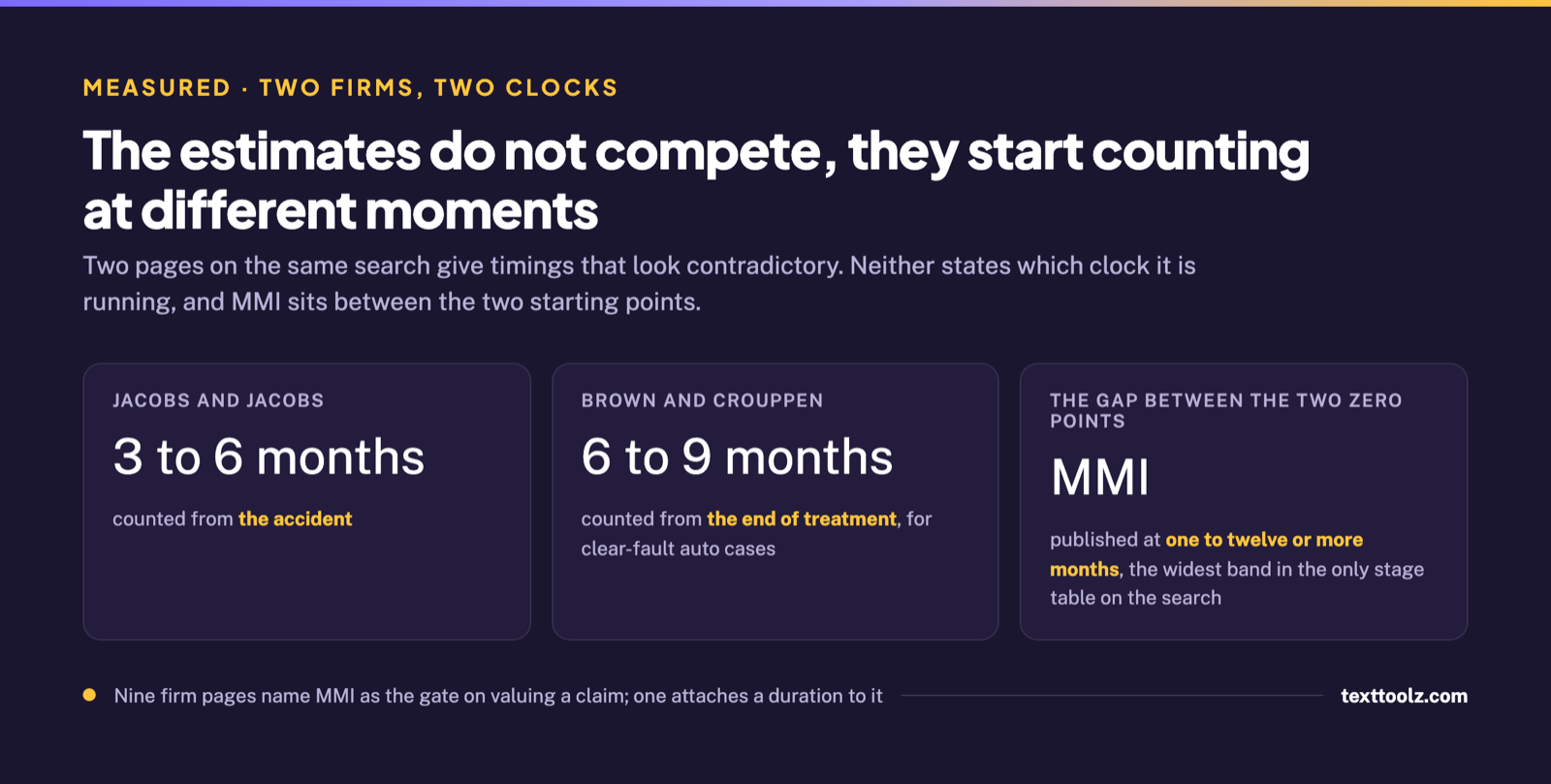
Jacobs & Jacobs, a Connecticut firm, writes that the average personal injury settlement is achieved in about three to six months after an accident. Brown & Crouppen writes that auto accident cases with clear fault and uncomplicated injuries often settle within six to nine months after treatment is complete. Read quickly, those look like a disagreement. They are not. There is an entire stage sitting between “the accident” and “treatment is complete,” and on the numbers below it can be the longest stage in the whole claim.
Meanwhile the Reddit thread that ranks first on this question reports twelve to eighteen months. Salvi & Maher put most claims at six months to two years. BB Law Group say several months to over two years. And Morris Bart, whose page ranks for the exact phrase “average personal injury lawsuit timeline,” opens by stating that there is no average personal injury lawsuit timeline, and that there is no way to determine how long the process could take.
They are all describing the same process. They are just starting the stopwatch in different places.
The stages, and what each one costs you in time
Every duration below is published by a named firm rather than estimated here. Where only one firm attaches a number to a stage, this page says so, because that is itself worth knowing.
1. Medical treatment, until your recovery stops improving
The term is maximum medical improvement, usually shortened to MMI, and it means the point at which your doctor concludes your condition has stabilised and further treatment will not meaningfully improve it. It does not mean you are better. It means the picture is finally clear enough to put a number on, including any permanent impairment.
Every one of the nine firm pages examined for this article names MMI as the gate on valuing a claim. Salvi & Maher put it flatly: they cannot accurately value a claim until a doctor confirms the condition has stabilised. Mahdavi Law Firm say the attorney will generally wait for MMI before calculating damages so the settlement reflects the full extent of the injuries.
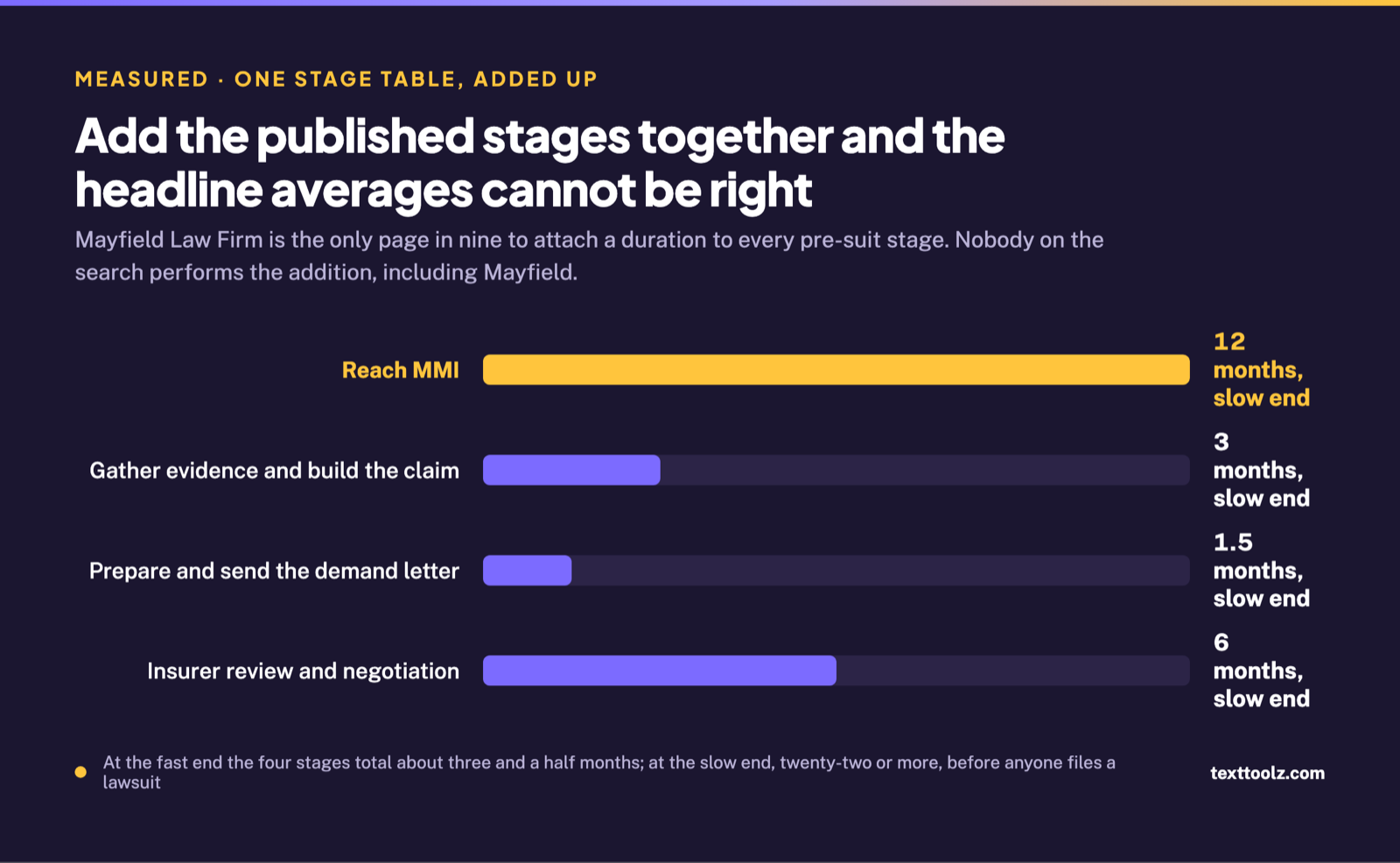
Exactly one of the nine attaches a duration to it. Mayfield Law Firm publishes a stage table giving “complete treatment and reach MMI” as one to twelve or more months. That is the widest band in their entire table, and it sits before any of the legal work starts.
This is also the one stage where hurrying costs you money rather than saving you time. Mayfield make the point directly: settling before MMI means accepting a number that may not cover future surgeries, ongoing therapy or long-term disability. A settlement signs away the right to come back for more from the same incident, so a fast settlement on an unfinished injury is not a fast win.
2. Investigation and building the claim
Published at one to three months. Your lawyer establishes what happened, identifies who is liable, and assembles the evidence that supports a number.
Sometimes that is quick. Morris Bart describe the simple version as obtaining a police report, interviewing a couple of witnesses, and compiling medical bills from your providers. The same firm lists what turns it into a longer job: accident scene reconstruction experts, expert witnesses to substantiate long-term care needs, identifying and requesting video evidence before it is overwritten, preserving evidence held by the liable party, and calculating future care needs.
That last item is the quiet one. Costing out care you have not received yet requires medical opinion, and medical opinion requires appointments, which is how an investigation stage ends up waiting on the same calendars the MMI stage waited on. Much of this work runs in parallel with treatment rather than after it, which is why the stages overlap in practice even though they are listed in sequence.
3. The demand letter and the insurer’s answer
The demand letter is the formal document setting out liability, injuries, treatment and the compensation sought. Mayfield give two to six weeks to prepare and send it. Then the insurer reviews it and negotiation begins, which Mayfield put at one to six months.
This is where most claims end. All nine pages agree that the large majority of personal injury cases settle without a trial, and Morris Bart note that most settle at exactly this point and never require suing anyone. The negotiation is genuinely a negotiation: the first response is rarely the final number, and the gap between the demand and the offer is what the following months are spent closing.
It is also the first stage where the delay is somebody else’s choice rather than a fact about your body or the evidence. An insurer with a reason to wait can wait, and a claimant with medical bills arriving cannot, which is the asymmetry the whole stage runs on.
4. Filing suit, and discovery
If negotiations stall, or the other side blames you, or the deadline to file is approaching, the next step is a lawsuit. Filing does not replace the negotiation; Morris Bart note that settlement talks generally continue right through litigation, often until the trial date and sometimes after it starts.
What filing adds is discovery, the formal exchange of evidence between the parties: written questions answered under oath, document production, and depositions. Three of the firms give the same band for it independently. Mayfield say discovery typically runs six to twelve months. Mahdavi say six to twelve months. BB Law Group say six months to a year or more.
Discovery is slow because it is adversarial and scheduled. Each request has a response deadline, each deposition needs a date that works for a witness, a court reporter and two sets of lawyers, and disputes about what must be produced go to a judge who has a calendar of their own. Esclaw note the flip side: the pressure discovery creates is often what produces a better offer, because it compels the other side to produce records and commit to positions.
5. Mediation, and then the court’s docket
Before a trial, most courts route the case through mediation or another guided negotiation. That part is short, usually a day, and many cases settle there because it is the first time both sides sit down with a neutral third party who tells each of them what is weak about their position.
If it does not settle, you join a queue. Mayfield write that after discovery closes, courts schedule hearings and set trial dates that can sit one to two years out depending on the county’s docket. Esclaw put even cases that are strong on liability and damages at one to two years to reach trial, depending on the court’s docket and the defence’s willingness to negotiate.
This is the stage least connected to anything about your case. The wait is a function of how many cases that particular court is carrying, and no amount of preparation on your side shortens it. The trial itself, if you get there, is short by comparison: Morris Bart say at least a day or two, Jacobs & Jacobs say a week or longer.
6. What actually moves your timeline
Four things move it more than anything else, listed here in rough order of how much they matter.
How long your injuries take to stabilise, which is the MMI band above and the largest single variable. Whether liability is disputed, because a case where the other side accepts fault skips the fight that discovery exists to resolve. What kind of case it is: Salvi & Maher single out medical malpractice as inherently complex and requiring extensive review by medical experts, putting it at two to four years, well beyond any of the headline averages. And the limitation period, the deadline your state sets for filing suit, which does not slow a case down but can force it forward, because several firms name an approaching deadline as a reason to file whether or not negotiations were ready.
Notice what is not on that list. Your lawyer’s diligence affects the stages they control, which are the investigation and the demand, together perhaps two to nine months of a claim that may run years.
Adding it up
Mayfield Law Firm publish the four pre-suit stages with durations attached, and then, like everyone else on this search, do not add them together. So here is the addition.
Reach MMI, one to twelve or more months. Gather evidence and build the claim, one to three months. Submit the demand letter, two to six weeks. Insurance review and negotiation, one to six months. At the fast end that totals about three and a half months. At the slow end it totals twenty-two months or more, and that is before anyone files a lawsuit.
Now stack litigation on top for the cases that do not settle. Discovery adds six to twelve months. The trial date sits one to two years beyond that. A litigated claim on these published figures runs somewhere between two and four years.
Which is precisely what Salvi & Maher independently report for medical malpractice. The stage durations corroborate the long-case estimate. The headline averages do not. When a firm’s own stage table and its own average disagree, the stage table is the one built from steps you can check.
So why do the published averages disagree?
Three reasons, none of which require anyone publishing these numbers to be acting dishonestly.
The zero point, as above: three to six months from the end of treatment and three to six months from the accident are different claims about the world, and the pages rarely say which they mean. Case mix: a firm doing mostly clear-fault auto claims genuinely sees faster resolutions than one doing malpractice, and each is describing its own caseload accurately. And survivorship, the subtle one, because a firm summarising how long its settlements took is summarising the cases that settled, while the cases still open, which are the slow ones by definition, are not in the average yet.
The practical consequence is that no published average tells you much about your claim, and a stage table does. If you want a real estimate, ask a personal injury attorney in your state which stage you are currently in and what typically follows it, rather than asking how long cases like yours take. The first question has an answer. The second mostly does not.
What to do while it runs
Keep treating, and attend the appointments, because gaps in treatment are read by insurers as evidence the injury resolved. Keep your own records of expenses, missed work and how the injury affects ordinary days, since that documentation is difficult to reconstruct a year later. Answer your lawyer’s requests quickly, as the investigation and demand stages are the ones your own responsiveness genuinely affects. And do not settle before you reach MMI without understanding exactly what you are giving up.
One more thing worth knowing before the end arrives: the settlement figure is not what you receive. Attorney fees, case costs and medical liens all come out of it first, and depending on one sentence in your retainer agreement, the order they come out in can change your share by five figures.