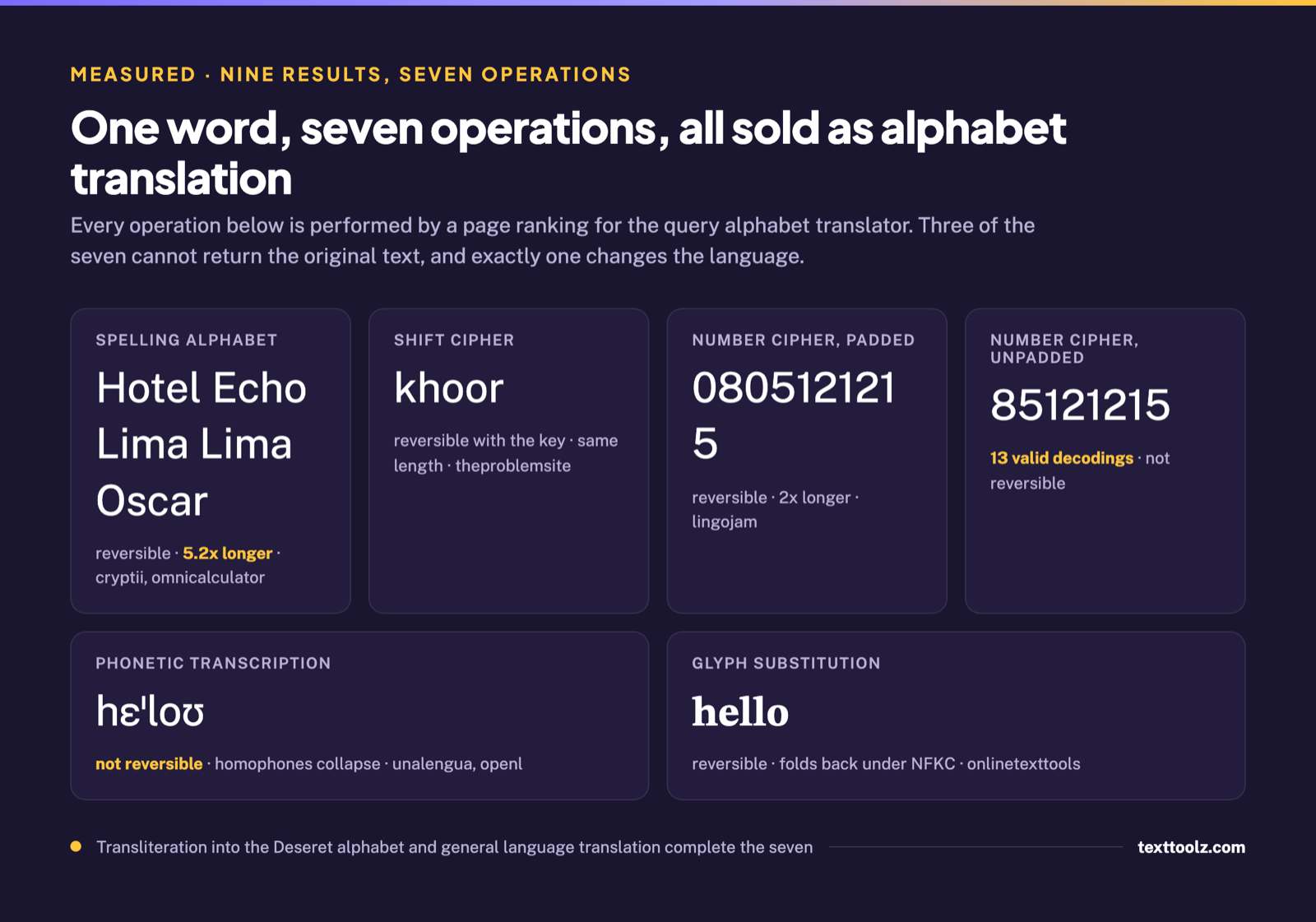
Nine pages rank for the phrase alphabet translator and they perform seven different operations. One transliterates English into the Deseret alphabet, two convert letters into NATO code words, one shifts every letter by a fixed distance, one turns letters into their positions in the alphabet, two transcribe pronunciation into the International Phonetic Alphabet, one translates between languages, and one swaps letters for lookalike Unicode characters. None of them says which operation it performs before you paste your text in. Two questions separate all seven: does your original text come back, and does the language change. Three of the seven cannot return your text, and exactly one changes the language. Google served no AI Overview on either capture of this query, and the People Also Ask box answers a different question than the one typed.
Which seven operations share the name?
Each operation below is named with the page in the ranking set that performs it, so the classification can be checked against the search results rather than taken on trust. The two columns that decide which one a reader wants are the third and the fourth: whether the language changes, and whether the original spelling can be recovered.
| Operation | Ranking page | Output language | Original spelling recoverable | Readable aloud | Length |
|---|---|---|---|---|---|
| Transliteration into another script | 2deseret.com | same | no | by a reader of that script | about the same |
| Spelling alphabet | cryptii.com, omnicalculator.com | same | yes | yes, that is its purpose | 5.31 times longer |
| Shift cipher | theproblemsite.com | same | yes, with the key | no | same |
| Number cipher | lingojam.com | same | yes when padded, no when unpadded | no | twice as long |
| Phonetic transcription | unalengua.com, openl.io | same | no | by a trained reader | about the same |
| Language translation | quillbot.com | different | no | yes | varies |
| Glyph substitution | onlinetexttools.com | same | yes | yes, same letters | same characters, more bytes |
Read the table by column rather than by row. Only one of the seven changes the language, which is what the word translator normally means, and three of the seven discard something that cannot be reconstructed. A reader who picks a tool by its appearance has worse than even odds of getting a conversion they can undo.
Spelling alphabets: why does one letter become a whole word?
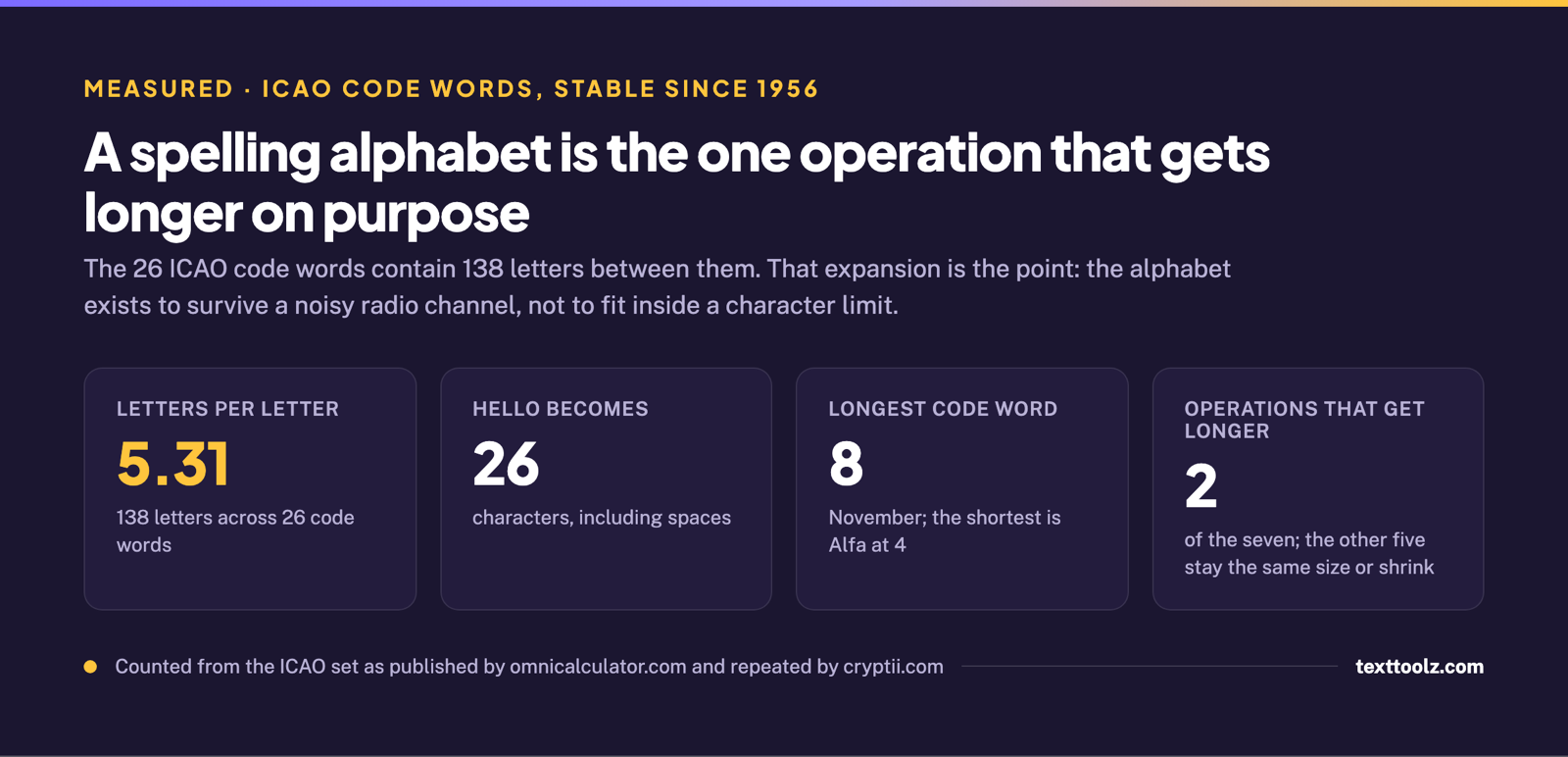
Because a spelling alphabet is built for a noisy audio channel, so it trades length for distinguishability, which is the opposite of the trade every other operation here makes. omnicalculator.com is the one page in this ranking set to state the underlying distinction, and this page’s whole taxonomy rests on it: the NATO alphabet, in their words, “is not actually a true phonetic alphabet, unlike the International Phonetic Alphabet (IPA). Instead, it is a spelling alphabet, specifically an orthographic system designed for consistent spelling rather than perfect pronunciation. Its official name is the International Radio-Telephony Spelling Alphabet.” They date the ICAO code words as stable since 1956.
Measured, the 26 code words contain 138 letters between them, a mean of 5.31 letters for every letter of input. The longest is November at eight letters and the shortest is Alfa at four. The five-letter word hello becomes Hotel Echo Lima Lima Oscar, which is 26 characters including spaces, an expansion of 5.2 times. That is the correct behaviour for a system designed to survive a radio, and it is the reason a spelling alphabet is useless anywhere a field has a character limit.
Shift ciphers and number ciphers: what comes back out?
Both are reversible in principle, and one of them is reversible only if it is written correctly. A shift cipher, which theproblemsite.com documents as the shifted alphabet code, moves every letter a fixed distance along the alphabet, so the key is a single number between 1 and 25 and the message returns exactly when the key is known. Our Caesar cipher decoder performs it in both directions.
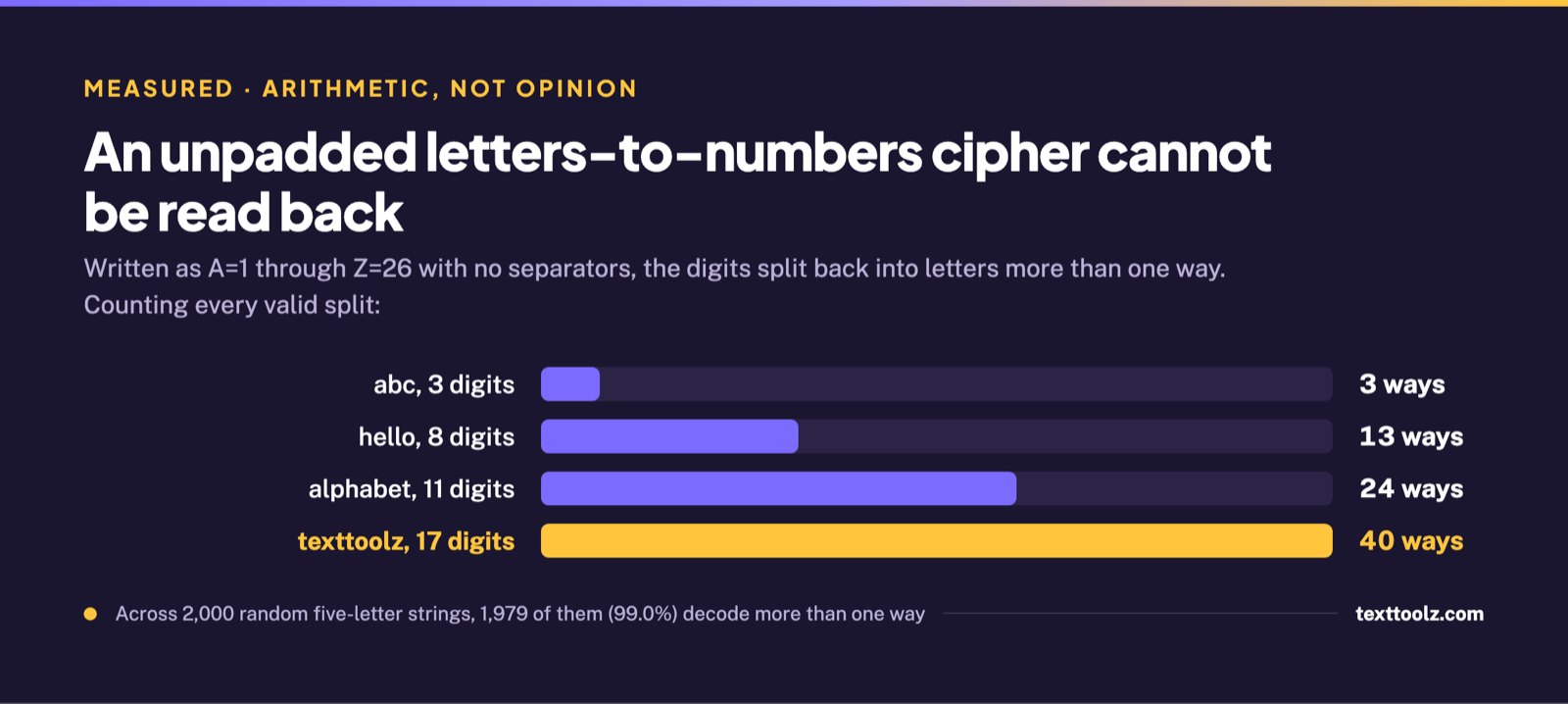
The number cipher is the interesting one, because the convention taught almost everywhere loses information. Written unpadded as A=1 through Z=26 with no separators, the digits cannot be split back into letters uniquely. Counting every valid split:
| Word | Unpadded digits | Valid decodings |
|---|---|---|
| abc | 123 | 3 |
| hello | 85121215 | 13 |
| alphabet | 11216812520 | 24 |
| texttoolz | 20524202015151226 | 40 |
Across 2,000 random five-letter strings, 1,979 of them, 99.0%, have more than one decoding. An unpadded number cipher is not really a cipher, because a cipher is defined by being reversible with the key and this one is ambiguous even with it. lingojam.com, ranking fourth for this query, sidesteps the problem entirely and deserves the credit: its page states the rule as “the letter A gets turned into 01, the letter B gets turned into 02 … up to Z which is turned into 26”. Zero-padding gives every character a fixed width of two digits, and fixed width is what makes an encoding reversible. The same principle is why binary conversion is reversible: every character occupies the same number of bits.
Transliteration and transcription: why can you not get your spelling back?
Because both encode sound rather than spelling, and the information that separates two spellings of the same sound is discarded at the moment of conversion. The Deseret alphabet, which the first result for this query converts into, was built for exactly that purpose: the quotation that page carries defends it as “the means of introducing uniformity in our orthography”, and the site credits the Moby Project for its pronunciation data. Uniformity in orthography is another way of saying that different spellings become the same thing.
Phonetic transcription into IPA, where two of the nine results land, is the same problem sharpened. Homophones collapse: two words that sound alike produce one transcription, so the reverse direction has more than one right answer and no way to choose between them. Both operations are useful and neither is a round trip, which is worth knowing before you paste in the only copy of something.
Glyph substitution: why does this one look different and read the same?
Because the letters are replaced with lookalike characters rather than encoded, so the text is still the same text and a reader still says it the same way. onlinetexttools.com describes the mechanism as a set of rules in the form oldLetter=newLetter, and its own example swaps each vowel for a circled Unicode vowel and each consonant for a filled-circle one, turning a sentence into a row of characters that read identically aloud.
One property matters more than the appearance. These substituted characters fold back to plain letters under Unicode compatibility normalisation, which means they survive a copy and do not survive an index. That is the mechanism behind almost everything odd about styled text on social platforms, and it is measured in which platforms keep your styled text.
Font substitution is a different thing again
The two largest clusters in this section by search demand are not in the taxonomy above at all. Wingdings and the Standard Galactic Alphabet substitute a font rather than a character, so the underlying text never changes and the appearance exists only on a device that has the font installed.
The consequence is the one thing everybody discovers the hard way: the symbols do not survive a copy, because nothing was ever converted. What was copied was the letters, and the letters arrive as letters. That failure is measured on why Wingdings does not survive copy and paste, and the Wingdings translator exists to produce the substituted characters that do survive.
Which of these can give you your text back?
Three of the seven cannot. Transliteration into a phonemic alphabet discards spelling by design. Phonetic transcription discards it and collapses homophones on top. An unpadded number cipher discards the boundaries between characters, which is why 99.0% of five-letter strings decode more than one way.
That yields a rule nothing in the ranking set states. If the output is no longer than the input and no key was involved, assume information was discarded and keep the original. Length is a rough but reliable signal here: a spelling alphabet expands by 5.31 times and a number cipher doubles, and both of those are recoverable, while the two operations that produce output roughly the same size as the input are the two that encode sound.
Which of these actually translates anything?
One of the seven. Only general language translation changes the language, and it is probably the operation a reader typing this phrase is least likely to have wanted. QuillBot ranks sixth on this query with a general-purpose translator covering 50 languages, which is the search results’ own evidence that the word is doing two unrelated jobs at once.
The boundary is worth stating plainly for this site as well. The tools here convert text: they change which characters carry a message, or how those characters look, and they leave the language exactly where it was. A page here claiming to translate a language would be claiming a capability none of these tools has.
Which one do you actually want?
What does an alphabet translator actually do for you, in practice? Choose by what you want back, not by what the output looks like. Four cases cover almost every reason people arrive at this question.
- Your name in another writing system, to look at. That is transliteration, and the hieroglyphics translator performs it. Expect the appearance to be the point and the spelling not to survive a round trip.
- A message a friend can decode. That is a cipher with a key, and the Caesar cipher decoder both encodes and decodes it. Anything without a key is either public or ambiguous.
- A word spelled out unmistakably for someone listening. That is a spelling alphabet, and it costs 5.31 characters per letter, which is the point rather than a flaw.
- Text that looks different inside a profile or a message. That is glyph substitution, and the Standard Galactic Alphabet translator and text to ASCII converter sit at opposite ends of it, one substituting characters and the other exposing the codes underneath.
Where does each of these questions get answered?
Each page below answers one question in this section and carries its own measurement, so the list routes by question rather than by title.
- What the Minecraft enchanting table says, which is the Standard Galactic Alphabet, this section’s strongest position at 3.61 on its head query.
- Why Wingdings does not survive a copy, the font-substitution case above.
- How Webdings and Wingdings differ, two symbol fonts often treated as one.
- How to write a name in hieroglyphics, the transliteration case.
- What ASCII actually covers, the 128 characters underneath all of this.
- What leetspeak costs, where the basic map covers 6 of 26 letters and normalisation does not undo it.
Questions people ask about this
These are the four questions Google served in its People Also Ask box for this query, identically on both captures taken on 23 August 2026. All four are about alphabets as writing systems and none is about translating anything, which is itself evidence that the phrase has no settled meaning. Two are answered below, one is out of scope and says so, and one has no answer this research supports.
What is the 26 letter alphabet?
It is the modern English alphabet, A to Z, and it is the input side of every operation on this page. Every conversion described here starts from those 26 letters and maps them onto something else: 26 code words, 26 shifted letters, 26 numbers, or 26 lookalike characters drawn from a Unicode block. The number matters because it is the reason coverage gaps are visible: a styled alphabet missing four letters is missing four of 26.
What is the A to Z alphabet?
The same 26 letters, listed in their conventional order, which is what gives a shift cipher and a number cipher their meaning. A shift cipher depends on the order because it moves each letter a fixed distance along it, and a number cipher depends on it because it replaces each letter with its position in it. Change the order and both operations produce different output from the same input.
How do you write the Russian alphabet A to Z?
That is a script-learning question rather than a text-conversion question, and this page does not answer it. The distinction is the same one the taxonomy above draws: learning to write in another script is not the same act as converting text into it, and a transliteration tool produces the second without teaching the first.
Which language has 72 alphabets?
No source in this research supports any answer to that question, and none is offered here. It appears in Google’s People Also Ask box for this query alongside three other questions about writing systems, and nothing in the nine ranking pages addresses it. A number invented to fill the gap would be worth less than the gap.