A box means the text arrived perfectly and the font on the screen has no picture for it. Every character is a number, a font is a set of pictures indexed by those numbers, and when the number has no picture the text engine draws a placeholder box that the field nicknamed tofu. Nothing about the text is broken, which is why nothing done to the text repairs it. That leads to the split this page is organised around, and the one the search results miss: boxes on your own screen are a font you can install, while boxes on a reader’s screen are a font you cannot reach. Six of the nine pages ranking for this question answer the first case, one answers the second, and the second is what almost everybody asking has. Measured against 436 installed font faces, 60 of the 112 symbols on this blog’s most-read symbol page are carried by four faces or fewer.
Why is the symbol showing as an empty box?
The box is the font reporting that it cannot draw this character. Text is stored as numbers, one per character, assigned by the Unicode Standard, and a font file contains a table mapping some of those numbers to shapes. The Standard says which character a number means; it does not oblige any font to carry a picture of it, and that gap is where the boxes come from. When the text engine asks for a number the font does not have, it substitutes a fallback glyph, and on most systems that fallback is an empty rectangle. Google’s AI Overview for this query put it the same way on both captures taken on 23 August 2026, calling the missing shape a glyph and naming the box tofu.
Two things follow immediately. The character itself is intact and will render correctly the moment a font that contains it is available, so the boxes are a display state rather than damage. And because the fault lives in the font on the machine doing the drawing, nothing the sender does to the text will remove a box from a reader’s screen. That is the whole reason the advice on this topic so often fails to help the person who asked.
What do the digits inside the box mean?
A box with four or five hexadecimal digits inside it is the same failure carrying a diagnostic. The digits are the character’s Unicode codepoint, so the box is telling you exactly which character is missing instead of leaving you to guess. Looking the codepoint up names the character and usually names the script it belongs to, which is often enough to work out which font would carry it.
The Ask Ubuntu question documenting this variant was asked thirteen years ago and still ranks fifth for this query, which says something about how little has been written on it since. Not every system draws the numbered version: it depends on the fallback font, and the plain empty box is more common.
Boxes, question marks, or a black diamond: which one are you seeing?
Three symptoms are reported as the same problem and only one of them is a font problem. A box means the font lacks the glyph, and the character is still there. Question marks mean the text was converted into an 8-bit character set that had no way to represent the character, so the character is gone, and installing a font will not bring it back. Michael Burr set the two side by side in a Stack Overflow answer in 2008, and typeanysymbol.com is the only other page in this ranking set to keep them apart.
The third symptom is a black diamond containing a white question mark, U+FFFD REPLACEMENT CHARACTER, which is what a decoder inserts when a byte sequence is not valid in the encoding it was told to expect. Like question marks, and unlike boxes, it is a data loss rather than a drawing failure. Google’s AI Overview named a UTF-8 transmission fault on the first capture and did not mention it on the second minutes later, so the encoding family is real but the overview is not a stable source on it.
Is the problem on your device or on your reader’s?
If you can see the boxes yourself, they are on your device, and every fix in the next section works. If someone tells you your text looks like boxes to them, the missing font is on their machine, and none of those fixes is available to you. That distinction decides which half of the internet’s advice on this subject is worth reading, and the search results for this exact question are lopsided about it.
Counted across the nine results: six answer the first case, and they answer it well. Super User covers Segoe UI Symbol missing on Windows 7, Stack Overflow covers Windows GDI, Ask Ubuntu covers a Linux desktop, Adobe’s community forum covers Photoshop’s Symbol font on Windows 10, PTC’s forum covers diameter and counterbore symbols in Creo drawings, and fornav’s knowledge base covers a report exported to PDF or Word. One answers the second case: the Quora thread at position two, with 35 answers, titled around fancy fonts turning into boxes on other people’s phones.
The second case is the one produced by copying decorated text from a generator, which is what nearly everyone typing this query has just done. The related question of what platforms themselves do to that text, before any font gets involved, is set out in which platforms keep your styled text.
What actually fixes it, and for whom?
Four fixes, all of which operate on the machine that is showing boxes, and none of which travels to anyone else.
- Update the operating system or browser. New characters are added to Unicode regularly and shipped with system updates, so a device that has not been updated is missing the recent ones. Google’s AI Overview gives this on both captures.
- Install the missing language pack. Scripts outside the default set are shipped as optional font packages, which is why an unfamiliar script is the most common cause on an otherwise current machine. fornav’s knowledge base gives the same advice for report output and points at the Windows font list.
- Switch to a font family with wide coverage. The AI Overview names Google’s Noto family on its first capture; a Stack Overflow answer from 2008 names Arial Unicode MS and calls it a least-common-denominator font whose glyphs sit awkwardly beside each other. Both are the same idea at sixteen years’ distance.
- Check the ad blocker. This is the one cause in the entire ranking set that produces boxes with no missing font at all. A Stack Overflow answer from February 2020 reports two years of boxes in Chrome on Windows 10 traced to uBlock Origin, which blocks remote fonts on every site by default, leaving the browser to substitute a rectangle.
The fourth is worth trying first when the boxes appear only in a browser, because it costs one toggle and it is invisible to every other page on this subject.
How many fonts can actually draw an aesthetic symbol?
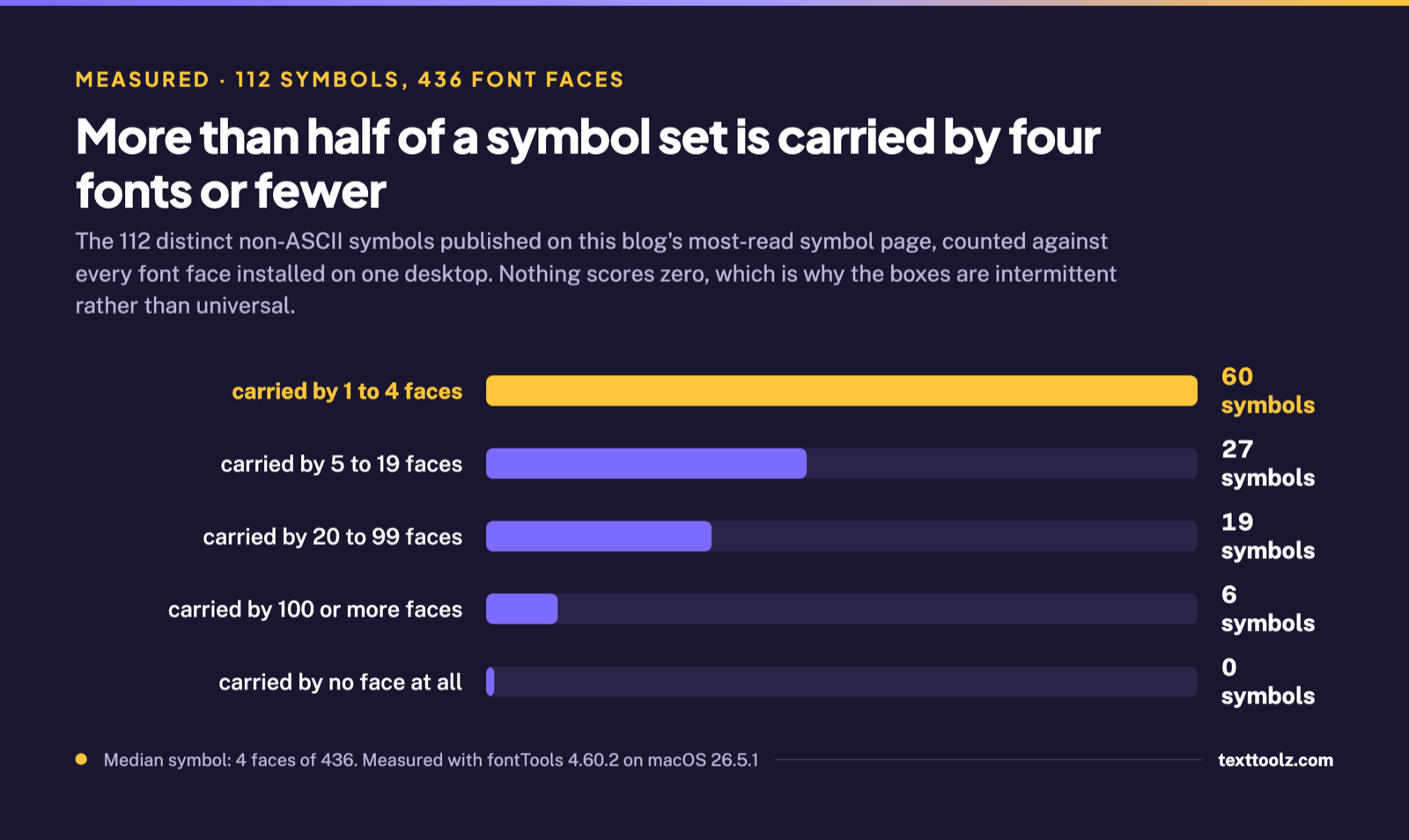
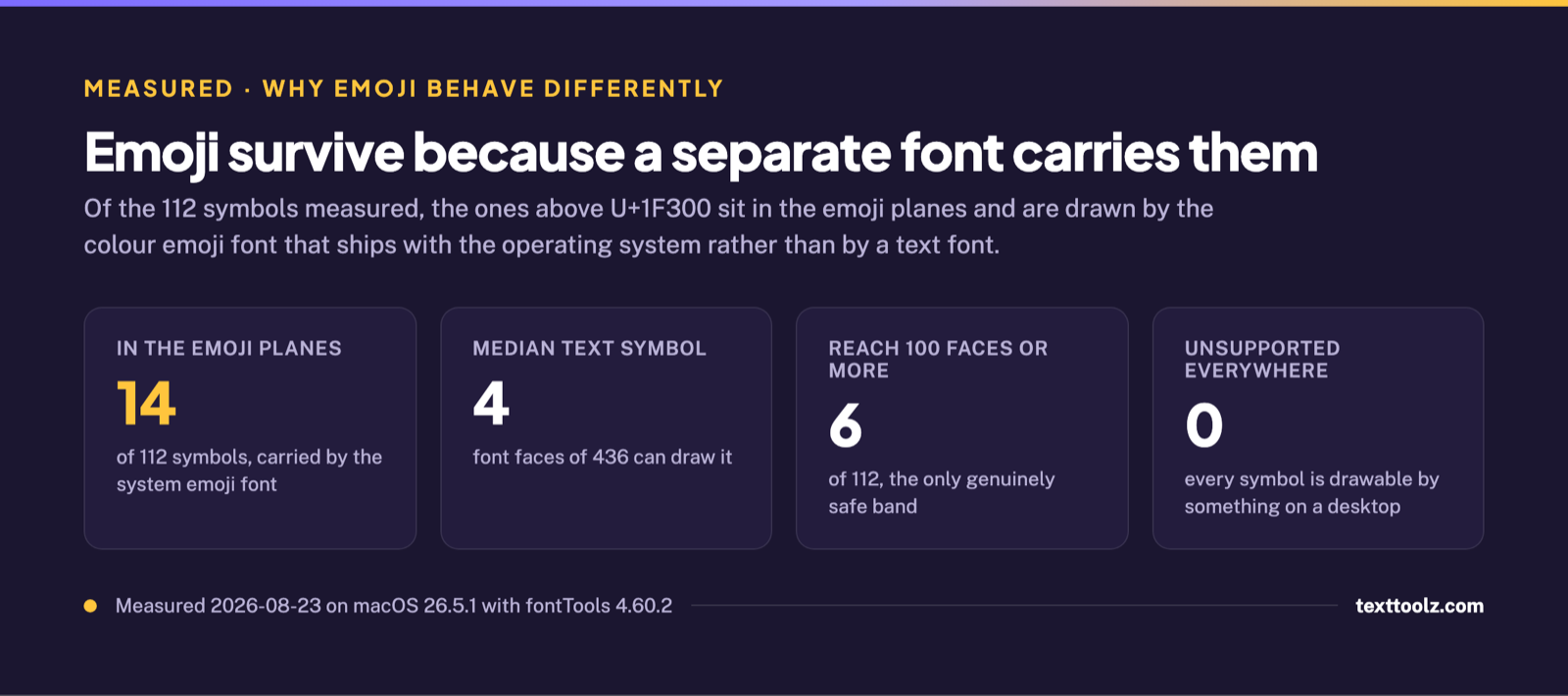
Of the 112 distinct non-ASCII symbols published on this blog’s largest page, 60 are carried by four or fewer of the 436 named font faces installed on this machine, and the median symbol is carried by four. The page measured is aesthetic symbols copy and paste, which earned 572 clicks from 61,167 impressions in the sixteen months to 30 July 2026. The instrument is fontTools 4.60.2 reading the character map table of every font file under the three system font directories on macOS 26.5.1, counting glyph presence with no rendering involved, and deduplicating the faces packed inside font collections by family name.
typeanysymbol.com, the only purpose-built article in this ranking set, carries a section on how to check whether a font contains a symbol. It describes the procedure. Neither it nor any other page in the set, nor either AI Overview capture, reports the result of running it. The table below is that result.
| Faces containing the symbol | Symbols | Share of the 112 |
|---|---|---|
| none | 0 | 0% |
| 1 to 4 | 60 | 53.6% |
| 5 to 19 | 27 | 24.1% |
| 20 to 99 | 19 | 17.0% |
| 100 or more | 6 | 5.4% |
Two readings matter. Nothing scores zero, which is why boxes are intermittent rather than universal: on a fully loaded desktop every one of these symbols is drawable by something, and the system finds it by falling back across faces. And only six of the 112 reach a hundred faces, which is the band where a symbol is genuinely safe on an unknown device. Everything between those two facts is the risk the reader is carrying without knowing it.
One correction belongs on this measurement. The first run of the script counted every face inside every font collection separately and reported 784 faces, while a sibling measurement of the same machine on the same day reported 436. Two denominators for one machine is an instrument fault, not a finding, so the script was changed to key faces by family name and every percentage above comes from the corrected run. The uncorrected run understated the shares.
What are the least supported symbols, really?
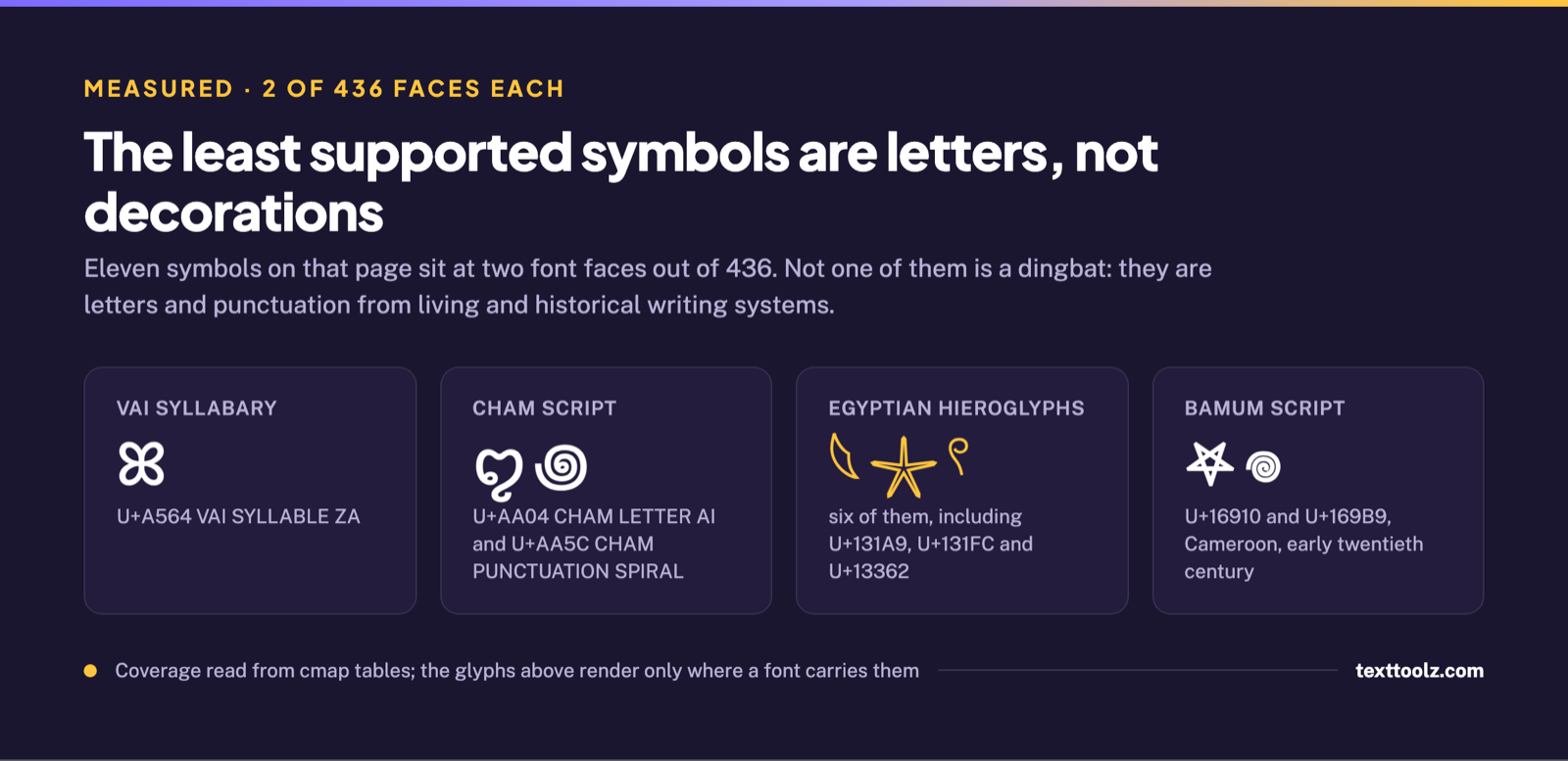
Eleven symbols on that page sit at two faces out of 436, and not one of them is a dingbat. They are letters and punctuation from real writing systems: U+A564 VAI SYLLABLE ZA, from the Vai syllabary used in Liberia; U+AA04 CHAM LETTER AI and U+AA5C CHAM PUNCTUATION SPIRAL, from the Cham script of Vietnam and Cambodia; six Egyptian hieroglyphs, U+131A9, U+131AA, U+131FC, U+13362, U+1336F and U+133F2; and two Bamum letters, U+16910 and U+169B9, from the Cameroonian script devised in the early twentieth century.
The aesthetic symbol sets circulating as decoration are letters borrowed from living and historical writing systems, which explains both halves of their behaviour. They look unusual because they are not decorations at all, and almost no font carries them because a general-purpose text font has no reason to ship the Bamum or Cham blocks. The next band up, at three faces, is more familiar: U+2728 SPARKLES sits there alongside the Mathematical Bold Script letters. If the hieroglyphs are the interesting case, the writing system behind them is covered in how to write your name in Egyptian hieroglyphics.
Why do emoji usually survive when the symbols beside them do not?
Because emoji are carried by a separate colour font that ships on every modern phone rather than by the text fonts. Of the 112 symbols measured, 14 sit above U+1F300 in the emoji planes, and those are the ones most likely to arrive intact on a device where the decorative letters beside them show as boxes.
The qualifier keeps it honest. A recently added emoji is exactly as unsupported as a Bamum letter on a device that has not been updated, because both depend on a font the device has never received. That is what the People Also Ask question about emoji showing as boxes is usually about, and the fix for it is the update in the section above.
Which symbols are safe to paste for other people?
Why do some symbols show as boxes for one reader and not another? Coverage decides whether your decoration reaches a reader, and appearance tells you nothing about coverage. The safe end of the measured range is the six symbols in a hundred or more faces; the risky end is the median symbol in four. A name built from widely carried symbols reads more or less everywhere, and a name built from Cham and Bamum letters reads on your screen and on very few others, with no way to know in advance which the reader has.
That gives a rule rather than a guarantee. Prefer symbols that have been in Unicode a long time and belong to blocks a general text font has a reason to carry, keep the exotic ones for places where only you will read them, and treat any symbol picker as a set of candidates rather than a set of safe choices. The library itself is at aesthetic symbols copy and paste, and the name to symbols converter performs the substitution for a name, which is the query 197 clicks and 8,716 impressions arrive on.
Where does each of these questions get answered?
Each page below answers one question in this section and carries its own measurement, so the list routes by question rather than by title.
- Which decorative symbols exist, the library this page measured, and the blog’s largest page by clicks.
- How to write a name in symbols, which performs the substitution rather than describing it.
- What the hieroglyphs are, the writing system behind six of the eleven least supported symbols above.
- Why Wingdings does not survive a copy, which is a font substitution rather than a character substitution and therefore a different failure entirely.
- How Webdings and Wingdings differ, for the same reason.
- What ASCII covers, which is the 128 characters that never show as boxes anywhere.
Questions people ask about this
These are the six questions Google served in its People Also Ask box across two captures of this query on 23 August 2026. Each answer points back to the section above that carries the measurement.
Why am I seeing boxes instead of text?
Because the font your device is using has no glyph for those characters, so the text engine draws a placeholder rectangle. The characters themselves are intact and will appear correctly on any device with a font that covers them. If the boxes are on your own screen, updating the system, adding the relevant language pack or switching to a wide font family will fix it.
What is this box symbol, and what does it mean?
It is not a symbol at all, it is the absence of one. Most systems draw an empty rectangle when a font is asked for a character it does not contain, and the field nicknamed the result tofu. Some systems draw the rectangle with the character’s Unicode codepoint in hexadecimal inside it, which tells you exactly which character is missing.
What does the box symbol mean in text?
In a message or a document, a box means the sender used a character your font cannot draw, most often a symbol from a script your device has no font for. It is not censorship, corruption or an error in the message. The same text opened on a device with wider font coverage shows the intended character.
Why do some of my emojis show up as boxes?
Because that emoji was added to Unicode after your device last received a font update. Emoji are carried by a colour font that ships with the operating system, and a device that has not been updated simply does not have the newer entries in it. Updating the operating system is the fix, and it is the same fix as for any other missing character.
Why do my fancy fonts turn into boxes on other phones?
Because the characters a font generator produces are drawn from Unicode blocks that most fonts do not carry, and your reader’s device has to have a font containing them. Of the 112 symbols measured on this site’s own symbol page, 60 are carried by four or fewer of 436 installed faces on a desktop, and a phone carries far fewer faces than that. Nothing you can do on your side installs a font on theirs.
How do I find out what a box actually is?
If the box contains hexadecimal digits, those digits are the codepoint and looking them up names the character. If it is empty, paste the text into a tool that lists codepoints, then look up the codepoints it reports. Knowing the codepoint tells you which script the character belongs to, and therefore which font or language pack would draw it.