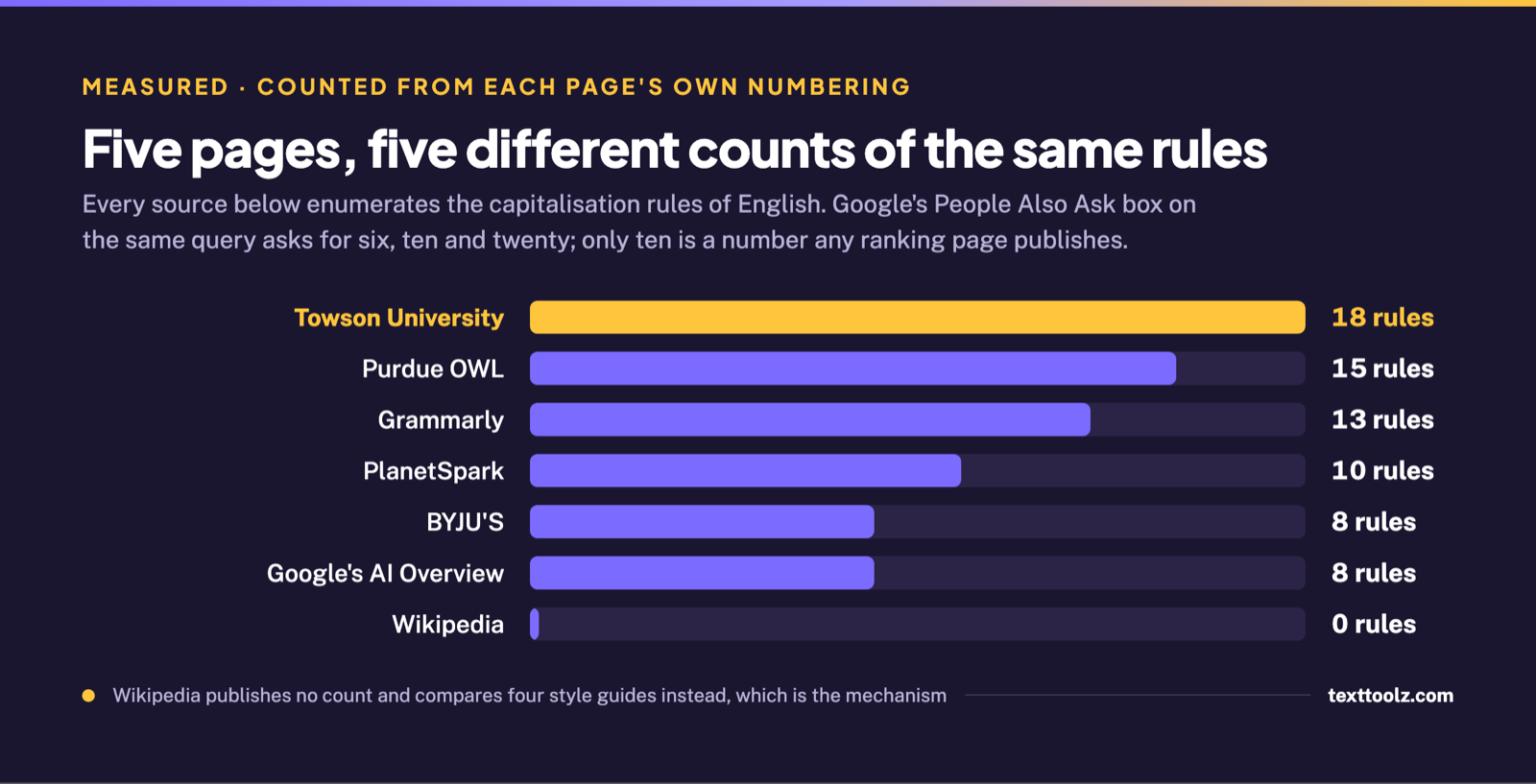
Nobody agrees how many capitalisation rules English has, and the pages ranking for the question publish five different counts: 8, 10, 13, 15 and 18. Google’s AI Overview gives eight. Google’s own People Also Ask box on the same query asks three times for a number, and asks for six, ten and twenty, of which only ten appears on any ranking page. The disagreement is not about English. Five rules appear on every list, and everything past those five is a decision about how finely to cut the remainder: one page gives the names of the planets their own numbered rule, another folds them into proper nouns. The same argument, in a sharper form, decides how a title is capitalised, where 9 of 12 real titles come out differently under MLA, Chicago and AP.
Which capitalisation rules does everyone agree on?
Five rules appear on every page in this ranking set that publishes a list, and on Google’s AI Overview as well. They are the ones worth holding as rules rather than looking up.
- The first word of a sentence. Eight of eight sources, with no exception recorded anywhere in the set.
- The pronoun I. Seven of eight, and the only single letter in English that is capitalised as a word.
- Proper nouns and names. Eight of eight: people, places, organisations and brands.
- Days, months and holidays. Seven of eight, with one exception attached, covered below.
- Languages, nationalities and countries. Six of eight, and the rule most often forgotten in the middle of a sentence.
Everything past those five is where the counts diverge, and the divergence begins with the rules that carry exceptions.
Which rules come with an exception attached?
Four of the common rules carry an exception, and the exceptions are where readers actually get caught. Seasons are lowercase in prose and capitalised in a title, which Purdue OWL and Towson University both state explicitly. A family title is capitalised when it stands in for a name and lowercase after a possessive: Ask Mom, but my mom. A job title is capitalised before a name and not after it, and Towson attaches two separate exception lines to that rule, one for titles following a name and one for titles used as general words.
The fourth is different in kind. Whether the first word after a colon is capitalised depends on the style guide, and it is the first place in this subject where the guides openly contradict each other rather than merely slice the rules differently. Grammarly gives it its own section; Towson gives it its own numbered rule; the eight-rule pages do not mention it at all.
Why do the counts run from eight to eighteen?
How many capitalisation rules are there depends on who is counting, and the counts diverge because the pages disagree about what counts as one rule, not about what to capitalise. Counted directly from each page’s own enumeration rather than by interpretation:
| Source | Rules published | How they are marked |
|---|---|---|
| Towson University Online Writing Support | 18 | numbered 1 to 18 |
| Purdue OWL | 15 | bulleted, plus 2 marked exceptions |
| Grammarly | 13 | its heading reads “13 capitalized words and examples” |
| PlanetSpark | 10 | numbered 1 to 10 |
| BYJU’S | 8 | numbered Rule 1 to Rule 8 |
| Google’s AI Overview | 8 | five core rules plus three for titles and quotes |
| Wikipedia | none | compares four style guides instead |
| EF | none | cases with examples, not numbered rules |
The evidence for the granularity reading is specific. Towson promotes to its own numbered rule the first word after a colon, the first word of each line of most poetry, salutations and closings in letters, initialisms and acronyms, and the names of the planets, which is a sub-case of proper nouns given rule status. BYJU’S folds every one of those into its eight. Neither page is wrong and neither is describing a different language.
That answers all three of the counts Google’s People Also Ask box asks for, in one go. There is no canonical ten and no canonical six, and no page in this ranking set publishes six or twenty at all. If a number is needed, five is the count of rules everyone agrees on and eighteen is the finest cut anyone in this set has published.
Why does the same title come out three different ways?
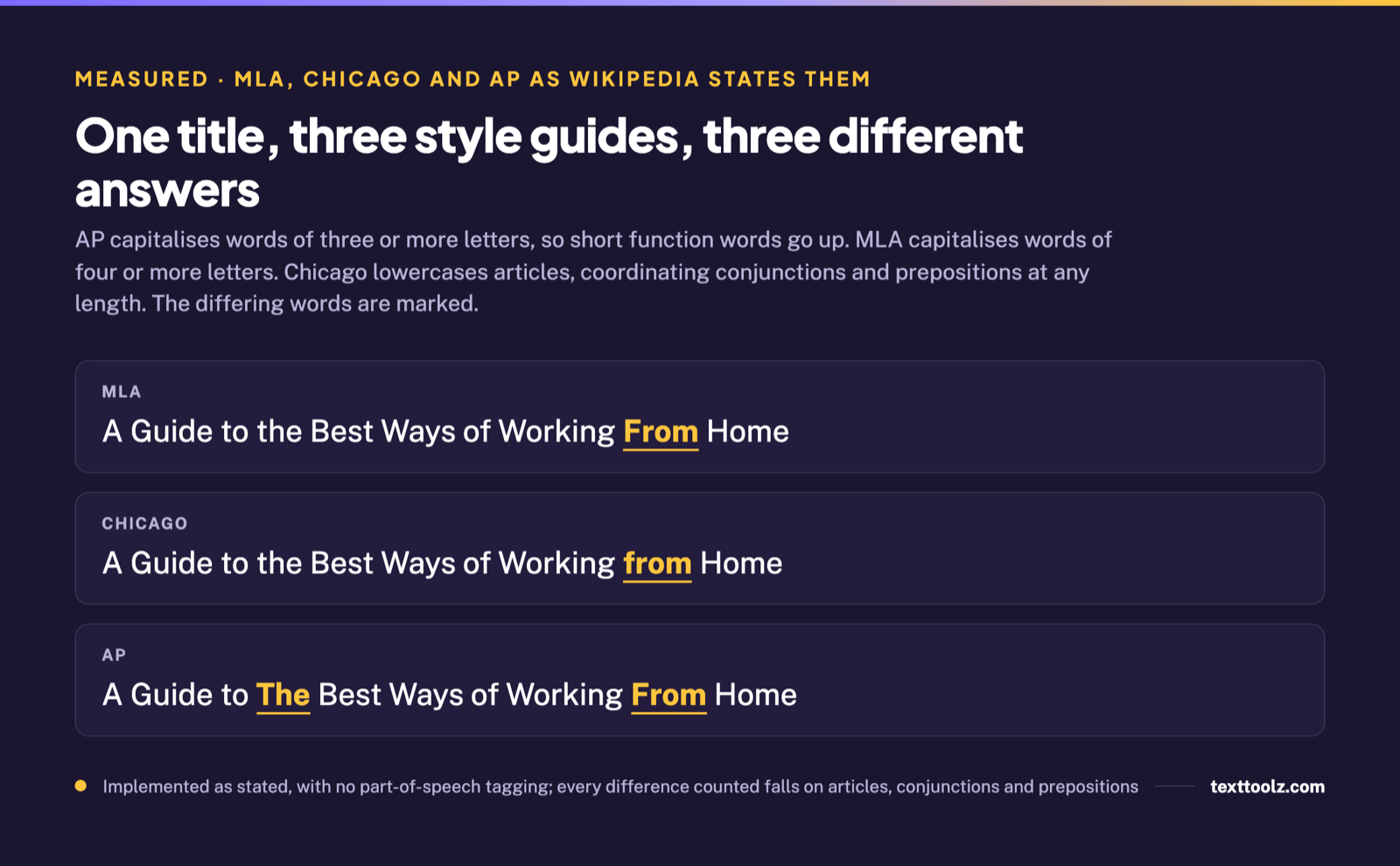
Because the style guides use different tests, and two of the three use word length. Wikipedia is the one page in this ranking set that publishes the rules instead of a list, and it states them precisely: MLA capitalises words of four letters or longer, plus nouns, verbs, adjectives, adverbs and pronouns; AP capitalises words of three or more letters; and Chicago lowercases articles, coordinating conjunctions and prepositions regardless of length.
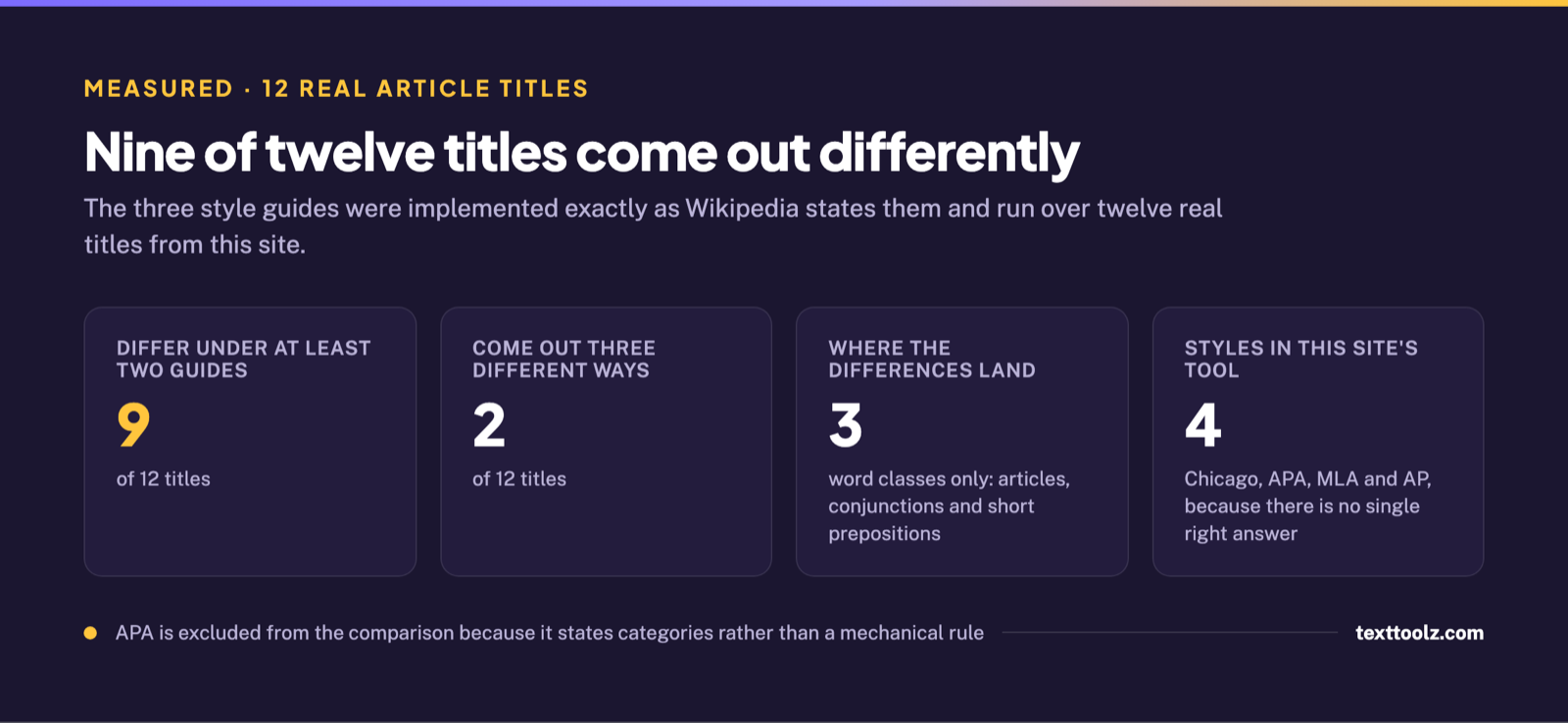
Those three rules were implemented exactly as Wikipedia states them and run over twelve real article titles from this site. 9 of the 12 come out differently under at least two of the three guides, and 2 of the 12 come out three different ways. Three worked examples:
| Title | MLA | Chicago | AP |
|---|---|---|---|
| why wingdings does not survive copy and paste | Copy and Paste | Copy and Paste | Copy And Paste |
| a guide to the best ways of working from home | Working From Home | Working from Home | The Best Ways of Working From Home |
| how to change the font in your instagram bio without an app | Bio Without an App | Bio without an App | Change The Font … Without an App |
One disclosure belongs with the measurement rather than under it. The implementation applies the length and word-class rules as Wikipedia states them and performs no part-of-speech tagging, so a word that is a preposition in one title and an adverb in another is treated identically, and acronyms are not special-cased. Every disagreement counted above falls on articles, conjunctions and prepositions, whose word class is not in doubt, so the finding survives that limit. Any row that would have depended on a part-of-speech judgement was not counted as a disagreement.
Which words do the guides actually fight over?
Articles, coordinating conjunctions and short prepositions, and nothing else. Every other word in a title is capitalised by all three guides, which is why the arguments about title case always sound larger than they are.
The two mechanisms produce opposite errors. AP capitalises the, and and for in the middle of a title because each is three letters long, which is why AP headlines look over-capitalised to anyone trained on Chicago. MLA capitalises from, with and over because each is four letters long, while Chicago lowercases all three because they are prepositions whatever their length. So the words a writer is least confident about are precisely the words the guides disagree on, and looking one up returns contradictory answers because the answers genuinely contradict.
Why is APA missing from that comparison?
Because implementing it would have meant inventing a rule it does not state. Wikipedia describes APA as a “down” style, meaning words stay lowercase unless a listed category applies, and it lists categories rather than a mechanical test: words beginning a sentence, proper nouns and trade names, job titles and positions, diseases and therapies and theories, titles of works and headings within works, titles of tests and measures, nouns followed by numerals or letters, names of conditions or groups in an experiment, and names of study factors.
A category list cannot be run over a title without judgement calls about which category each word falls into, and coding those judgements would produce a measurement of the coder rather than of APA. It was left out for that reason rather than approximated, and this section exists so the gap is explained instead of unexplained.
Which one should you actually use?
Pick the guide your field or publication already uses, and if none applies, pick one and stay with it. Consistency across a document is worth more than the difference between two defensible guides, because a reader notices a heading that does not match the heading above it and never notices which style guide either of them follows.
The defaults are stable enough to state. APA and MLA are the academic ones, APA in psychology and the social sciences, MLA in the humanities. Chicago is the book and long-form publishing default. AP is the journalism default, and it is the one that will capitalise short words other guides leave alone. For a document that is already inconsistent, fix the rule first and reformat every heading in one pass rather than correcting them as you find them, because the second approach leaves a document that is half one guide and half another.
The title capitalizer here implements four styles, Chicago as its default plus APA, MLA and AP. That is not a feature list. It has four buttons because the question has four answers, and a tool with one button would have to pretend otherwise.
How do you apply it consistently across a document?
Fix the rule once, apply it mechanically, and then check only the function words, since those are the only words the guides disagree on. In practice that means three passes: choose the guide, run every heading through the same conversion, and read the results looking only at articles, conjunctions and prepositions, which is a much smaller job than reading for capitalisation in general.
Two adjacent conversions come up at the same moment. Changing case wholesale, which the lowercase to uppercase converter and its reverse do, is a different operation from title casing and should not be confused with it: uppercasing a heading destroys the information a title case rule needs. And counting what you have, which the word counter does, matters because both MLA and AP make their decisions on word length.
Where does each of these questions get answered?
Each page below answers one question in this section and carries its own finding, so the list routes by question rather than by title.
- When to use title case and when to use sentence case, the choice that comes before any of the guides above.
- How to write numbers in words, where the same digits have two correct answers under international and Indian grouping, and where zero of the seven ranking pages mentions that billion has two readings.
- The number to words converter, which performs that conversion in both grouping systems.
- The title capitalizer, with the four styles measured above.
Questions people ask about this
These are the four questions Google served in its People Also Ask box for this query, identically on both captures taken on 23 August 2026. Three of the four ask for a count, and the three counts are different, which is the clearest evidence available that the count is not settled.
What are the basic capitalisation rules?
Five rules appear on every list in this ranking set: the first word of a sentence, the pronoun I, proper nouns and names, days and months and holidays, and languages and nationalities. Those five carry almost every capital letter in ordinary writing. Everything beyond them is either a sub-case of proper nouns or a rule about titles, quotes and formatting, and that is where the published lists start to differ from each other.
What are the 10 rules of capitalisation?
PlanetSpark publishes exactly ten, and it is the only page in this ranking set that does. Its ten are the five above plus titles before names, the first word of a quote, major words in titles, historical periods and events, and brand names and trademarks. Ten is a defensible cut of the material rather than a canonical set, and four other pages in the same results cut it into 8, 13, 15 and 18.
What are the six rules of capitalisation?
No page ranking for this query publishes six, and neither does Google’s own AI Overview, which gives eight. The nearest honest answer is the five rules every source agrees on, plus titles of works as a sixth. Any list of exactly six is one writer’s decision about where to stop, and the evidence on this search results page is that those decisions range from eight to eighteen.
What are the 20 rules of capitalisation?
No page in this ranking set publishes twenty either. The longest list found is Towson University’s eighteen, which reaches that length by giving separate numbered rules to the first word after a colon, each line of poetry, letter salutations, initialisms and the names of the planets. A twenty-rule list would be the same material cut two steps finer, and it would not add a rule anyone is currently breaking.