About the City Name Generator
A city name is a description that stopped being read as a description. Oxford still means the ford where oxen crossed; nobody hears it that way any more. This generator builds names from the parts real place names are built from, across 8 formation mechanisms, 4 language layers and 5 settlement sizes, and it shows the working: every name it produces is broken into its parts and glossed. It makes names for invented places, and it does not list real ones.
What is a city name actually made of?
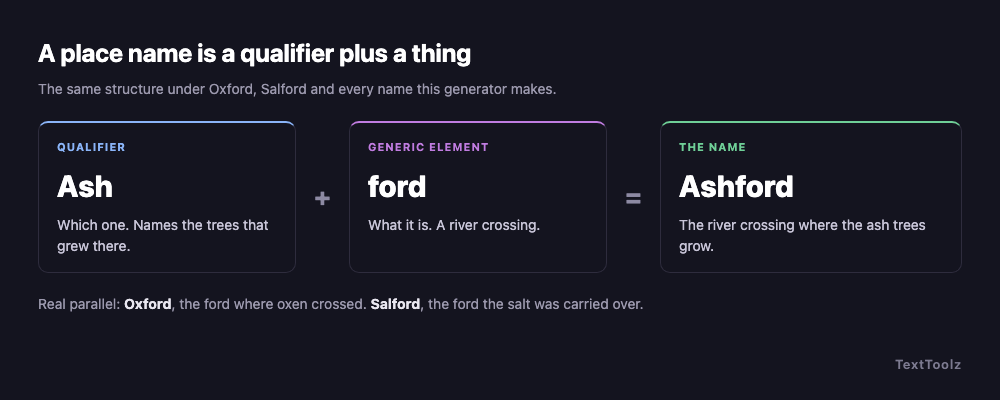
A city name is made of a generic element and a qualifier. The generic element is an ordinary noun for what the place is, and the qualifier says which one of those it is. That is nearly the whole system.
| Name | Qualifier | Generic element | Meaning |
|---|---|---|---|
| Oxford | oxen | ford, a river crossing | the ford where oxen crossed |
| Salford | salt | ford, a river crossing | the ford the salt was carried over |
| Interlaken | inter, between | laken, the lakes | the place between the lakes |
| Copenhagen | merchants | havn, a harbour | the merchants’ harbour |
Once you can see the seam, you can see it everywhere. Nottingham is a homestead, Derby is a village, Manchester is a Roman fort, Plymouth is a river mouth, Cambridge is a bridge. The element carries the meaning and the qualifier carries the specificity, and a generator that produces one undifferentiated pile of atmospheric syllables has skipped both.
Why do real city names sound so mundane?
Because they were descriptions before they were names, and descriptions are practical. This is the single most useful thing to know when you are naming an invented place, and it is the opposite of what most people do.
A worldbuilder on r/worldbuilding ran the experiment properly: they translated the names of the largest cities in the United States back into plain English. Los Angeles is The Angels. Chicago is the place where the wild onions smell, from a Native American word for the leeks that grew there. New York is a new version of an English city whose own name had already worn down past recognition. Their conclusion was that almost every invented fantasy world already has more realistic city names than its author thinks, because the bar is much lower than it looks.
It gets better. Some real names are simply tautologies, because one language borrowed a word it did not understand and then added its own: the Sahara Desert is the desert desert, and the River Avon is the river river. Others are accidents of timing: Rio de Janeiro is the January river, named for the month the Portuguese arrived. Belo Horizonte is beautiful horizon. Minas Gerais is general mines.
So if your invented city names sound fake, the problem is usually not that they are too plain. It is that they are too impressive. Real settlements are named by people who needed to tell one ford from another, not by people trying to evoke something. Name the trees, name the trade, name the person who built the mill, and the name will sound older than anything you could have invented.
What mechanisms are real place names built by?
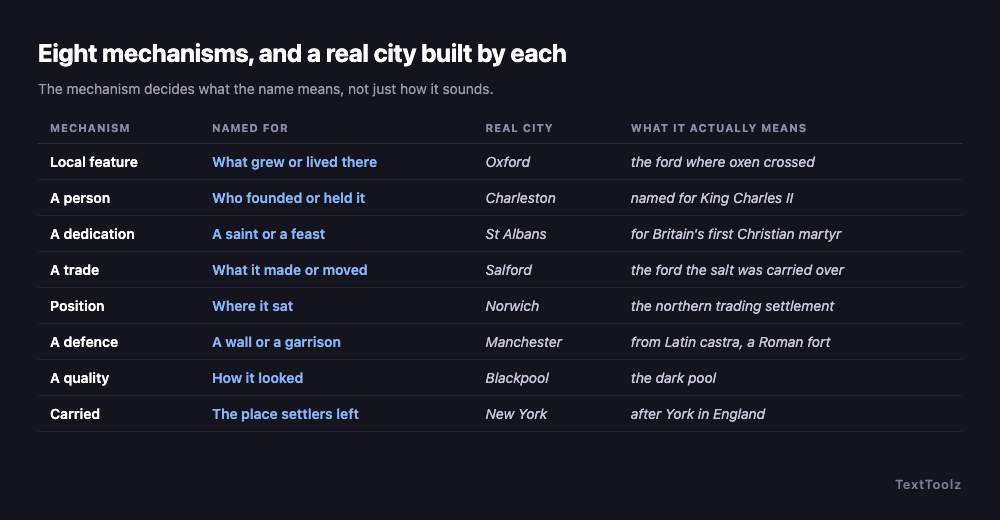
A small number of mechanisms produce most place names, and each one leaves a different fingerprint. The Mechanism control picks between them, which is why it sits first: it decides not just how the name sounds but what it means.
| Mechanism | Named for | Qualifiers | Real example | What it means |
|---|---|---|---|---|
| Local feature | What grew or lived there | ash, oak, thorn, reed, raven, otter | Oxford | the ford where oxen crossed |
| A person | Who founded or held it | Godwin, Hilda, Beorn, Halfdan | Charleston | named for King Charles II |
| A dedication | A saint, a feast or the church | St Alban, St Chad, All Hallows | St Albans | for Britain’s first Christian martyr |
| A trade or resource | What the place made or moved | salt, iron, wool, slate, coal | Salford | the ford the salt was carried over |
| Position | Where it sat relative to somewhere else | north, south, upper, nether, far | Norwich | the northern trading settlement |
| A defence | A wall, a gate or a garrison | ward, watch, shield, keep | Manchester | from Latin castra, a Roman fort |
| A described quality | How it looked | black, white, grey, cold, broad | Blackpool | the dark pool |
| Carried from elsewhere | The place the settlers left | New | New York | after York in England |
Mixing mechanisms is what makes a map read as a real region rather than a themed list. A country whose towns are all named after trees is a country nobody lived in. Put a founder’s name next to a trade next to a direction next to a saint, and the map starts to look like somewhere with a history.
What does the settlement size change?
It changes which generic elements are plausible at all. This is a real constraint and it is the reason a lot of invented names feel wrong without the reader being able to say why.
An Old Norse thorpe is an outlying farm. A toft is a single homestead plot. Neither ever grows into a capital, and a kingdom whose seat of power is called Something-thorpe reads as a joke to anyone who knows the element. At the other end, chester and caster descend from Latin castra and carry a Roman fort with them, so a hamlet of nine people called Ashchester is claiming a garrison it does not have.
The Settlement control filters the element list to what that size can carry. Set it to Hamlet and you get becks, tofts, garths and fells. Set it to Capital and you get bridges, forts, harbours and gates.
What does the language layer change in a city name?
It changes the element set, and keeping to one set is what makes a region cohere. Real maps show this plainly: English place names in the Danelaw are full of Norse elements because Norse speakers settled there, and the boundary is still visible in the names a thousand years later.
| Layer | Typical elements | Reads as |
|---|---|---|
| Old English | ton, ham, ford, bury, don, leigh, wich | Settled farmland with a long history |
| Old Norse | by, thorpe, toft, ness, dale, beck, fell | Blunter, colder, coastal or upland |
| Latinate | chester, caster, port, ville, pont, colne | Forts, roads and church foundations |
| Invented | hollow, reach, watch, gate, hold, mere | Secondary world, same structure, no real-world claim |
The invented set is deliberately built on the same shapes rather than on mood words. A hold behaves like a bury and a mere behaves like a well, so the names decline and combine the way real ones do, which is most of what makes a fictional map feel inhabited.
Why do old cities have worn-down names?
Because every generation that said the name filed a little off it, and because the language doing the saying kept changing. The clearest example in English is York: the Romans called it Eboracum, the Anglo-Saxons made that Eoforwic, and the Norse and then the Normans wore it down to York. Three languages, one place, and the modern name is a single syllable that means nothing to the people who use it.
That is worth stealing. If a city in your world is meant to be ancient, its name should look eroded rather than freshly minted: shorter than it should be, slightly irregular, and not quite parsing. A newly founded town can carry a name you can still read. The oldest city on the map should have a name whose meaning the characters have forgotten.
Does your city name pass the demonym test?
A demonym is what you call someone from the place, and it is the fastest test of whether a name is finished. Oxford gives Oxonian. Manchester gives Mancunian. Liverpool gives Liverpudlian, which nobody could have predicted and everybody uses.
Try it on your invented name. If a resident of Ashford is an Ashfordian, the name works. If you cannot say what a resident of your name is called without stopping to think, your readers will not manage it either, and the word will never appear in dialogue. Names that resist a demonym tend to be the ones built from two heavy stressed syllables with nothing to hang a suffix on.
60 city names with their meanings
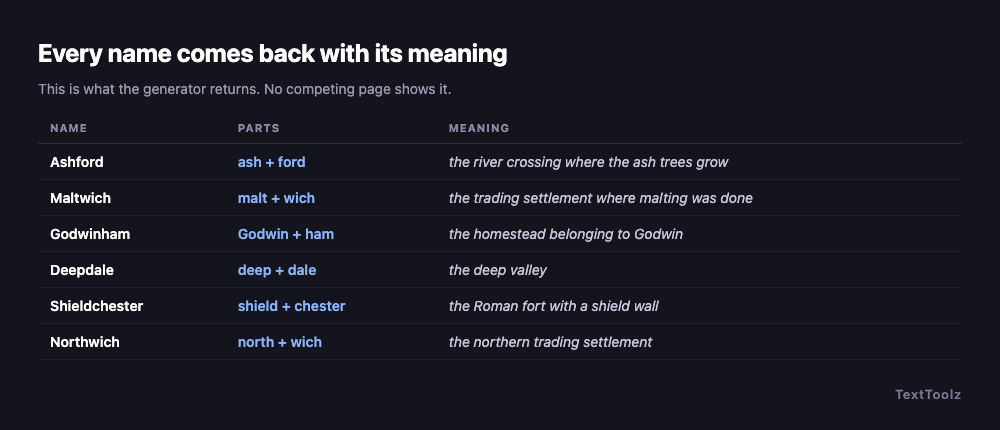
Sixty names from this generator, grouped by mechanism, with each one taken apart. Every competing page on this subject offers a longer list. None of them tells you what a single name means, which is the only thing that separates a place name from a pile of syllables.
| Name | Parts | Meaning | Mechanism | Layer |
|---|---|---|---|---|
| Ashford | ash + ford | the river crossing where the ash trees grow | Local feature | Old English |
| Ravenston | raven + ton | the farmstead where the ravens nest | Local feature | Old English |
| Elmwich | elm + wich | the trading settlement where the elms grow | Local feature | Old English |
| Thornleigh | thorn + leigh | the woodland clearing where the thorn scrub grows | Local feature | Old English |
| Alderdon | alder + don | the hill where the alders grow | Local feature | Old English |
| Heronmouth | heron + mouth | the river mouth where the herons fish | Local feature | Old English |
| Reedbeck | reed + beck | the stream where the reeds grow | Local feature | Old Norse |
| Otterholm | otter + holm | the water meadow where the otters are found | Local feature | Old Norse |
| Birchgarth | birch + garth | the enclosed yard where the birches grow | Local feature | Old Norse |
| Stonefell | stone + fell | the high bare hill where the stone lies | Local feature | Old Norse |
| Willowmere | willow + mere | the lake where the willows grow | Local feature | Invented |
| Bramblehollow | bramble + hollow | the sheltered low ground where the brambles grow | Local feature | Invented |
| Godwinham | Godwin + ham | the homestead belonging to Godwin | A person | Old English |
| Hildaford | Hilda + ford | the river crossing belonging to Hilda | A person | Old English |
| Osricworth | Osric + worth | the enclosed homestead belonging to Osric | A person | Old English |
| Edricstead | Edric + stead | the settlement site belonging to Edric | A person | Old English |
| Beornby | Beorn + by | the village belonging to Beorn | A person | Old Norse |
| Halfdandale | Halfdan + dale | the valley belonging to Halfdan | A person | Old Norse |
| Ingridness | Ingrid + ness | the headland belonging to Ingrid | A person | Old Norse |
| Wulfricreach | Wulfric + reach | the stretch of river belonging to Wulfric | A person | Invented |
| Saint Albans | St Alban | the place dedicated to St Alban | A dedication | Latinate |
| Saint Chads | St Chad | the place dedicated to St Chad | A dedication | Latinate |
| Saint Werburghs | St Werburgh | the place dedicated to St Werburgh | A dedication | Latinate |
| Saint Botolphs | St Botolph | the place dedicated to St Botolph | A dedication | Latinate |
| All Hallows | all the saints | the place dedicated to all the saints | A dedication | Latinate |
| Holy Rood | the holy cross | the place dedicated to the holy cross | A dedication | Latinate |
| Saltbridge | salt + bridge | the bridge where salt was worked or carried | A trade | Old English |
| Ironborough | iron + borough | the fortified town where ironworking was done | A trade | Old English |
| Woolfield | wool + field | the open land where wool was worked | A trade | Old English |
| Maltwich | malt + wich | the trading settlement where malting was done | A trade | Old English |
| Slatedale | slate + dale | the valley where slate was worked | A trade | Old Norse |
| Tanbeck | tan + beck | the stream where tanning was done | A trade | Old Norse |
| Chalkport | chalk + port | the harbour where chalk was shipped | A trade | Latinate |
| Cornmarch | corn + march | the border country where grain was grown | A trade | Invented |
| Northwich | north + wich | the northern trading settlement | Position | Old English |
| Southton | south + ton | the southern farmstead | Position | Old English |
| Upperleigh | upper + leigh | the upper woodland clearing | Position | Old English |
| Netherford | nether + ford | the lower river crossing | Position | Old English |
| Eastthorpe | east + thorpe | the eastern outlying farm | Position | Old Norse |
| Farwick | far + wick | the far bay | Position | Old Norse |
| Middlemont | middle + mont | the middle mountain | Position | Latinate |
| Westcrest | west + crest | the western ridge top | Position | Invented |
| Wardbury | ward + bury | the fortified place with a guarded gate | A defence | Old English |
| Shieldchester | shield + chester | the Roman fort with a shield wall | A defence | Old English |
| Watchdon | watch + don | the hill with a lookout | A defence | Old English |
| Keepcaster | keep + caster | the Roman fort with a keep | A defence | Latinate |
| Wallcolne | wall + colne | the settled colony with a wall | A defence | Latinate |
| Barhold | bar + hold | the stronghold with a barrier | A defence | Invented |
| Blackwell | black + well | the dark spring | A quality | Old English |
| Whitebridge | white + bridge | the pale bridge | A quality | Old English |
| Greyton | grey + ton | the grey farmstead | A quality | Old English |
| Broadmouth | broad + mouth | the broad river mouth | A quality | Old English |
| Coldbeck | cold + beck | the cold stream | A quality | Old Norse |
| Deepdale | deep + dale | the deep valley | A quality | Old Norse |
| Greenville | green + ville | the green town | A quality | Latinate |
| Fairspire | fair + spire | the fair peak | A quality | Invented |
| New Ashford | new + Ashford | a new settlement named after Ashford | Carried | Old English |
| New Thornby | new + Thornby | a new settlement named after Thornby | Carried | Old Norse |
| New Stonegate | new + Stonegate | a new settlement named after Stonegate | Carried | Invented |
| New Oakchester | new + Oakchester | a new settlement named after Oakchester | Carried | Latinate |
City name generators, city name lists and test data
Three different things share this phrase, and searching for one will hand you the other two. It is worth knowing which you actually want.
- A city name generator invents names for fiction: novels, games, tabletop campaigns, maps. That is this page, and it is what almost every ranking result for the phrase is doing.
- A list of city names is geography. If you want real cities, ranked, or sorted by country, you want an encyclopaedia, an atlas or a statistical agency, and you will find those first under the shorter query. A text-tools site has no business publishing a list of real cities and this one does not.
- City names as test data is a developer’s problem: plausible strings to seed a database or fill a staging environment. A seeding library in your own language will serve you better than any web page, because you need the data inside your test run rather than on a screen.
Can you use these city names in a novel or a game?
Yes. A place name assembled from common elements is not the sort of thing anybody owns: the elements are centuries old and in general use, and a short combination of ordinary words is not protected by copyright. Publish the novel, ship the game, print the map.
The one thing worth a moment’s thought is trademark, not copyright. If the generator happens to hand you a name that is already a well-known product or company in the same field you are publishing in, pick another one. That is a rare coincidence and a ten-second search settles it. This is general information rather than legal advice, and anything commercially significant is worth asking a professional about.
Where do these city name elements come from?
The generic elements and their meanings are standard place-name scholarship: Old English tun, ham, ford, burh and dun; Old Norse by, thorp, toft and nes; and the descendants of Latin castra that give English its chester, caster and cester endings. The real cities named in the tables are given as examples of each element in use.
Contested etymologies are left out on purpose, because a page arguing that meanings matter cannot afford to print a meaning that is wrong. The worked example is Buenos Aires. The popular story derives it from good air, and it is repeated constantly. The city was in fact named for a Marian title, Santa María del Buen Ayre, after the Madonna di Bonaria venerated by Sardinian and Spanish sailors. The plausible explanation is the wrong one, which is exactly why the rule here is to gloss only what is documented.
Names are assembled in your browser. No request leaves the page, nothing is logged, and the generator keeps working with the network disconnected.
Other name generators for your map
A settlement usually needs people in it. The D&D Name Generator builds character names from the naming conventions each fantasy race actually uses, and the D&D Warlock Name Generator and D&D Monk Name Generator add the class layer on top. Once the map is named, the text style generators will set those names in the fonts a campaign document or a game UI will accept.