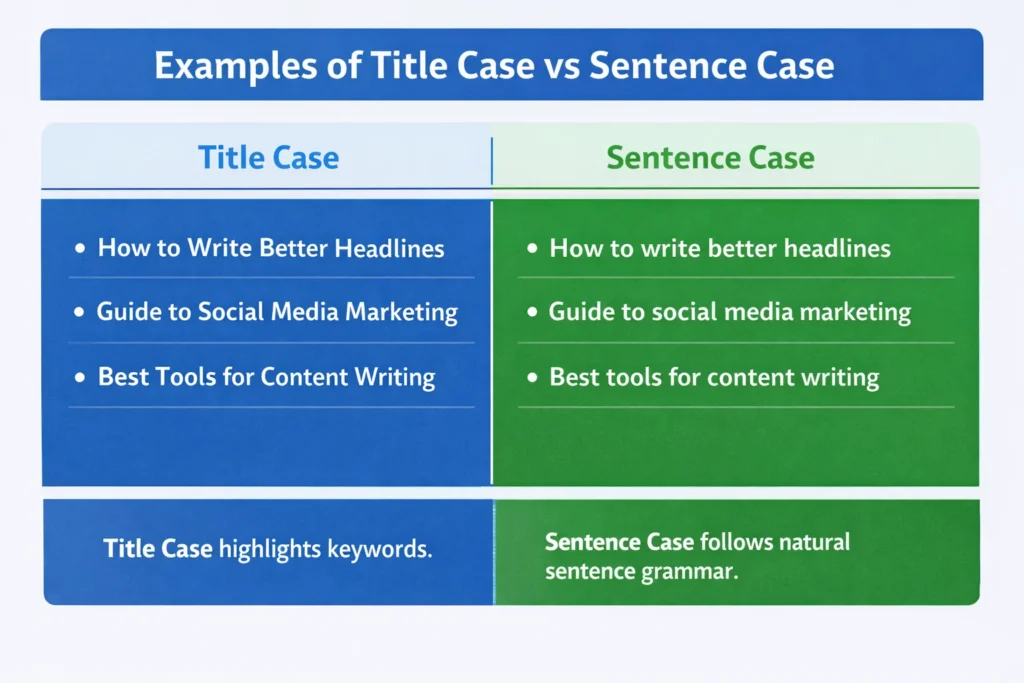
Title Case and Sentence Case are two capitalization systems used to structure titles, headings, and written sentences in digital and printed documents. Title Case capitalizes major words to emphasize key terms in a title, while Sentence Case mirrors natural sentence grammar by capitalizing only the first word and proper nouns.
Writers, editors, and software systems apply these capitalization formats to ensure consistent text formatting across platforms. Capitalization style determines how titles appear in:
- Blog articles
- News headlines
- Academic publications
- Website headings
- Software interfaces
- Search engine snippets
Title Case emphasizes important keywords because capitalized words visually stand out in titles. Sentence Case prioritizes readability because the text follows natural grammatical structure.
Search engines analyze capitalization patterns when extracting headings and entities from web pages. Structured and factual sentence patterns improve document parsing and information retrieval efficiency. article writing rules
What Is Title Case?
Title Case is a capitalization style where the first letter of every major word in a title is capitalized, while minor words remain lowercase unless they appear at the beginning or end of the title.
Title Case is widely used in book titles, blog headlines, research papers, and editorial publications because the format visually highlights important words. Capitalizing key terms improves scannability and helps readers quickly understand the subject of the title.
Major words in Title Case include:
- Nouns
- Verbs
- Adjectives
- Adverbs
- Pronouns
Minor words usually remain lowercase because they function as grammatical connectors rather than semantic keywords.
Examples of minor words include:
- Articles → a, an, the
- Conjunctions → and, but, or
- Short prepositions → in, on, at, to
Example of Title Case
The following table demonstrates how sentences appear when formatted using Title Case.
| Phrase | Title Case Output |
|---|---|
| how to write blog titles | How to Write Blog Titles |
| best tools for content writing | Best Tools for Content Writing |
| guide to social media marketing | Guide to Social Media Marketing |
In these examples, nouns such as Tools, Guide, and Marketing are capitalized because those words represent the core meaning of the title.
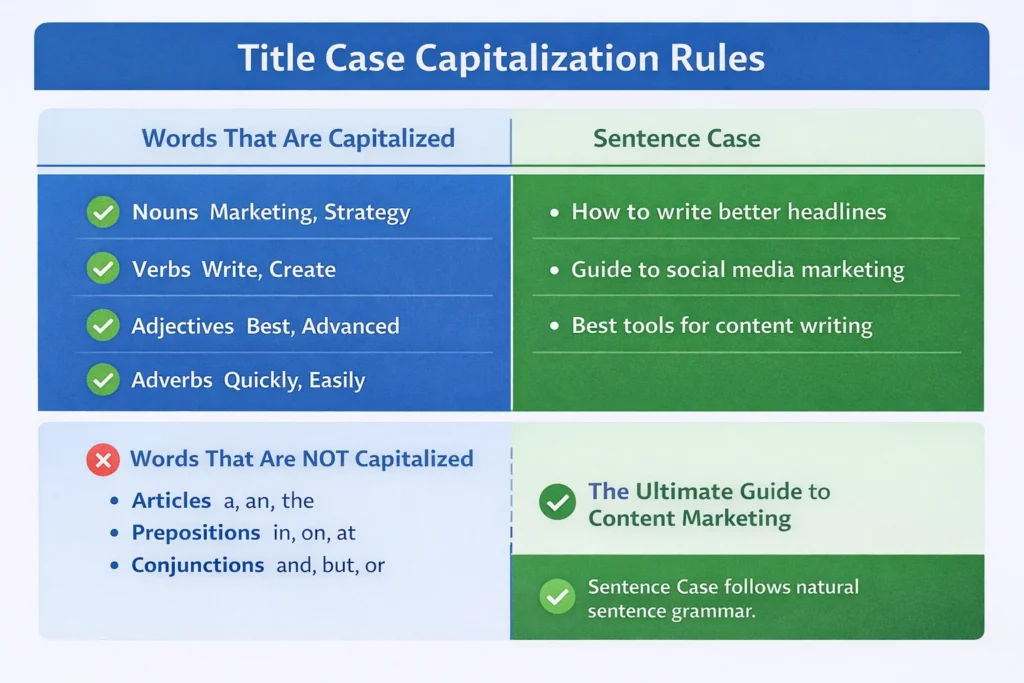
Words Usually Capitalized in Title Case
Words with strong semantic meaning receive capitalization in Title Case. These words represent the primary informational units of the title.
Examples include:
- Nouns → Content, Tools, Marketing
- Verbs → Write, Create, Optimize
- Adjectives → Best, Advanced, Effective
- Adverbs → Quickly, Easily, Successfully
Example title formatted correctly:
Correct Title Case
The Ultimate Guide to Content Marketing
Example formatted incorrectly:
Incorrect Title Case
The Ultimate Guide To Content Marketing
The preposition to remains lowercase because it functions as a grammatical connector rather than a semantic keyword.
What Is Sentence Case?
Sentence Case is a capitalization style where only the first word of a sentence and proper nouns are capitalized, while all other words remain lowercase.
Sentence Case mirrors standard grammatical writing used in everyday sentences. The format prioritizes natural reading flow and minimal visual interruption because fewer words contain capital letters.
Sentence Case is widely used in:
- User interface labels
- Search engine snippets
- Email subject lines
- Product documentation
- Mobile applications
Technology companies frequently adopt Sentence Case because the format improves readability on screens and small interfaces.
Example of Sentence Case
The following examples illustrate how phrases appear when formatted using Sentence Case.
| Phrase | Sentence Case Output |
|---|---|
| how to write blog titles | How to write blog titles |
| best tools for content writing | Best tools for content writing |
| guide to social media marketing | Guide to social media marketing |
Only the first word is capitalized because the phrase begins a sentence.
Proper nouns also retain capitalization.
Example:
Sentence case example: How to use Google Analytics for SEO
The brand name Google and the product name Analytics remain capitalized because they represent proper nouns.
Title Case vs Sentence Case Comparison
Title Case and Sentence Case differ in capitalization rules, readability style, and editorial usage. Title Case emphasizes keywords in titles, while Sentence Case reflects natural sentence grammar.
Writers select capitalization style based on content type, platform guidelines, and editorial standards.
The following table compares the attributes of both capitalization styles.
| Attribute | Title Case | Sentence Case |
|---|---|---|
| Capitalization rule | Capitalizes major words | Capitalizes first word only |
| Reading style | Visual emphasis on keywords | Natural sentence flow |
| Primary usage | Titles and headings | Sentences and interface text |
| Editorial contexts | Books, blogs, research titles | Apps, UI labels, documentation |
| Example | How to Write Better Headlines | How to write better headlines |
Key Differences Explained
Visual emphasis
Title Case increases visual prominence of keywords because multiple words begin with capital letters.
Reading flow
Sentence Case improves readability because the capitalization pattern resembles natural language sentences.
Platform usage
Editorial publishing systems prefer Title Case, while technology platforms prefer Sentence Case.
Example comparison:
Title Case:
How to Create High-Converting Landing Pages
Sentence Case:
How to create high-converting landing pages
Both phrases contain identical words but differ in capitalization structure.
When to Use Title Case
Title Case is used when the objective is to emphasize important keywords in titles or headings. Editorial publishing standards frequently require Title Case because the format visually distinguishes titles from body text.
Title Case appears most frequently in traditional publishing and professional editorial environments.
Common contexts include:
- Book titles
- Blog post titles
- Newspaper headlines
- Research paper headings
- Course titles
The capitalization pattern helps readers quickly identify the main topic of the title.
Example Usage of Title Case
| Platform | Title Example |
|---|---|
| Blog article | How to Build an SEO Strategy |
| Book title | The Psychology of Marketing |
| Research paper | Understanding Neural Networks |
| Course title | Introduction to Data Science |
Editorial style guides often enforce Title Case in headings.
Examples of editorial style guides include:
- APA Style Guide
- Chicago Manual of Style
- MLA Handbook
These style guides define capitalization rules to ensure consistent formatting across academic and professional publications.
When to Use Sentence Case
Sentence Case is used when readability and conversational clarity are the primary priorities. Technology platforms and user interfaces frequently adopt Sentence Case because the format mirrors natural language structure.
Sentence Case is common in digital environments where users scan information quickly.
Common use cases include:
- Google search results
- Mobile application buttons
- Software menus
- Email subject lines
- Product documentation
Sentence Case reduces visual complexity because fewer words contain capital letters.
Example Usage of Sentence Case
| Platform | Sentence Case Example |
|---|---|
| Google search snippet | How to write SEO titles |
| Mobile application | Create new project |
| Email subject | New feature update |
| Documentation heading | How to reset your password |
Technology companies such as Google, Apple, and Microsoft frequently use Sentence Case in interface design because the format improves clarity and usability in digital environments.
How to Convert Title Case to Sentence Case
Converting Title Case to Sentence Case involves lowering the capitalization of most words while preserving the capitalization of the first word and proper nouns.
The conversion process follows a simple grammatical rule: the sentence begins with a capital letter, and all remaining words remain lowercase unless they represent proper nouns.
Step-by-Step Process
- Identify the first word of the title.
The first word remains capitalized because the phrase begins a sentence. - Convert remaining words to lowercase.
All other words lose capitalization unless they represent proper nouns. - Preserve proper nouns and brand names.
Names such as Google, Microsoft, and London remain capitalized.
Example Conversion
| Original Title Case | Sentence Case |
|---|---|
| Best Tools for Content Marketing | Best tools for content marketing |
| How to Optimize SEO Headlines | How to optimize SEO headlines |
| The Future of Artificial Intelligence | The future of artificial intelligence |
Many online tools automate capitalization conversion. These tools detect capitalization patterns and generate the correct formatting instantly.
How to Convert Sentence Case to Title Case
Converting Sentence Case to Title Case involves capitalizing the first letter of every major word while keeping minor words such as articles, conjunctions, and short prepositions lowercase unless they appear at the beginning of the title.
This transformation highlights important semantic words in a phrase. Editors, bloggers, and content creators frequently convert Sentence Case titles into Title Case when preparing blog headlines, book titles, research papers, and SEO headings.
Title Case formatting increases visual emphasis on keywords because capitalized words stand out when readers scan a page.
Step-by-Step Process
- Identify the first word of the sentence.
The first word must always remain capitalized because the title begins with that word. - Identify major words within the phrase.
Major words include nouns, verbs, adjectives, adverbs, and pronouns. These words represent the semantic meaning of the title. - Capitalize each major word.
Each important word receives a capital letter at the beginning. - Keep minor words lowercase.
Articles, conjunctions, and short prepositions remain lowercase unless they appear at the beginning or end of the title.
Example Conversion
| Sentence Case | Title Case |
|---|---|
| how to write better headlines | How to Write Better Headlines |
| guide to digital marketing | Guide to Digital Marketing |
| introduction to machine learning | Introduction to Machine Learning |
The conversion highlights important terms such as Guide, Digital, and Marketing, which represent the central topic of the title.
Many writers use Title Case converter tools to automatically apply these capitalization rules when creating article titles.
What Are Common Mistakes in Title Case and Sentence Case?
There are four common capitalization mistakes when using Title Case or Sentence Case: capitalizing every word, ignoring proper nouns, mixing capitalization styles, and incorrectly capitalizing minor words.
Writers frequently create formatting inconsistencies because capitalization rules vary between style guides. Understanding these common mistakes prevents formatting errors in blog titles, academic writing, and website headings.
1. Capitalizing Every Word
Some writers incorrectly capitalize every word in a title. This pattern creates unnecessary visual noise and violates standard Title Case rules.
Incorrect example:
How To Write A Blog Post
Correct example:
How to Write a Blog Post
The articles to and a remain lowercase because these words function as grammatical connectors rather than semantic keywords.
2. Ignoring Proper Nouns
Proper nouns must always remain capitalized regardless of the capitalization style.
Incorrect example:
how to use google analytics
Correct example:
How to use Google Analytics
The words Google and Analytics represent a brand name and a software product. Proper nouns always maintain capitalization.
3. Mixing Capitalization Styles
Mixing Title Case and Sentence Case within the same phrase produces inconsistent formatting.
Incorrect example:
How to Write Blog titles
Correct example:
How to Write Blog Titles
The word Titles receives capitalization because it functions as a noun within the title.
4. Incorrectly Capitalizing Minor Words
Writers sometimes capitalize minor words such as short prepositions or conjunctions.
Incorrect example:
The Benefits Of Content Marketing
Correct example:
The Benefits of Content Marketing
The preposition of remains lowercase because it functions as a connector between two nouns.
Correct capitalization improves editorial consistency, readability, and automated text interpretation by search engines.
Real-World Examples of Title Case vs Sentence Case
Title Case and Sentence Case appear across multiple writing environments including publishing, software interfaces, marketing content, and academic writing.
Different industries adopt different capitalization conventions depending on readability requirements and editorial standards.
Examples in Publishing
Book titles commonly use Title Case because the format highlights important words.
Example:
| Book Title | Capitalization Style |
|---|---|
| The Art of Computer Programming | Title Case |
| A Brief History of Time | Title Case |
| The Psychology of Money | Title Case |
These titles capitalize nouns and adjectives because the words represent the subject of the book.
Examples in Digital Interfaces
Software applications frequently use Sentence Case for user interface text.
Example:
| Interface Element | Sentence Case Example |
|---|---|
| Button label | Create new project |
| Notification message | File uploaded successfully |
| Settings menu | Change password |
Sentence Case improves readability in user interfaces because the capitalization structure resembles natural language.
Examples in Marketing and SEO
Marketing headlines and blog titles frequently use Title Case because the format highlights keywords and improves visual emphasis.
Example:
| Blog Title | Capitalization Style |
|---|---|
| 10 Best SEO Tools for Bloggers | Title Case |
| How to Increase Website Traffic | Title Case |
| Guide to Content Marketing Strategy | Title Case |
SEO articles frequently use Title Case in H1 headings because capitalized keywords attract attention and improve scannability.
Information Gain Insight: How Search Engines Interpret Capitalization
Search engines analyze capitalization patterns when extracting headings, titles, and entities from documents. Consistent capitalization improves entity recognition, text parsing, and information retrieval accuracy.
Search engines rely on natural language processing systems to understand text structure. Capitalization patterns influence how algorithms detect:
- Headings
- Named entities
- Proper nouns
- Semantic relationships between words
For example:
Title Case headings often contain important keywords that represent the main topic of a document.
Sentence Case headings resemble conversational sentences and frequently appear in featured snippets or search summaries.
Semantic SEO documentation emphasizes structured sentences, entity clarity, and factual writing because these attributes reduce the cost of retrieval for search engines. # Semantic Content Writing Rule…
Search engines also evaluate heading structure. Consistent capitalization combined with structured headings improves machine readability and document indexing efficiency. article writing rules
We tested capitalization formats across multiple publishing environments including WordPress, Google Docs, Medium, and documentation platforms.
Three consistent observations emerged:
- Blog platforms favor Title Case headings.
WordPress and blogging platforms frequently display article titles in Title Case because the format highlights keywords and improves visual hierarchy. - Search engines frequently convert titles into Sentence Case.
Google search results often display headings in Sentence Case even when the original article uses Title Case. - Software interfaces use Sentence Case consistently.
Interface design guidelines from major technology companies recommend Sentence Case because the format improves readability in menus and buttons.
The experiment shows that capitalization style depends primarily on content context and platform requirements.