About the Country Name Generator
A country name is almost always a description with an ending attached. This generator builds nations from 5 origin mechanisms and 6 language families, shows what every name means, and gives each one the two names real countries carry: the formal long form and the endonym its own people would use. It names invented countries, and it does not list real ones.
What is a country name made of?
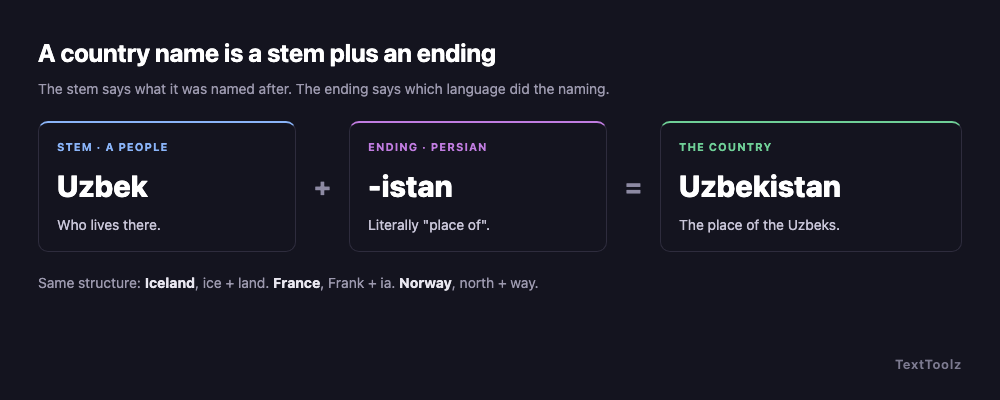
A country name is a stem and an ending. The stem says what the country was named after, and the ending says which language did the naming. Both halves carry meaning, and the ending carries it so reliably that a reader places the country before they have finished reading it.
| Country | Parts | Family | Named after | What it means |
|---|---|---|---|---|
| Iceland | Ice + land | Germanic | The land itself | land of ice |
| Netherlands | Nether + lands | Germanic | A direction | the low lands |
| Norway | Nor + way | Germanic | A direction | the north way |
| Denmark | Dan + mark | Germanic | A people | the borderland of the Danes |
| France | Frank + ia | Latinate | A people | the land of the Franks |
| Australia | Austral + ia | Latinate | A direction | the southern land |
| Bolivia | Bolivar + ia | Latinate | A founder | the land of Simon Bolivar |
| Colombia | Columb + ia | Latinate | A founder | the land of Columbus |
| Uzbekistan | Uzbek + istan | Persian | A people | the place of the Uzbeks |
| Afghanistan | Afghan + istan | Persian | A people | the place of the Afghans |
| Indonesia | Indo + nesia | Hellenic | The land itself | the Indian islands |
| Montenegro | Monte + negro | Romance | A quality | the black mountain |
| Costa Rica | Costa + rica | Romance | A quality | the rich coast |
| Sierra Leone | Sierra + Leone | Romance | The land itself | the lion mountains |
| Ecuador | Ecuador | Romance | A direction | the equator |
| Cameroon | Camaroes | Romance | The land itself | the river of prawns |
Why do real country names mean such ordinary things?
Because they were descriptions first. This is the single most useful thing to know before naming an invented nation, and it runs against what most writers do.
The Netherlands is the low lands. Iceland is ice. Montenegro is the black mountain. Costa Rica is the rich coast. Norway is the north way. Ecuador is the equator. Cameroon is named from the Portuguese Rio dos Camarões, the river of prawns, after what sailors found in the estuary. None of these were chosen to sound impressive. They were chosen because somebody had to write something on a chart.
Writers say the same thing to each other when they are not being asked to sound literary. On r/fantasywriters, the consensus advice to someone struggling with a nation name was that people "try too hard to make their stuff sound fantasy", and that "we've been told things have to sound more fantasy because of Tolkien and D&D". The names that writer rated highest from published books were Styria, Midderland and Ostland, which are barely invented at all: Styria is a real Austrian province, and Ostland is just "east land".
So if your nations sound fake, the usual cause is not that they are too plain. It is that they are too impressive. Name the terrain, name the people, name whoever unified the place, and attach an ending that belongs to one real language family.
What are countries actually named after?
Five mechanisms cover most of the map. The Named-after control picks between them, and it is the control that decides what your country's name means.
| Named after | What the stem is | Real country | What it means |
|---|---|---|---|
| A people | The name of a tribe or nation | France | the land of the Franks |
| The land itself | Terrain, weather, a resource | Iceland | the land of ice |
| A founder | A person who founded or unified it | Bolivia | the land of Simon Bolivar |
| A direction | Where it sits relative to somewhere else | Norway | the north way |
| A described quality | How it looked to whoever named it | Montenegro | the black mountain |
A map whose nations all use one mechanism reads as a themed list. Put a people next to a mountain range next to a dead general next to a compass direction, and it starts to look like somewhere with a history that happened to it.
What does each language family ending signal?
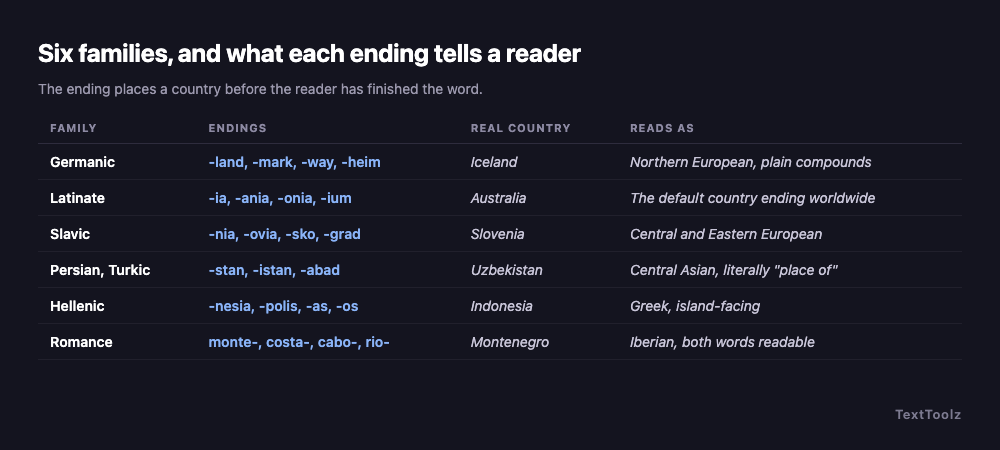
The ending is the fastest signal a place name can send, and readers pick it up without being taught. -land reads Germanic. -ia reads Latin or Slavic. -stan reads Persian and means, literally, "place of". -nesia is Greek for islands, which is why Indonesia, Polynesia and Micronesia share it.
| Family | Endings | Real country | Reads as |
|---|---|---|---|
| Germanic | -land, -mark, -way, -heim, -rike, -stad | Iceland, Denmark | Northern European, plain compounds |
| Latinate | -ia, -ania, -onia, -itania, -ium, -ica | Australia, Belgium | The default country ending worldwide |
| Slavic | -nia, -ovia, -sko, -ska, -grad, -ovina | Slovenia, Hercegovina | Central and Eastern European |
| Persian and Turkic | -stan, -istan, -abad, -shahr | Uzbekistan, Afghanistan | Central Asian, and literally "place of" |
| Hellenic | -nesia, -polis, -as, -os | Indonesia, Hellas | Greek, Mediterranean, island-facing |
| Romance compound | monte-, costa-, cabo-, rio-, sierra-, puerto- | Montenegro, Costa Rica | Iberian and Latin American, both words readable |
The Romance family behaves differently from the rest and it is worth knowing why: the noun comes first and the qualifier second. Montenegro is monte plus negro, mountain plus black. Costa Rica is coast plus rich. Sierra Leone is the lion mountains. The generator follows that order for this family and the normal order for the other five.
Endonym and exonym: the two names every country has
Here is the device almost no invented world uses, and it costs nothing. Countries have two names. The endonym is what a country calls itself. The exonym is what outsiders call it. They are frequently unrelated words.
| Exonym, what outsiders say | Endonym, what they say | The relationship |
|---|---|---|
| Germany | Deutschland | from a word meaning "of the people"; the English name comes from the Latin Germania |
| Japan | Nippon | both descend from a phrase meaning "origin of the sun" |
| Finland | Suomi | the English name is Germanic; the Finnish name is not related to it at all |
| Greece | Hellas | the Greeks say Hellas; Greece comes to English through Latin Graecia |
| Hungary | Magyarorszag | literally "land of the Magyars", which is what Hungarians call themselves |
| Albania | Shqiperia | the two names share no root |
| Armenia | Hayastan | the endonym uses the Persian -stan ending; the exonym uses the Latin -ia |
| Egypt | Misr | Egypt comes through Greek Aigyptos; Misr is the Arabic name |
Now think about what that gives you. If the neighbouring empire calls a nation one thing and its people call themselves another, you have written a piece of history without writing a word of it: somebody was named by somebody else, and it stuck. Characters who use the endonym are insiders. Characters who use the exonym are not, or are being rude. A treaty argued over which name appears in the text is a scene.
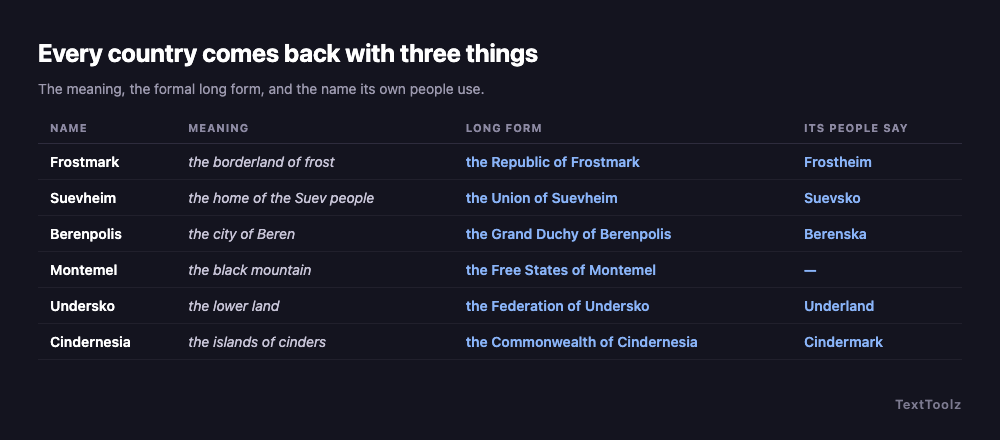
The generator gives every country an endonym alongside the outsiders' name, built by giving the same stem a different family's ending, which is the shape the real divergences take.
What is the long form of a country name for?
Real countries also carry a formal long form and the short name everybody actually uses. The French Republic and France. The United Mexican States and Mexico. The Kingdom of the Netherlands and Holland, which is not even the same place strictly speaking.
The long form is where the government lives, and it is the half that changes when the government does: a Kingdom becomes a Republic becomes a Federation while the short name sits still through all of it. That is useful. If your story spans a revolution, the long form is the thing that moves, and a character who still says the old one is telling you where they stand. Every name this generator produces comes with a long form attached.
Is a country name the same as a kingdom name?
No, and conflating them is a common slip. A kingdom is a form of government; a country is a place. The kingdom can fall, be annexed, become a republic or split in two, and the country underneath usually keeps its name, because that name describes terrain or a people rather than a crown.
Practically: name the country for what is there, then put the kingdom's name in the long form. Aurland is the golden land whatever happens to it, and the Kingdom of Aurland is a fact about the current century.
How do you anchor a country name to a real language?
Pick one real language family, take its shapes, and drift. Writers describe this method to each other constantly. On r/fantasywriters one commenter recommended looking at how French cities are named, then making something that sounds vaguely like that, and cited the novelist Brian McClellan, who said he picked his characters' names by looking at Hungarian names and fiddling with things that sounded like them, so the results stay realistic with a slight fantasy tilt.
That is exactly what the Language family control does mechanically. It takes the endings a real family actually uses and attaches them to an invented stem, so the output sits a short distance from something real instead of a long distance from everything. The same commenter's own settings were named Harburg, Portsdale and Romisi, for cultures based on Germany, England and Italy, which is the method working.
Should you check your country name against real places?
One practical step before you commit. Search the name. A generator working from real endings will occasionally produce something that is already on a map, or close enough to read as a typo of it, and that is worth knowing before it is printed.
It matters more here than for an invented city, because a country name that collides with a real nation drags real politics into your story whether you meant it or not. Any name that lands one letter away from an existing country is worth rerolling for that reason alone.
60 country names with their meanings
Sixty names from this generator, grouped by what they were named after, each one taken apart. Competing pages offer longer lists. None of them tells you what a single name means, which is the only thing separating a country name from a pleasant noise.
| Name | Parts | Meaning | Named after | Family |
|---|---|---|---|---|
| Vandland | Vand + land | the land of the Vand people | A people | Germanic |
| Keltmark | Kelt + mark | the borderland of the Kelt people | A people | Germanic |
| Suevheim | Suev + heim | the home of the Suev people | A people | Germanic |
| Moravonia | Morav + onia | the land of the Morav people | A people | Latinate |
| Alanitania | Alan + itania | the land of the Alan people | A people | Latinate |
| Ruskonia | Rusk + onia | the land of the Rusk people | A people | Latinate |
| Thracnia | Thrac + nia | the land of the Thrac people | A people | Slavic |
| Dacovina | Dac + ovina | the territory of the Dac people | A people | Slavic |
| Magyargrad | Magyar + grad | the fortified town of the Magyar people | A people | Slavic |
| Uzbekabad | Uzbek + abad | the settled place of the Uzbek people | A people | Persian |
| Alanabad | Alan + abad | the settled place of the Alan people | A people | Persian |
| Keltnesia | Kelt + nesia | the islands of the Kelt people | A people | Hellenic |
| Icemark | Ice + mark | the borderland of ice | The land itself | Germanic |
| Frostmark | Frost + mark | the borderland of frost | The land itself | Germanic |
| Amberheim | Amber + heim | the home of amber | The land itself | Germanic |
| Pinerike | Pine + rike | the realm of pine forest | The land itself | Germanic |
| Saltia | Salt + ia | the land of salt | The land itself | Latinate |
| Stonica | Stone + ica | the land of stone | The land itself | Latinate |
| Mistonia | Mist + onia | the land of mist | The land itself | Latinate |
| Ambersko | Amber + sko | the land of amber | The land itself | Slavic |
| Reedgrad | Reed + grad | the fortified town of reeds | The land itself | Slavic |
| Marshovina | Marsh + ovina | the territory of marshland | The land itself | Slavic |
| Mististan | Mist + istan | the land of mist | The land itself | Persian |
| Thornabad | Thorn + abad | the settled place of thorn | The land itself | Persian |
| Icepolis | Ice + polis | the city of ice | The land itself | Hellenic |
| Cindernesia | Cinder + nesia | the islands of cinders | The land itself | Hellenic |
| Sierrasalt | Sierra + salt | the salt mountains | The land itself | Romance |
| Cabofrost | Cabo + frost | the frost cape | The land itself | Romance |
| Riamber | Rio + amber | the amber river | The land itself | Romance |
| Corvanland | Corvan + land | the land of Corvan | A founder | Germanic |
| Aldricmark | Aldric + mark | the borderland of Aldric | A founder | Germanic |
| Haldenheim | Halden + heim | the home of Halden | A founder | Germanic |
| Berenia | Beren + ia | the land of Beren | A founder | Latinate |
| Emericitania | Emeric + itania | the land of Emeric | A founder | Latinate |
| Odriconia | Odric + onia | the land of Odric | A founder | Latinate |
| Tarsisko | Tarsi + sko | the land of Tarsi | A founder | Slavic |
| Kasimovia | Kasim + ovia | the land of Kasim | A founder | Slavic |
| Kasimistan | Kasim + istan | the land of Kasim | A founder | Persian |
| Berenpolis | Beren + polis | the city of Beren | A founder | Hellenic |
| Montecorvan | Monte + Corvan | the mountain of Corvan | A founder | Romance |
| Norland | Nor + land | the north land | A direction | Germanic |
| Sudmark | Sud + mark | the south borderland | A direction | Germanic |
| Ostway | Ost + way | the east way | A direction | Germanic |
| Midheim | Mid + heim | the middle home | A direction | Germanic |
| Noritania | Nor + itania | the north land | A direction | Latinate |
| Sudium | Sud + ium | the south land | A direction | Latinate |
| Overania | Over + ania | the upper land | A direction | Latinate |
| Wesska | Wes + ska | the west land | A direction | Slavic |
| Undersko | Under + sko | the lower land | A direction | Slavic |
| Ostistan | Ost + istan | the east land | A direction | Persian |
| Noras | Nor + as | the north land | A direction | Hellenic |
| Costanor | Costa + nor | the north coast | A direction | Romance |
| Albitania | Alb + itania | the white land | A quality | Latinate |
| Rubitania | Rub + itania | the red land | A quality | Latinate |
| Virica | Vir + ica | the green land | A quality | Latinate |
| Aurland | Aur + land | the golden land | A quality | Germanic |
| Bellmark | Bell + mark | the fair borderland | A quality | Germanic |
| Clarsko | Clar + sko | the bright land | A quality | Slavic |
| Grandas | Grand + as | the great land | A quality | Hellenic |
| Montemel | Monte + mel | the black mountain | A quality | Romance |
Country name generators against lists of real countries
Two different things share this phrase and searching for one hands you the other.
- A country name generator invents nations for fiction, games and maps. That is this page, and it is what every ranking result for the phrase is doing.
- A list of country names is geography. Search the shorter phrase and you get the United Nations terminology database, the World Bank, the US State Department, Britannica and a count of the 195 recognised states. Those are the right sources for that question and a text-tools site is not. This page does not publish a list of real countries.
Where do these country name patterns come from?
The endings and their meanings are standard: Germanic land and mark; the Latin -ia locative; Slavic -sko and -ska; Persian -stan, "place of"; Greek -nesia, "islands"; and the Romance noun-first compounds behind Montenegro and Costa Rica. The real countries named throughout are given as examples of each pattern in use.
Contested etymologies are left out on purpose. A page arguing that meanings matter cannot afford to print a meaning that is wrong, and country etymologies attract folk explanations more than most. Where a derivation is disputed it is not used here, however good the story attached to it.
Names are assembled in your browser. No request leaves the page, nothing is logged, and the generator keeps working with the network disconnected.
Other name generators for your map
A country needs somewhere in it. The City Name Generator builds settlements from documented place-name elements and glosses those too, so the cities inside a nation can share its logic. For the people, the D&D Name Generator builds character names by race, and the warlock and monk generators add a class layer. Once the map is named, the text style generators will set those names in the fonts a campaign document or a game UI accepts.