About the Sith Name Generator
A Sith name is a real word with an operation performed on it. This generator carries 14 dark concepts, 5 transformations and 3 eras, and every name it returns names its own source word, that word's real language, and what was done to it. It generates Darth names and ancient Sith Lord names for fiction. It does not return canon names, it does not invent a Sith language, and where a canon reading is disputed the page says so instead of picking a side.
What is a Sith name made of?
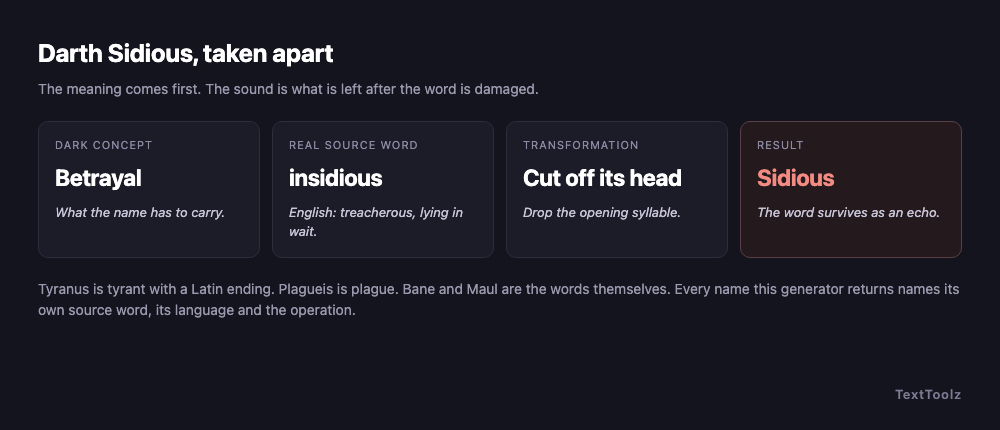
A Sith name is made of a dark concept, a real word that carries it, and an operation that damages the word. Work Darth Sidious backwards and the three parts are visible: the concept is treachery, the word is insidious, and the operation is cutting off the opening syllable. Darth Tyranus is tyranny, the word tyrant, and a Latin ending. Darth Plagueis is contagion and the word plague, with nothing done to it at all.
The order matters more than it looks. The meaning comes first and the sound is what is left over, which is the reverse of every generator competing for this search. The deepest of them offers a Name Harshness slider, which dials the sound of a name that was never built out of a meaning in the first place. A name assembled that way can be made to sound menacing, and it can never be decoded, because there is nothing under it.
What do the canon Darth names actually mean?
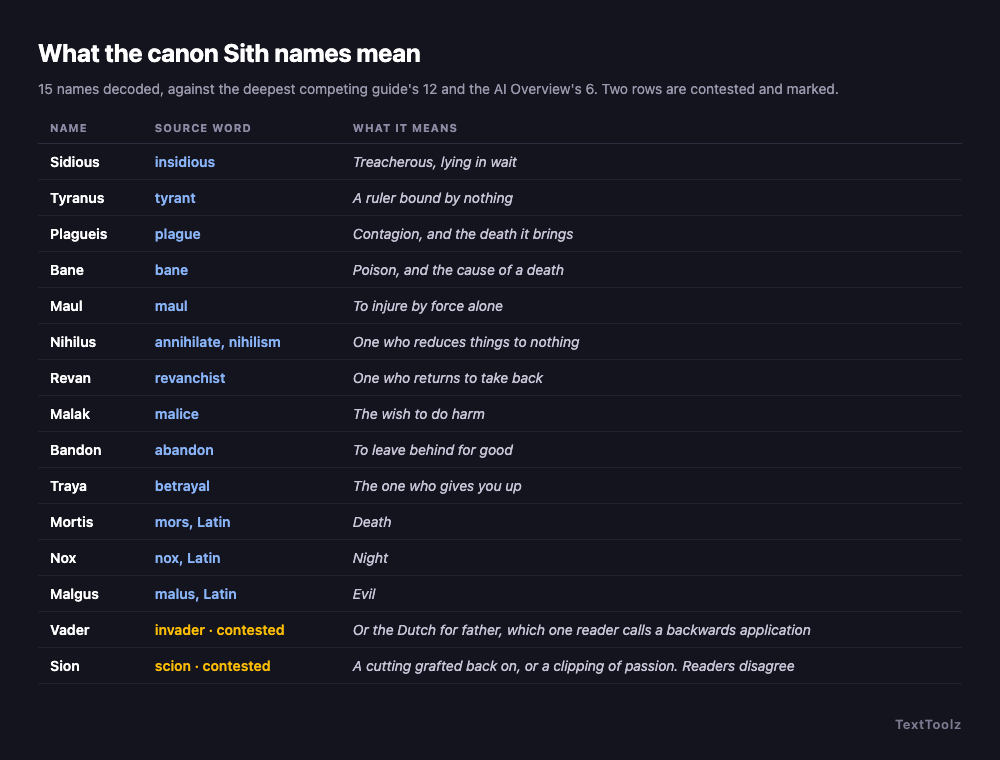
Fifteen of them decode cleanly, and thirteen decode without argument. The table below is the fullest decoding available for this search: the deepest competing guide publishes twelve rows and Google's AI Overview lists six. The extra rows come from a reader thread on Sith naming nomenclature, where one commenter works through Revan, Malak, Bandon, Sion and Traya in a single reply, and they are credited here in prose rather than by link.
| Name | Source word | What it means |
|---|---|---|
| Sidious | insidious | Treacherous, lying in wait |
| Tyranus | tyrant | A ruler bound by nothing |
| Plagueis | plague | Contagion, and the death that follows it |
| Bane | bane | Poison, and the cause of a death |
| Maul | maul | To injure by force alone |
| Nihilus | annihilate, nihilism | One who reduces things to nothing |
| Revan | revanchist | One who returns to take back what was lost |
| Malak | malice | The wish to do harm |
| Bandon | abandon | To leave behind for good |
| Traya | betrayal | The one who gives you up |
| Mortis | mors, Latin | Death |
| Nox | nox, Latin | Night |
| Malgus | malus, Latin | Evil |
| Vader [contested] | invader | One who forces entry. The reading that it is the Dutch word for father is disputed, and one reader calls it a backwards application |
| Sion [contested] | scion, or passion | A cutting grafted back onto another plant, or a clipping of passion. Readers who agree on every other name do not agree on this one |
Two rows are flagged because the readers who agree on everything else do not agree on these. Darth Sion is read by one commenter as scion, a cutting grafted onto another plant, which fits a character held together after being broken apart; another reads it as a clipping of passion, since anger is what keeps him alive. Darth Vader is read almost everywhere as invader, and the popular claim that it is the Dutch word for father is called "a backwards application" by a reader who does not think it was intended when the name was written. Neither is settled here, because neither is settled anywhere.
How do you turn a word into a Sith name?
Five operations account for every canon name in the table above, and each one is listed here with the canon name that proves it is real rather than invented for this tool. These are the values of the Transformation control, and they are the reason a generated name can be traced back to a dictionary.
| Transformation | What it does | Canon proof | Generated example |
|---|---|---|---|
| Take the word whole | Use the word as it stands, because it is already a verdict. | Bane, Maul, Mortis, Nox | Darth Blight, from blight |
| Cut off its head | Drop the opening syllable so the word survives only as an echo. | insidious to Sidious, abandon to Bandon | Darth Tagion, from contagion |
| Give it a Latin ending | Attach a Latin ending so an English word reads as an old name. | tyrant to Tyranus, plague to Plagueis | Darth Tyrax, from tyrant |
| Translate it first | Take the Latin or Greek word for the concept, then shape that. | nihil to Nihilus, malus to Malgus | Darth Nihilax, from nihil |
| Clip it short | Cut the tail until only the weight is left. | revanchist to Revan | Darth Venge, from vengeance |
None of this is a discovery. A 9,013-word guide ranking for these queries names four of these five operations, calls the first of them the Corruption Method, and works through examples in Latin, Sanskrit and Old Norse. Google's AI Overview describes two of them in its own words: "take an intimidating English word and trim or alter it", and "modify negative words from Latin, Greek, or other languages". The mechanism is common knowledge on this search. What is missing everywhere is a generator that performs it.
Should a Sith name's meaning be obvious?
The guides and the readers flatly disagree, and both sides are worth having. Every ranking guide gives the same advice: embed the meaning, but bury it. One puts it as "Sidious doesn't scream evil, it whispers it" and lists "too obviously evil" first among the mistakes to avoid.
The top comment on the reader thread that ranks in the top five for sith names, and which Google's AI Overview cites three separate times, says the opposite:
"Personally, I think the majority of Sith names suck because their meanings are too obvious. For example, Sidious is obviously a shortened variant of insidious. I like your Darth Deimos because its true meaning is not abundantly apparent, audiences would have to research the name to find its meaning."
The synthesis neither side writes is that the meaning and its visibility are two separate decisions. A name has to be built out of something, or there is nothing to bury. How far to bury it is then a choice about the reader: an English source word is legible on sight, a Latin one needs a moment, and a Greek one sends most people to a search box. That is exactly what the Transformation control moves between, and it is why this generator shows the source word to you rather than to your audience. The gloss is a build tool, not a reveal.
Who gives a Sith the Darth title?
A master gives it to an apprentice, which is why the names are insults. The title is bestowed rather than chosen, and the name attached to it describes what the apprentice is or what the master expects them to become. That explains the pattern in the decoding table: tyrant, betrayer, plague, poison. Almost nothing in that list is something a person would pick for themselves.
There is one in-universe claim about the naming itself and it comes with its own hedge attached. A reader reports that the Revenge of the Sith novelisation implies Sith names are chosen by the dark side of the Force rather than by the master, and adds in the same comment that they have yet to see it corroborated anywhere else. It is repeated here with that caveat rather than as a rule, because that is all the support it has.
The larger finding is an absence. The reader who opened that thread went looking for a published Sith naming nomenclature, worked through a great deal of source material, and came back with almost nothing. There is no in-universe rulebook for this. The pattern is real and it is observable across fifteen names, and it was never written down as a rule, which is why this page argues from the names themselves rather than citing a chapter.
What happens to the birth name?
It stays, and the distance between the two names is the character. Anakin Skywalker became Darth Vader. Sheev Palpatine became Darth Sidious. Count Dooku became Darth Tyranus. The birth name is the person there was first, the Sith name is what the dark side made of them, and a story that uses both has somewhere to stand.
Every result here returns both, which is a small thing that no competing generator does. A page ranking second for this search argues at length that the dual identity is central to Sith storytelling, and then returns the Darth name on its own. The birth names in this tool are the one invented part of it, for the reason given in the sources section below.
Did every Sith use the Darth title?
No, and that is why Era is a control rather than a decoration. The ancient Sith predate the title completely. Naga Sadow, Marka Ragnos, Tulak Hord, Ajunta Pall and Exar Kun carry a personal name and a bloodline name and no title at all, and their names do not decode into English or Latin the way the Darth names do.
So the Ancient Sith setting here emits no Darth title and a two-part name, which is the shape those names actually have. It does not pretend to decode a language nobody has published, and that restraint is the whole difference between this setting and the generator ranking second, which hands out names glossed from "the Old Sith dialect, combining kra (cruelty) and ron (silence)". No such dialect has ever been published. The Old Republic and Rule of Two settings both attach the title, with the Rule of Two carrying the extra weight that from Bane onward there were only ever two Sith at a time, so each name was one person's judgement of one other person.
Can you make a Sith name from your own name?
Yes, and the method readers actually use is translation followed by damage. Take your own name, put it into another language, then apply one of the same five operations. One reader describes their result plainly: "Mine is Darth Nismios, which is an anagram of my name in latin." Another works from a trait rather than a name, translating their dominant dark-side impulse and trimming it, and arrives at Darth Neugierig from the German for curious, or Darth Inquisi from inquisitive.
This generator does not do that, and the reason is that it takes no name as input. Google offers sith name generator based on your name as a related search and nothing on the results page answers it as a method, so it is written out here instead of faked. The operation list above works identically on a personal name: translate it, then cut off its head, clip it short, or attach a Latin ending.
What makes a Sith name sound fake?
Random syllables, an obvious villain word, or a name a letter away from a canon one. Every guide on this search lists those three, and the striking thing is how many of them then commit the first one. This is stated as a reading taken on 2026-09-16 rather than as an opinion.
- Random syllables. One page warns against them in prose and publishes Darth Phlormelrir, Darth Striasneic and Darth Qaft as its own sample output. Its FAQ describes its method as pairing "menacing prefixes" with "dark-sounding suffixes", which is the thing the prose above it says not to do.
- A name with nothing underneath. The 9,013-word guide that names four naming methods returns Rowanelix, Daxanan, Finleyeni, Skyvenis and Quinneron, which are ordinary first names with a suffix attached.
- An invented etymology. The generator ranking second does attach a meaning to every name, and makes it up: Darth Morvok is glossed from "morp (to burn) and vok (fury)" in the "Sith Pureblood tongue", and each name also arrives with a fabricated history such as being famous in the Korriban archives. None of those roots exists.
- Too close to a real one. Darth Vador and Darth Maulus read as copies. No canon name is ever returned as a result by this generator, which is checkable: every one of the 60 names in the list below is traceable to a dictionary word instead.
The first version of this generator failed the same test. It applied the five operations with string rules rather than by hand, and produced Darth Ght from fright and Darth Nzy from frenzy. Those results are why the word bank is hand-written and hand-checked rather than computed, and why a transformation that does not suit a word is simply not offered for that word.
60 Sith names, each with the word it came from
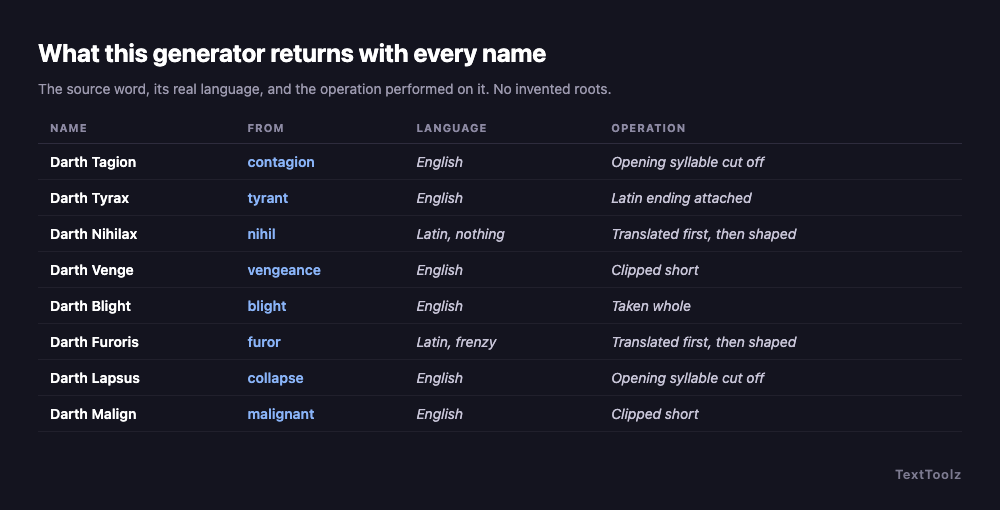
Sixty names from this generator's own bank, grouped by transformation. Every row carries the real source word, that word's language and the operation performed on it, so any one of them can be checked in a dictionary. Competing pages publish 500 names and not one entry on any of them can be traced to a word, which is why the count is not the differentiator here.
| Name | From | Language | Operation |
|---|---|---|---|
| Darth Blight | blight | English | Taken whole |
| Darth Dread | dread | English | Taken whole |
| Darth Terror | terror | English | Taken whole |
| Darth Wrath | wrath | English | Taken whole |
| Darth Void | void | English | Taken whole |
| Darth Hollow | hollow | English | Taken whole |
| Darth Ruin | ruin | English | Taken whole |
| Darth Spite | spite | English | Taken whole |
| Darth Venom | venom | English | Taken whole |
| Darth Gloom | gloom | English | Taken whole |
| Darth Eclipse | eclipse | English | Taken whole |
| Darth Umbrage | umbrage | English | Taken whole |
| Darth Ending | ending | English | Taken whole |
| Darth Dominion | dominion | English | Taken whole |
| Darth Timor | timor | Latin, fear | Taken whole |
| Darth Formido | formido | Latin, dread | Taken whole |
| Darth Clades | clades | Latin, disaster | Taken whole |
| Darth Pestis | pestis | Latin, plague | Taken whole |
| Darth Furor | furor | Latin, frenzy | Taken whole |
| Darth Inane | inane | Latin, the empty void | Taken whole |
| Darth Tagion | contagion | English | Opening syllable cut off |
| Darth Fright | affright | English | Opening syllable cut off |
| Darth Lapsus | collapse | English | Opening syllable cut off |
| Darth Fallux | downfall | English | Opening syllable cut off |
| Darth Stilus | pestilence | English | Opening syllable cut off |
| Darth Ragis | enrage | English | Opening syllable cut off |
| Darth Voidis | devoid | English | Opening syllable cut off |
| Darth Trayus | betrayal | English | Opening syllable cut off |
| Darth Rodus | corrode | English | Opening syllable cut off |
| Darth Livion | oblivion | English | Opening syllable cut off |
| Darth Jugatis | subjugate | English | Opening syllable cut off |
| Darth Vourax | devour | English | Opening syllable cut off |
| Darth Nihilate | annihilate | English | Opening syllable cut off |
| Darth Rosion | corrosion | English | Opening syllable cut off |
| Darth Terrax | terror | English | Latin ending attached |
| Darth Ruinax | ruin | English | Latin ending attached |
| Darth Wrathus | wrath | English | Latin ending attached |
| Darth Furax | fury | English | Latin ending attached |
| Darth Voidus | void | English | Latin ending attached |
| Darth Hollux | hollow | English | Latin ending attached |
| Darth Blightus | blight | English | Latin ending attached |
| Darth Tyrax | tyrant | English | Latin ending attached |
| Darth Perfidus | perfidy | English | Latin ending attached |
| Darth Malicus | malice | English | Latin ending attached |
| Darth Vengeris | vengeance | English | Latin ending attached |
| Darth Anguis | anguish | English | Latin ending attached |
| Darth Cravus | craving | English | Latin ending attached |
| Darth Shadus | shadow | English | Latin ending attached |
| Darth Nihilax | nihil | Latin, nothing | Translated first, then shaped |
| Darth Ruinus | ruina | Latin, collapse | Translated first, then shaped |
| Darth Pestor | pestis | Latin, plague | Translated first, then shaped |
| Darth Furoris | furor | Latin, frenzy | Translated first, then shaped |
| Darth Iraxis | ira | Latin, anger | Translated first, then shaped |
| Darth Umbrax | umbra | Latin, shadow | Translated first, then shaped |
| Darth Tenebris | tenebrae | Latin, darkness | Translated first, then shaped |
| Darth Dolorem | dolor | Latin, pain | Translated first, then shaped |
| Darth Phobus | phobos | Greek, fear | Translated first, then shaped |
| Darth Venge | vengeance | English | Clipped short |
| Darth Malign | malignant | English | Clipped short |
| Darth Lament | lamentation | English | Clipped short |
Sith Purebloods, SWTOR and where those names live
The word Sith covers three separate naming problems and this page serves one of them. The Darth title is a naming convention for fallen Force users and it is what this generator builds. The Sith Purebloods are a species with their own personal-plus- bloodline convention, closer in shape to the ancient Sith Lords than to the Darth names, and a resource of roughly 5,600 words of Pureblood names already exists elsewhere. The Old Republic game carries a third problem again, which is finding a name nobody on the server has taken.
If you are naming a Pureblood or a character for that game, the ancient Sith setting here produces the right shape and the rest of that work belongs on those pages rather than this one.
Where do these Sith names come from?
Every source word is a real word in a real language, and the operation performed on it is named beside it. The English words come from ordinary English, the Latin and Greek words are given with their own meanings, and the five operations are derived from the canon names in the decoding table rather than asserted. Nothing here is drawn from an invented Sith lexicon, and that is a deliberate refusal: the generator ranking second on this search glosses its output from a Sith language nobody has ever published, which turns a naming tool into a source of false lore.
One thing here is invented and it is labelled as such. The birth names are written for this tool, because no birth-naming rules are published for these characters, and a birth name without a source is better disclosed than dressed up. Contested readings stay contested: Darth Vader and Darth Sion are marked in the table and are not used as evidence for anything else on the page.
Everything runs in your browser. No name is sent anywhere, the generator keeps working with the network disconnected, and nothing you generate or copy is logged. Star Wars and the characters named on this page are trademarks of Lucasfilm; TextToolz is not affiliated with or endorsed by Lucasfilm or Disney.
Other name generators
The D&D name generator works the same way for tabletop characters, building on published race conventions rather than on sound, and the warlock generator adds a patron epithet on top of it. For the places your characters come from, the city name generator and the country name generator gloss every result the same way this one does.