About the Stripper Name Generator
A stage name is a working identity built by a formula, and this generator carries 5 formulas, 6 registers and 60 rated examples. Every name says which formula produced it and whether a stranger can hear it once and repeat it. Four of the five formulas come from performers; the fifth is the party-game formula Google's own AI Overview gives, and it produces the longest and least legible names on the page. No real performer's name is published here, and the section on what this page will not produce explains why that is a rule rather than a courtesy.
What is a stage name actually for?
A stage name does three jobs, and only one of them is atmosphere. It separates the performer from the person, so what happens on stage belongs to a character rather than to a private life. It has to be remembered by a stranger who met a dozen people that night. And it has to be said back correctly, which is the job everybody designing these tools forgets.
This page serves three audiences and says so rather than pretending to serve one. Writers naming a performer character in fiction or comedy, which is the largest genuine use. Burlesque and pole performers picking a name for a showcase or a class. And the party game, the first-pet-plus-a-street formula that made this a search in the first place. It publishes no real worker's name in any of those three cases.
What are the five formulas a stage name is built from?
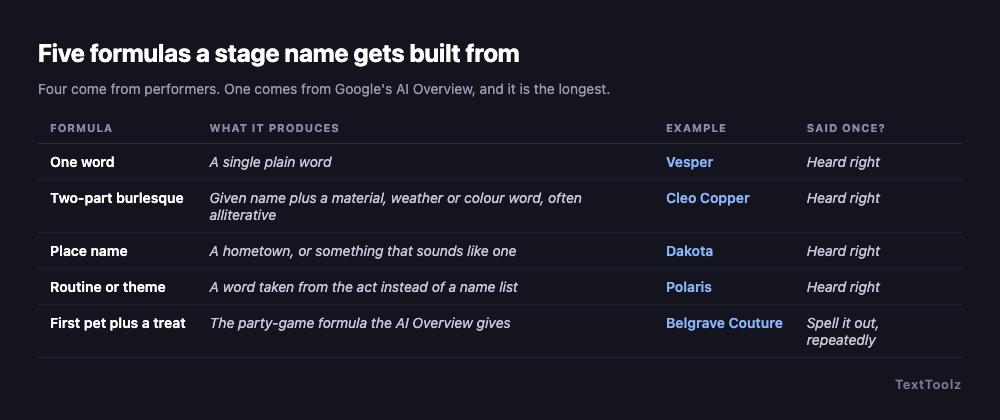
Five formulas produce almost every stage name in use, and four of them come from performers rather than from generators. The table gives each one with a worked example and how it fares in a loud room. The Formula control switches between them, which is the only control here that changes how a name is built rather than what it is made of.
| Formula | What it produces | Example | Said once? | Where it comes from |
|---|---|---|---|---|
| One word | A single plain word, given name or object. | Vesper | Heard right | The register the named expert on this search recommends |
| Two-part burlesque | A given name plus a material, weather or colour word, frequently alliterative. | Cleo Copper | Heard right | The form Gypsy Rose Lee and Tempest Storm worked under |
| Place name | A hometown, or a place that sounds like one. | Dakota | Heard right | Reported in a pole-dancing thread, with a caution attached |
| Routine or theme | A word taken from the act instead of from a name list. | Polaris | Heard right | A country-themed set produced Revolver; an astronomy joke produced Polaris |
| First pet plus a treat | Your first pet or a street, then a snack or a luxury word. | Belgrave Couture | Spell it out, repeatedly | The formula Google's AI Overview gives for this query |
The last row is the one everybody knows and the worst performer in the room. The pet-plus-treat formula is what Google's AI Overview hands back for this exact query, and it is genuinely good fun at a party. It also produces Belgrave Couture and Pippin Praline, which are five syllables of French spelling shouted at someone across music. Both things are true and the page keeps them both.
Will your stage name survive being said once, over music?
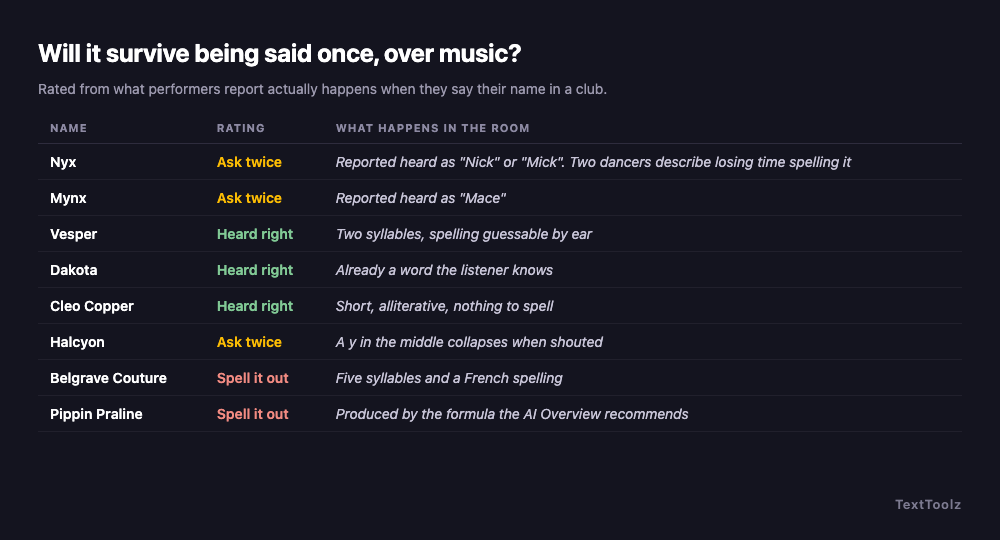
This is the test no competing page applies, and the people who work under these names raise it unprompted. Two dancers using the name Nyx describe the same failure independently. One: "People always think it's Nick or Mick with how loud the music is." The other, on the running cost: "Soooo much time wasted telling ppl how to spell it, or 'think Stevie Nicks!'" A third, working as Mynx, reports being heard as Mace, and has built a whole routine around correcting it.
Three things cost a name a hearing, and all three are testable rather than aesthetic:
- Length. More than three syllables and the back half gets lost.
- An x or a z. Both letters are the ones the reported mishearings turn on, because they carry no distinct sound at volume.
- A y in the middle of a word. Ivy and Mercury are heard correctly because the y sits at the end; Nyx and Halcyon are not.
Every generated name carries a rating built from those three. It is a rule of thumb derived from what performers report, not a measurement, and it is stated that way rather than dressed up as a score.
Plain or exotic?
The tools say exotic and the performers say plain, and this is worth publishing as a disagreement rather than resolving. Every generator ranking for this query builds elaborate compound names. The one named expert anywhere on the search, dancer and instructor Stephanie Jeronymo, interviewed by wikiHow, says the opposite:
"The simpler the better. But also you want to do a name that is not too unique, so people will remember it... Just do a name that kind of suits you and that you feel comfortable with."
A dancer in a working thread puts the commercial case behind it: "I would stray away from creative names when working in gentleman's clubs. It's important to get these men to see you as a person to build a connection with and it's difficult to do that when you're going by something bizarre. Using a regular name helps to maintain the real person thing." Another, shorter: "I think most people overthink it... Keep it memorable and short-ish for repeat customers but otherwise."
The other side is held just as firmly. "Of course. It's your alter ego. Your super hero. You need to own it." Two dancers using the name Minx describe it suiting opposite physical types, one reading it as cute and one as "a powerful feline vibe", and conclude that this is the point: "you make it yours and own it."
The resolution this page offers is that the two sides are arguing about different things. Legibility is a constraint and can be tested. Personality is a choice and cannot. Generate for the constraint, choose for the personality, and do not let a tool make the second decision for you.
Are candy stage names a cliche?
Google says use them and a performer says they are the cliché to avoid. The AI Overview for this exact query instructs the reader to build the second word from "your favorite snack, candy, or a luxury item (like Sugar or Mercedes)". A performer answering a question about choosing a stage name says: "I like color names. I would stay away from sweets like Cinnamon or Cupcake or Teacup or any of that. It's way too stereotypical."
Both are kept here and the sweet register stays in the generator, labelled. The practical observation that neither side makes is that they are describing the same fact from two directions: the sweets register is the most crowded one precisely because it is the most legible, since Sugar and Cherry are words a listener already owns. Crowded and audible are the same property. Which one matters more depends on whether you need to be remembered or need to be distinct.
Which stage names are already taken?
Names are allocated per venue, first come first served, and the obvious ones are gone. A dancer who wanted to move from Nyx to Raven found that "both of my clubs said it's taken". Another, using Halo and assuming it was unusual, was corrected by someone who had "met 2 separate halos" across two states and a handful of clubs.
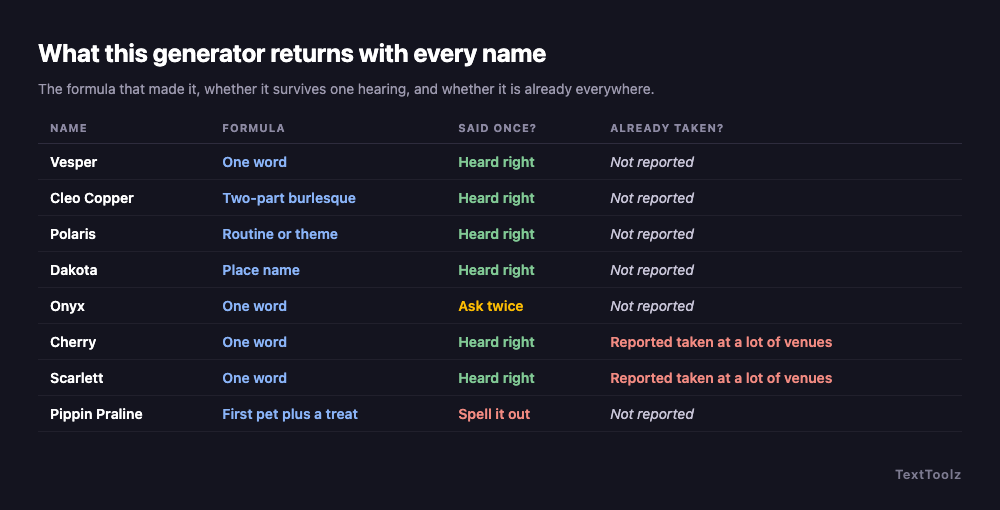
The generator flags the names reported repeatedly in those threads: Nyx, Raven, Halo, Scarlett, Diamond, Candy, Bambi, Destiny, Cherry, Sugar, Honey, Luna, Angel, Ruby and Crystal. That flag is a caution and not a guarantee. No tool can check a specific club's roster, and any generator implying otherwise is selling something. The useful version of this is to generate a shortlist rather than a single name, which is what the Download option is for.
Where does the two-part burlesque name come from?
The two-part form is about a century old and it predates every generator competing for this search. Gypsy Rose Lee, Tempest Storm and Lili St. Cyr are all documented public performers, and their names share a shape: a given name followed by a weather, material or place word, frequently alliterative, always longer than the plain register a club dancer would pick today.
That length difference is not an accident, and it is the most interesting thing about the formula. A burlesque name was printed on a bill and announced by a compere, so it could afford syllables. A club name is said by the person carrying it, once, across music. Same job, different room, and the room decides the length.
How do writers use stage names in fiction and comedy?
The gap between the persona and the person is the engine, and in comedy the gap is the joke. A character who is magnetic on stage and uncertain off it carries tension before anything has happened, and a nervous accountant introduced by an enormous stage name is funny before they speak. A competing page makes this point well and it is credited here by argument rather than by link.
It is also why this generator returns the formula alongside the name. A writer needs to know what logic the character used to choose it, because that logic is characterisation: someone who named themselves after their hometown is a different person from someone who named themselves after a gemstone, and both are different from someone who took a word out of their own routine.
60 stage names, with their formula and rating
Sixty names from this generator's own banks, grouped by formula. Each row carries the formula that produced it and how it fares in a loud room, and the two names flagged as reported-common are marked. Competing pages publish longer lists, and not one entry on any of them is rated or traceable to a method.
| Name | Formula | Said once? | Note |
|---|---|---|---|
| Vesper | One word | Heard right | None |
| Iris | One word | Heard right | None |
| Sable | One word | Heard right | None |
| Cleo | One word | Heard right | None |
| Margot | One word | Heard right | None |
| Simone | One word | Heard right | None |
| Wren | One word | Heard right | None |
| Juno | One word | Heard right | None |
| Marlowe | One word | Heard right | None |
| Verity | One word | Heard right | None |
| Odette | One word | Heard right | None |
| Delphine | One word | Heard right | None |
| Scarlett | One word | Heard right | Reported taken at a lot of venues |
| Cherry | One word | Heard right | Reported taken at a lot of venues |
| Onyx | One word | Ask twice | None |
| Roxy | One word | Ask twice | None |
| Cleo Copper | Two-part burlesque | Heard right | None |
| Sable Storm | Two-part burlesque | Heard right | None |
| Iris Ivory | Two-part burlesque | Heard right | None |
| Wren Rose | Two-part burlesque | Heard right | None |
| Juno Jet | Two-part burlesque | Heard right | None |
| Nova Noir | Two-part burlesque | Heard right | None |
| Elle Ember | Two-part burlesque | Heard right | None |
| Lena Lace | Two-part burlesque | Heard right | None |
| Cash Crimson | Two-part burlesque | Heard right | None |
| Ace Amber | Two-part burlesque | Heard right | None |
| Beau Blaze | Two-part burlesque | Heard right | None |
| Cole Coral | Two-part burlesque | Heard right | None |
| Margot Satin | Two-part burlesque | A little long | None |
| Simone Silk | Two-part burlesque | A little long | None |
| Violet Velvet | Two-part burlesque | A little long | None |
| Cassia Crimson | Two-part burlesque | A little long | None |
| Rosalind Rain | Two-part burlesque | A little long | None |
| Sterling Slate | Two-part burlesque | A little long | None |
| Dakota | Place name | Heard right | None |
| Vegas | Place name | Heard right | None |
| Georgia | Place name | Heard right | None |
| Memphis | Place name | Heard right | None |
| Aspen | Place name | Heard right | None |
| Reno | Place name | Heard right | None |
| Verona | Place name | Heard right | None |
| Sierra | Place name | Heard right | None |
| Montana | Place name | Heard right | None |
| Odessa | Place name | Heard right | None |
| Savannah | Place name | A little long | None |
| Adelaide | Place name | A little long | None |
| Polaris | Routine or theme | Heard right | None |
| Orbit | Routine or theme | Heard right | None |
| Vantage | Routine or theme | Heard right | None |
| Cadence | Routine or theme | Heard right | None |
| Tempo | Routine or theme | Heard right | None |
| Revolver | Routine or theme | A little long | None |
| Solstice | Routine or theme | Heard right | None |
| Kestrel | Routine or theme | A little long | None |
| Bellwether | Routine or theme | A little long | None |
| Pendulum | Routine or theme | A little long | None |
| Mocha Vogue | First pet plus a treat | A little long | None |
| Maple Cocoa | First pet plus a treat | A little long | None |
| Pippin Praline | First pet plus a treat | Spell it out | None |
| Belgrave Couture | First pet plus a treat | Spell it out | None |
What this stage name generator will not produce
It will not name a real person, and that is a rule rather than a courtesy. The reasons are visible on the search results themselves, read on 2026-09-16 and stated here as verified readings rather than as opinion.
- No bank built from real performers' names. One ranking page publishes its own sample output, and several of those samples pair an ordinary given name with the surname of a working drag performer. The same page's FAQ states that its names "remain tasteful", and one of its published samples contains a slur. A word bank assembled that way puts real people into a random generator without asking them.
- No list of famous names. Another ranking page heads twenty names "Famous Female Stripper Names". None of them is famous; the list is invented under a heading that asserts otherwise. This page has no such section, because the honest version of it would be empty.
- No explicit output. The registers here are materials, gems, weather, colours, places and plain given names, and every word in them is checked by hand.
The only real names anywhere on this page are Gypsy Rose Lee, Tempest Storm and Lili St. Cyr, who are documented public figures named as history in the burlesque section, and Stephanie Jeronymo, a dancer and instructor who gave a named interview about naming and is quoted for it.
Where do these stage names come from?
The word banks are ordinary English: materials, gems, weather, colours, places and plain given names, assembled by formula in your browser. The five formulas come from three places, each credited textually rather than by link: Google's AI Overview for the pet-and-treat formula, wikiHow's named interview with a dancer and instructor for the simplicity position, and two performer threads for the place, theme, burlesque and one-word formulas.
The legibility rating is a rule of thumb and says so. It counts syllables and looks for the two letter patterns the reported mishearings turn on. It is derived from what performers say happens to them, not from any study, and no study of this exists to cite. The collision flag is the same: it lists names reported as common in those threads, and it cannot know what is taken at your venue.
Everything runs in your browser. No name is sent anywhere, the generator keeps working with the network disconnected, and nothing you generate or copy is logged.
Other name generators
The D&D name generator applies the same say-it-aloud test at a table instead of in a club, and the Sith name generator builds every name out of a real word and shows you which one. For the places a character comes from, the city name generator and the country name generator gloss their output the same way.