Writing a name in ancient Egyptian hieroglyphics involves converting the phonetic sounds of the name into corresponding hieroglyphic symbols from the Egyptian writing system. The Easiest way to use online Hieroglyphics translator tool. Each hieroglyph represents a consonant sound, object, or concept, and modern names are written through phonetic transliteration rather than direct translation.
Ancient Egyptian hieroglyphics formed one of the earliest writing systems in human history. Archaeological evidence shows that hieroglyphic writing appeared around 3100 BCE during the Early Dynastic Period of ancient Egypt. The writing system was used for temple inscriptions, religious texts, royal monuments, papyrus manuscripts, and administrative records.
Today, hieroglyphics remain important for:
- history education and classroom projects
- museum exhibitions and Egyptology research
- tattoo designs inspired by ancient Egypt
- artistic calligraphy and graphic design
- cultural learning about Egyptian civilization
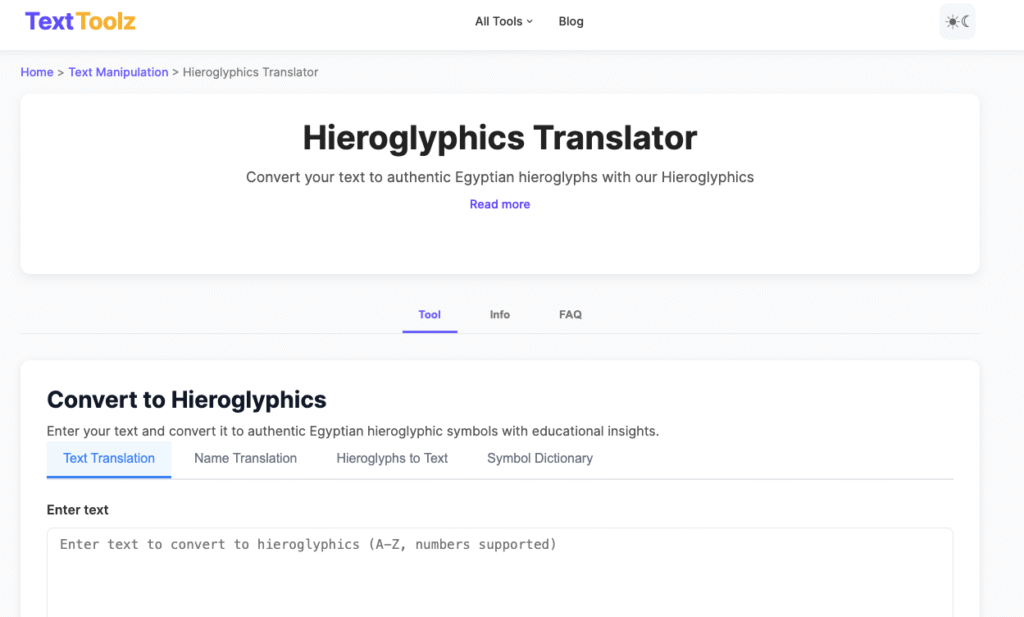
For quick conversion, you can convert English characters through a hieroglyphics translator available on Texttoolz.com.
What Is Hieroglyphics?
Hieroglyphics are the writing system of ancient Egypt that uses pictorial symbols to represent sounds, objects, and meanings.
The word “hieroglyphics” originates from the Greek words hieros (sacred) and glyphein (to carve), meaning “sacred carvings.” Greek historians used this term because Egyptian inscriptions were frequently carved into stone monuments, temple walls, and tomb chambers.
Ancient Egyptian hieroglyphic writing contained three main categories of symbols.
Phonetic symbols
Phonetic hieroglyphs represent sounds similar to letters in an alphabet. These symbols correspond to consonant sounds such as M, N, R, T, and S.
Logograms
Logograms represent entire words or objects. For example, a sun disk symbol represents the word “sun.”
Determinatives
Determinatives clarify the meaning of words. These symbols appear at the end of a word to identify its category, such as human actions, animals, locations, or divine beings.
Ancient Egyptian writing appeared in several forms of media:
- stone monuments and temple walls
- pyramid and tomb inscriptions
- papyrus scroll manuscripts
- royal cartouches containing pharaoh names
Although simplified scripts such as Hieratic and Demotic were used for everyday writing, hieroglyphics remained the most prestigious writing system in Egyptian culture.
How to Write Your Name in Ancient Egyptian Hieroglyphics
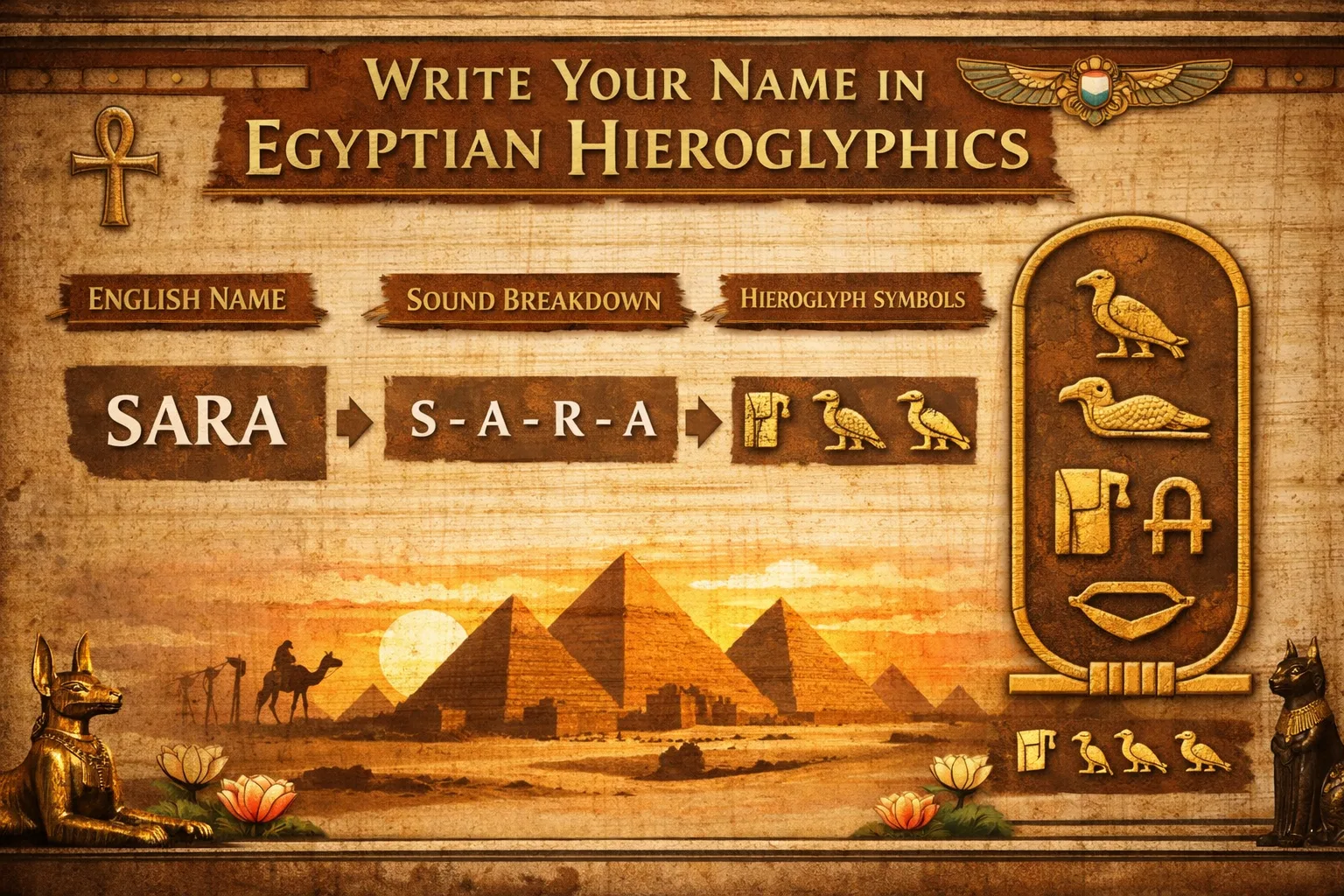
Writing a modern name in ancient Egyptian hieroglyphics involves converting the phonetic sounds of the name into equivalent hieroglyph symbols and arranging them sequentially to form the name.
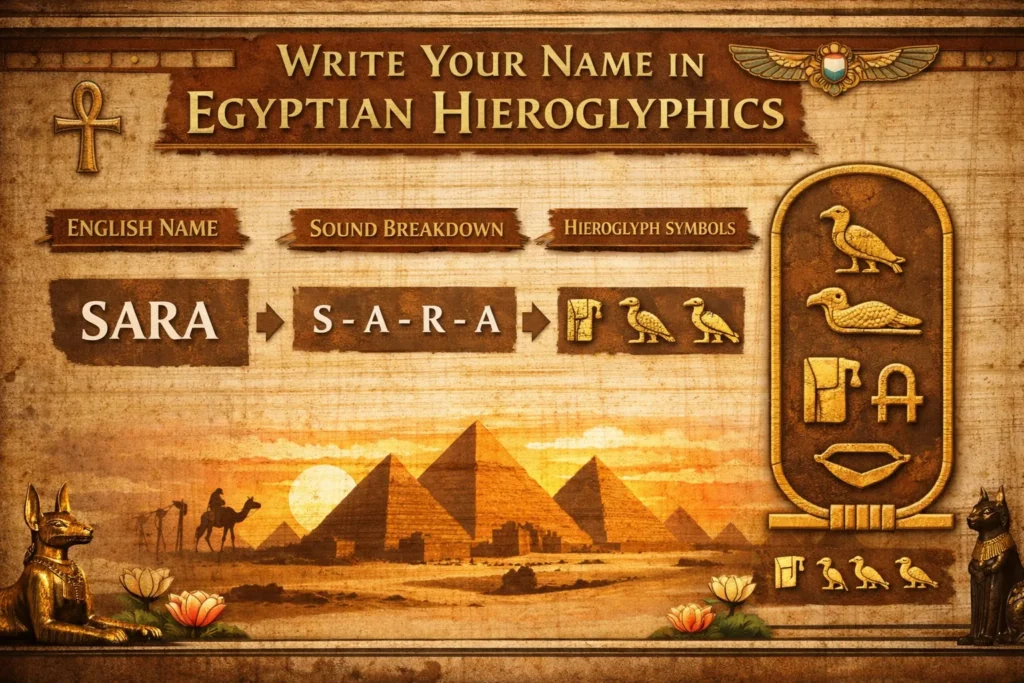
Ancient Egyptian scribes wrote names using phonetic symbols known as uniliteral hieroglyphs, which represent single consonant sounds. Modern names can therefore be written using these phonetic symbols even though the names themselves did not exist in ancient Egyptian language.
The process involves four steps.
Step 1: Break the name into phonetic sounds
Modern English names must first be converted into their basic pronunciation sounds.
Example:
| Name | Phonetic Pattern |
|---|---|
| Sara | S – A – R – A |
| Daniel | D – A – N – I – L |
| Mark | M – A – R – K |
Breaking the name into phonetic sounds ensures that each sound can be matched to the closest hieroglyph symbol.
Step 2: Find the matching hieroglyph symbols
Each phonetic sound corresponds to a hieroglyph symbol from the Egyptian phonetic alphabet.
Example for the name Sara:
| Sound | Hieroglyph |
|---|---|
| S | 𓋴 |
| A | 𓄿 |
| R | 𓂋 |
| A | 𓄿 |
Result:
𓋴𓄿𓂋𓄿
The name is now written in hieroglyphic form.
Step 3: Arrange the symbols correctly
Hieroglyphic text can be written in several orientations:
- left to right
- right to left
- vertically from top to bottom
However, modern hieroglyphic name writing typically uses left-to-right orientation for simplicity.
Ancient Egyptian inscriptions determined reading direction by examining the direction the animal or human symbols face. The text is read toward the faces of the symbols.
Step 4: Place the name inside a cartouche (optional)
Ancient Egyptian pharaoh names were often enclosed in a cartouche, an oval frame symbolizing divine protection and royal identity.
Modern hieroglyphic name designs frequently imitate this tradition for decorative purposes such as:
- tattoos
- jewelry designs
- classroom history projects
- museum activities
Placing the name inside a cartouche creates a traditional Egyptian appearance.
Examples of Names Written in Hieroglyphics
Modern names can be represented in hieroglyphics by converting each letter into its corresponding phonetic symbol.
The table below demonstrates several example name conversions.
| Name | Hieroglyphic Writing |
|---|---|
| Sara | 𓋴𓄿𓂋𓄿 |
| Mark | 𓅓𓄿𓂋𓎡 |
| Noah | 𓈖𓍯𓉔 |
| Liam | 𓃭𓇋𓄿𓅓 |
| Daniel | 𓂧𓄿𓈖𓇋𓃭 |
These examples illustrate the transliteration process where each letter is replaced with a hieroglyphic symbol representing the same sound.
Because hieroglyphic writing focuses primarily on consonants, some vowels may be simplified or omitted depending on pronunciation.
How Does the Hieroglyphic Writing System Work?
The hieroglyphic writing system represents language through a combination of phonetic signs, symbolic images, and contextual indicators.
Unlike modern alphabets that record vowels and consonants separately, ancient Egyptian writing primarily recorded consonant sounds. This means hieroglyphic writing focuses on phonetic patterns rather than exact spelling.
For example:
| English Word | Hieroglyphic Sound Pattern |
|---|---|
| Ram | R-M |
| Sam | S-M |
| Noah | N-H |
Egyptian scribes used phonetic hieroglyphs that represented:
- single consonants
- two-consonant sounds
- three-consonant sounds
Egyptologists call this system a consonantal writing system. Similar systems exist in Semitic scripts such as Hebrew and Arabic, where vowels may be omitted or inferred from context.
The hieroglyphic system contained more than 700 symbols, and later versions included over 1,000 glyphs used in religious texts and inscriptions.
What Is the Hieroglyphic Alphabet?
The hieroglyphic alphabet is a set of phonetic symbols representing single consonant sounds used in the Egyptian writing system.
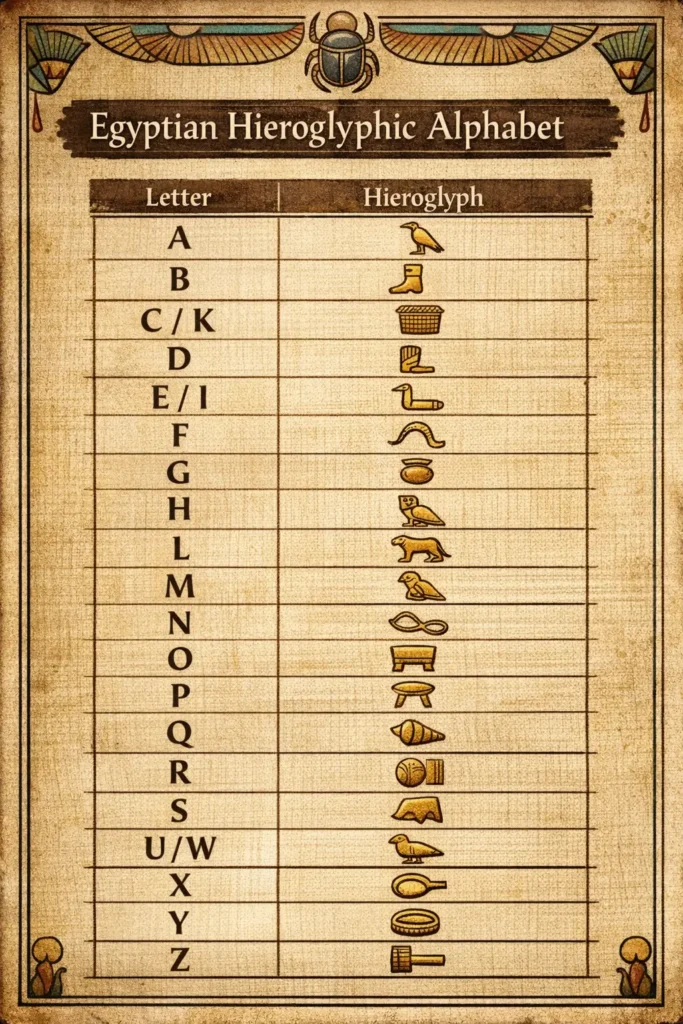
Although ancient Egyptian writing was not a true alphabet, Egyptologists often use a 24-symbol phonetic set to represent common sounds when transliterating names or foreign words.
The table below shows common hieroglyphs used for writing modern names.
| English Sound | Hieroglyph | Meaning |
|---|---|---|
| A | 𓄿 | Vulture |
| B | 𓃀 | Foot |
| C / K | 𓎡 | Basket |
| D | 𓂧 | Hand |
| E / I | 𓇋 | Reed leaf |
| F | 𓆑 | Horned viper |
| G | 𓎼 | Jar stand |
| H | 𓉔 | Courtyard |
| L | 𓃭 | Lion |
| M | 𓅓 | Owl |
| N | 𓈖 | Water ripple |
| O | 𓍯 | Lasso |
| P | 𓊪 | Stool |
| Q | 𓈎 | Hill slope |
| R | 𓂋 | Mouth |
| S | 𓋴 | Folded cloth |
| T | 𓏏 | Bread loaf |
| U / W | 𓅱 | Quail chick |
| X | 𓐍 | Placenta symbol |
| Y | 𓇌 | Double reed |
| Z | 𓊃 | Door bolt |
Egyptologists commonly use these symbols when writing modern names in hieroglyphic form.
How Do Hieroglyphs Represent Sounds?
Hieroglyphs represent sounds through phonetic values assigned to each symbol in the Egyptian writing system.
Each hieroglyph corresponds to a consonant sound rather than a complete modern alphabet letter. Ancient Egyptian scribes used these phonetic signs to spell words based on pronunciation.
Three phonetic categories existed in hieroglyphic writing.
Uniliteral signs
Uniliteral signs represent one consonant sound. These signs function similarly to alphabet letters.
Example:
| Hieroglyph | Sound |
|---|---|
| 𓅓 | M |
| 𓂋 | R |
| 𓈖 | N |
Biliteral signs
Biliteral signs represent two consonant sounds.
Example:
| Hieroglyph | Sound |
|---|---|
| 𓎛 | H-R |
Triliteral signs
Triliteral signs represent three consonant sounds.
Example:
| Hieroglyph | Sound |
|---|---|
| 𓆣 | N-F-R |
The triliteral sign 𓆣 (NFR) represents the word “nefer,” meaning beautiful or good in ancient Egyptian.
Why Names Were Written Inside Cartouches
A cartouche is an oval frame used in ancient Egyptian inscriptions to enclose and highlight royal names.
Ancient Egyptian scribes placed the names of pharaohs inside cartouches to emphasize divine authority and royal identity.
Famous examples include:
| Pharaoh | Hieroglyphic Cartouche |
|---|---|
| Tutankhamun | Royal cartouche inscriptions on tomb artifacts |
| Ramesses II | Temple wall carvings |
| Cleopatra VII | Ptolemaic dynasty monuments |
Cartouches served two important purposes:
- Royal identification – distinguishing the king’s name from other text.
- Symbolic protection – representing divine protection around the name.
Modern hieroglyphic name designs frequently imitate this tradition by placing the translated name inside a cartouche.
How to Translate Hieroglyphics
Translating hieroglyphics involves identifying phonetic symbols and converting them into modern alphabet sounds through transliteration.
Two different processes exist when working with hieroglyphic text.
| Process | Description |
|---|---|
| Translation | Converting Egyptian words into modern language meaning |
| Transliteration | Converting hieroglyph sounds into alphabet letters |
Writing modern names uses transliteration, because names represent phonetic sounds rather than Egyptian vocabulary.
Two methods exist for translating hieroglyphics.
Manual decoding method
- Identify the hieroglyph symbol.
- Find the phonetic value in a hieroglyph chart.
- Combine sounds to form a recognizable word.
Digital translation method
Online tools automatically convert letters into hieroglyphic symbols.
To generate hieroglyphic names instantly, you can convert English characters through a hieroglyphics translator.
How to Translate Hieroglyphics Back to English
Translating hieroglyphics into English involves identifying each symbol’s phonetic value and reconstructing the original sound sequence.
Egyptologists follow a structured decoding process when interpreting hieroglyphic inscriptions.
Step-by-step translation method
- Identify each hieroglyph symbol in the inscription.
- Determine the phonetic sound associated with the symbol.
- Combine the phonetic sounds to form recognizable words.
Example translation:
| Hieroglyph | Sound |
|---|---|
| 𓅓 | M |
| 𓄿 | A |
| 𓂋 | R |
| 𓎡 | K |
Result:
MARK
This method allows researchers to interpret ancient inscriptions and reconstruct Egyptian words even when vowels are missing.
How Hieroglyphics Translators Work
Hieroglyphics translators convert English characters into hieroglyph symbols by mapping phonetic sounds to the Egyptian phonetic alphabet.
Digital translators use a database containing hieroglyphic Unicode characters and their phonetic equivalents. When a user enters text, the system replaces each letter with the corresponding hieroglyph symbol.
The translation process typically follows three steps.
- Text input analysis
The system analyzes the entered English characters. - Phonetic symbol mapping
Each character is matched with its corresponding hieroglyph. - Symbol output generation
The hieroglyphs are displayed in sequence.
These tools simplify the process of writing hieroglyphic names and are widely used in educational websites and museums.
If you want to generate hieroglyphic text instantly, you can convert English characters through a hieroglyphics translator.
Why People Write Names in Hieroglyphics Today
Modern interest in hieroglyphic names comes from cultural curiosity, educational projects, and artistic design.
Hieroglyphics remain visually distinctive and historically significant, which makes them popular for several modern uses.
Common modern uses include:
School history projects
Students studying ancient Egypt often write their names in hieroglyphics to learn how the writing system works.
Tattoo designs
Some people choose hieroglyphic names for tattoos inspired by Egyptian culture and symbolism.
Decorative artwork
Graphic designers and artists sometimes incorporate hieroglyphic symbols into illustrations, jewelry, or calligraphy.
Educational museum activities
Museums frequently offer interactive displays where visitors convert their names into hieroglyphics.
These applications help people engage with ancient Egyptian culture in an accessible way.
Information Gain Insight: Why Hieroglyphic Names Are Approximations
Writing modern names in hieroglyphics produces phonetic approximations rather than exact translations because ancient Egyptian writing primarily recorded consonants.
Unlike modern alphabets that include vowels, the Egyptian writing system relied on consonantal sounds. As a result, some modern vowels must be approximated when converting names.
For example:
| Modern Name | Hieroglyphic Pattern |
|---|---|
| Emily | M – L |
| Aaron | R – N |
| Olivia | L – V |
Egyptologists reconstruct missing vowels when translating ancient texts based on linguistic analysis.
This phonetic limitation explains why hieroglyphic name conversions represent pronunciation rather than exact spelling.
Conclusion
Writing your name in ancient Egyptian hieroglyphics involves converting the phonetic sounds of the name into corresponding hieroglyph symbols from the Egyptian phonetic alphabet.
Although hieroglyphics originated more than 5,000 years ago, the system remains understandable because many symbols represent individual consonant sounds. By identifying these phonetic values, modern names can be written using hieroglyphic characters.
The process involves:
- breaking the name into phonetic sounds
- matching each sound with a hieroglyph symbol
- arranging the symbols sequentially
- optionally placing the name inside a cartouche
Today, hieroglyphic name writing is used for education, artistic design, and cultural exploration of ancient Egyptian civilization.
For quick conversion, you can convert English characters through a hieroglyphics translator.